
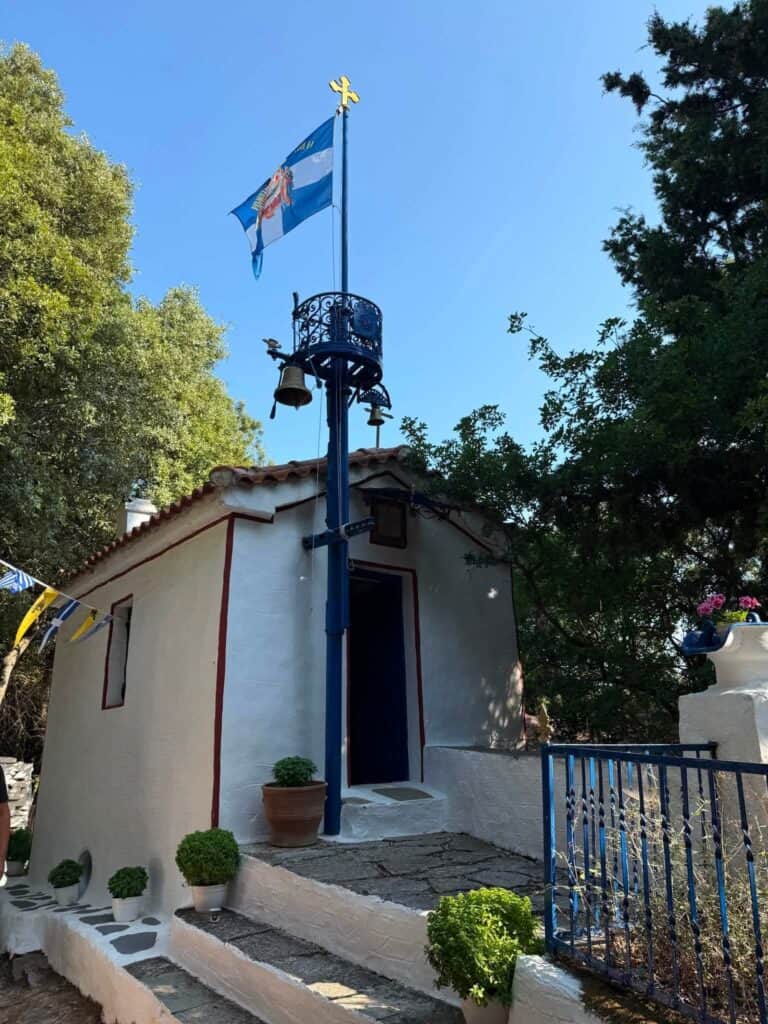
 |
| The Church of the Dormition of the Theotokos, also known as Panagia Kardasi, inspired the poem by Papadiamantis "At the Little Panagia at Pyrgi". |
Introduction
Alexandros Papadiamantis’s “At the Little Panagia at Pyrgi” (Στὴν Παναγίτσα στὸ Πυργί) is one of the poet’s late Marian poems, composed in 1910, during the final months of his life on his native island of Skiathos. The poem was published posthumously in 1923. Papadiamantis, who was born on Skiathos in 1851 and died there on January 3, 1911, devoted a number of his later poems to particular churches and shrines of the Panagia on the island, joining the familiar landscape of his homeland to the devotional world that permeates his writing.
The title refers to a small church of the Panagia at Pyrgi, and the poem is deeply rooted in the physical landscape surrounding it. Papadiamantis evokes the deserted seashore, the rock and precipice facing the sea, the little fragrant church on the ridge, the wild tree bending over the rocks, and the shepherd with his pipe and animals. Yet this is not merely landscape poetry. At the Nativity of the Theotokos, the entire landscape participates in the feast: the shore, the rock, the tree, the shepherd, the goat, and the kid all rejoice, and finally all creation itself exults. The concrete world of Skiathos thus becomes the setting in which the cosmic significance of the birth of the Mother of God is revealed.
The poem's opening immediately introduces another dimension. Before the celebration begins, Papadiamantis places a Psalmic plea above the poem: “Give me respite, that I may recover my breath before I depart and exist no more.” The text identifies this as a Psalm of David. The ancient words of mortality stand in striking contrast to the joy of the Nativity that follows. The contrast becomes still more poignant at the poem's conclusion, when the poet himself turns directly to the Panagia: “Give me also relief, my Panagia, before I depart and no longer exist.” The poem therefore moves between the joy of the Nativity and the poet's own consciousness of life's transience.
This tension is central to the poem's beauty. Autumn itself is described as becoming young again, like a modest maiden who has waited for years for her betrothed to return from abroad and finally receives him before it is too late. It is then compared to a barren old woman who has given birth to a divine child and rejoices in her old age. The image clearly evokes the miraculous motherhood of Anna, but within Papadiamantis's poem it also becomes an image of renewal: barrenness gives way to fruitfulness, old age to new life, and expectation to fulfillment.
The poem belongs to a small but significant group of Marian poems that Papadiamantis wrote in the final period of his life, including poems devoted to Panagia Kounistra, Panagia Kehria, and Panagia tou Domán. These works unite his profound Orthodox spirituality with the local religious geography of Skiathos, making particular chapels and churches places where the biblical, liturgical, and natural worlds meet.
The fact that “At the Little Panagia at Pyrgi” was composed only months before Papadiamantis's death inevitably gives its final prayer an added poignancy. What can be said with confidence is that the poem brings together two realities that were deeply characteristic of Papadiamantis's spiritual vision: the joy of creation in the presence of the Panagia and the humble awareness of human mortality. In this little church at Pyrgi, the poet sees heaven and earth rejoice at the birth of the Mother of God, while quietly asking that same Mother for a little respite before his own departure.
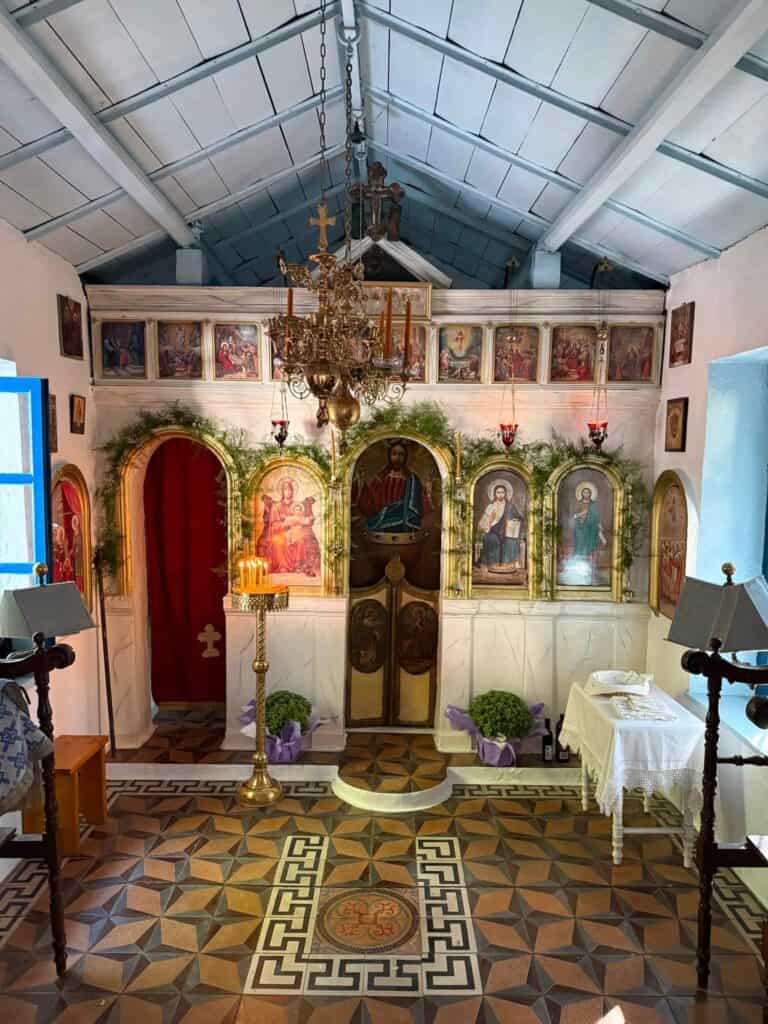
At the Little Panagia at Pyrgi
By Alexandros Papadiamantis
“Give me respite, that I may recover my breath before I depart
and exist no more.” (Psalm of David)
Rejoice, Joachim and Anna,
who gave birth to a daughter full of grace
at the Little Panagia at Pyrgi!
All the deserted shore rejoices,
and the rock and the precipice facing the open sea,
which the waves beat against with fury;
the little church rejoices,
which fills the ridge with its fragrance.
The wild tree rejoices, which leans,
half upon the rock, half over the precipice;
the shepherd rejoices, who blows upon his flute;
his goat rejoices, running among the rocks;
the kid rejoices, leaping for joy.
And all creation exults,
and in autumn the earth grows young again,
like a modest maiden who waited for years
for her betrothed to return from foreign lands,
and at last enjoyed his presence before it was too late;
and like the barren old woman who gave birth to a divine child
and rejoiced in her old age!
Give me also respite, my Panagia,
before I depart and exist no more.
(1923)
By Alexandros Papadiamantis
“Give me respite, that I may recover my breath before I depart
and exist no more.” (Psalm of David)
Rejoice, Joachim and Anna,
who gave birth to a daughter full of grace
at the Little Panagia at Pyrgi!
All the deserted shore rejoices,
and the rock and the precipice facing the open sea,
which the waves beat against with fury;
the little church rejoices,
which fills the ridge with its fragrance.
The wild tree rejoices, which leans,
half upon the rock, half over the precipice;
the shepherd rejoices, who blows upon his flute;
his goat rejoices, running among the rocks;
the kid rejoices, leaping for joy.
And all creation exults,
and in autumn the earth grows young again,
like a modest maiden who waited for years
for her betrothed to return from foreign lands,
and at last enjoyed his presence before it was too late;
and like the barren old woman who gave birth to a divine child
and rejoiced in her old age!
Give me also respite, my Panagia,
before I depart and exist no more.
(1923)
Source: Translated by John Sanidopoulos.
