
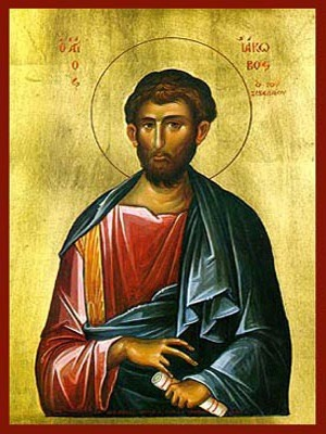
By Fr. George Dorbarakis
1. Saint James was the son of Zebedee and the brother of John the Theologian. After the calling of Andrew and Peter, he too was called by the Savior Himself, together with his brother, to become His disciple. They immediately left both their father and the boat — in a word, everything — and followed the Lord. And the Lord loved them so greatly that to the one He granted to recline upon His breast at the time of the Secret Supper, and to the other to drink the cup which He Himself drank. Saints James and John showed such zeal for Christ that they desired to call down fire from Heaven and destroy the unbelievers. And perhaps they would even have done so, if His goodness had not restrained them. For this reason, therefore, the Lord would take them, together with the foremost Peter, always with Him in His prayers and in His other divine dispensations, initiating them into the higher and more secret teachings of the doctrines. This blessed James, after the Passion and the Ascension of our Lord Jesus Christ, because Herod could not endure that he spoke with boldness and proclaimed the saving preaching, seized him and killed him with the sword, making him the second martyr after Stephen, thus sending him to the Master Christ.
2. Most exalted is the poetry of the great Hymnographer of our Church, Saint Theophanes, concerning the “ruler of all the earth,” as he calls him, Saint James — the foremost among the apostles together with his brother John the Theologian and Saint Peter, indeed also a kinsman of our Lord Jesus, being the son of Salome, daughter of Joseph, the betrothed of the Most Holy Theotokos. And he calls him a ruler both because he was a disciple of the Lord and because of his most fervent zeal for Him — so much so that he was the first among the Twelve to give his life for Him.
“You were established, O glorious one, as ruler over all the earth, as it is written concerning you, having become a disciple of Him who made all things; and because of your most fervent zeal, by the sword of lawless men, O all-wise one, you endured death, being taken beforehand from therevered assembly of your twelve fellow-disciples, O blessed one” (Sticheron of Vespers and Ode 8).
Saint Theophanes insists in his hymns on the fervent longing of Saint James for the Lord:
“O, how fervent is your longing toward the Master Christ” (Ode 4).
Indeed, such a longing that it was continually increasing:
“Having taken on unrestrained longing upon longing, you attained the final blessedness of the things desired, of the source of goodness” (Ode 4).
This means: if a human being does not respond with love to the love of the Creator — “we love because He first loved us” — he can hardly, if at all, advance into a living relationship with Him; and the more one opens himself in love toward the Lord, the more he feels this love being kindled.
“Offering your whole self to the commands of the Master, O God-taught initiate, you were manifestly raised to the highest and truly divine summit of the virtues” (Ode 4).
For this reason, the Holy Hymnographer considers that the calling of Saint James to become an apostle of the Lord began in reality long before his outward calling. God, as the One who foreknows, seeing beforehand the nobility of his soul, and also the strength and courage of his mind, called him as His distinguished apostle to proclaim Him among the nations.
“Having understood the nobility of your soul, the foreknowing God, and the firmness, O initiate, and the unconquerable power of your mind, O glorious one, He enrolled you among His servants in a distinguished manner, proclaiming Him to the nations” (Ode 1)
And:
“The brightness of your spotless soul having been seen by the Master even before your calling, O blessed one, you were shown acceptable to Him, O James, and you became an initiate of His dispensation” (Ode 3).
Therefore it is not by chance that Theophanes characterizes the birth of James as sacred and light-bearing, which shone even more because of his kinship with the Lord Himself.
“Your birth, O wise one, is most sacred and light-bearing, O all-blessed one, being made splendid by your kinship with God” (Ode 3).
The amazement which Saint Theophanes feels before the immense and radiant personality of Saint James — an outcome not only of his calling by the Lord and of his sanctified life, but also from the flame of the Comforter Spirit which he received on the day of Pentecost - (“The breath from on high of the Comforter, forceful, having set you ablaze, shows you as a wise God-proclaiming orator, clearly speaking the mighty deeds of the Incarnate Word, of whom you also have become an eyewitness” - Ode 3) - leads him, in one of his hymns, to reach levels of exaggeration, as he attempts to justify with a good reasoning the primacy which he himself sought together with his brother and their mother from the Lord.
We all remember that their mother and they themselves asked Christ, shortly before His sufferings, clearly misunderstanding the spiritual Kingdom of the Lord and interpreting it in an earthly way, to stand beside Him as those seated in the first thrones. And the Lord answered that indeed “they do not know what they are asking,” but that “who will stand first beside Him is something which He Himself does not give, but the Father, according to the love which a person bears toward Him, even to the point of sacrifice.”
The Hymnographer, therefore, interprets his request as follows:
“Having mounted upon the highest virtue, being borne by love, you desired, O glorious one, to bear the primacy of the distinguished thrones of the Master, not as loving glory in vain, but to behold directly Him whom you loved” (Ode 5).
However, Saint Theophanes understands the exaggeration; for this reason also in the following ode he “corrects”:
“Seeking the glory upon the earth from Christ to grant to you, as to an earthly King, you attained the kingdom, not the one below and corruptible, O blessed James, but the incorruptible, which you received through your struggle” (Ode 6).
Therefore, before the disciple of the Lord, before the first who gave from among the twelve his life for Him, before the Apostle’s heart inflamed with love for Christ and his zeal which made him “a new Elijah” (Ode 5), “the whole Church dances, celebrating your all-holy memory, in which we acclaim you” (Kathisma of Matins).
Source: Translated by John Sanidopoulos.
