June 22, 2025

June: Day 22: Holy Hieromartyr Eusebius of Samosata

 
June: Day 22:
Holy Hieromartyr Eusebius of Samosata

 
(On Obedience To Civil Authority)

By Archpriest Grigory Dyachenko

I. Saint Eusebius, whose memory is celebrated today, lived in the 4th century and was bishop in the city of Samosata (on the Euphrates River) in the Antiochian metropolis. He waged a long and tireless struggle against heretics and suffered much under Constantius, who patronized the Arians. Under Emperor Julian, Eusebius, hiding his bishopric, went around various regions to confirm Christians in the faith and support them. At this time, he also restored several churches and ordained many priests and deacons.

Upon the ascension of Jovian, Eusebius and other holy figures were restored to their thrones. The pious emperor respected them, while the heretics feared them. However, the Church did not enjoy peace for long, as Jovian soon passed away; after him, Valens ascended to the throne and once again instigated persecution against the Orthodox faith, exiling shepherds into banishment. Eusebius was imprisoned in Thrace, and in his stead an Arian was appointed. Eusebius learned of his exile while in Samosata; preparing to leave the city, he asked the messenger to keep this matter confidential, so that the people would not harm the messenger bringing news of their separation from the bishop. Under the cover of night, he left the episcopal residence, but upon crossing the Euphrates, he was halted by the townsfolk who had learned of his departure, and they wept, beseeching him to return. Eusebius persuaded them not to resist royal authority and to return to their homes, and, having blessed everyone, continued his journey to Thrace, from where he returned during the time of Gratian, who summoned the exiled bishops back to their flocks. However, he soon died from a wound inflicted upon him by an Arian woman who had thrown a vessel from the roof, which struck the bishop on the head... As he was dying, he bequeathed that the woman should not be punished.

Homily Three for the Second Sunday of Matthew (St. John of Kronstadt)


Homily Three for the Second Sunday of Matthew 
(2nd Sunday of Pentecost)


By St. John of Kronstadt

"And they (Peter and Andrew) immediately left their nets and followed Him (i.e. Christ)" (Matt. 4:20).

The Gospel of Matthew, read today, tells of the calling of four simple and uneducated fishermen to the apostolic ministry: the two brothers, Peter and Andrew, the sons of Jonas, and James and John, the sons of Zebedee the fisherman. It speaks of their immediate and resolute following of the Savior for the great work of the salvation of mankind; of the preaching of the gospel of the Kingdom by Jesus Christ throughout Galilee, and of His healing of all kinds of diseases and infirmities among people. Let us strive, through pious reflection and discussion, to derive benefit from the Gospel read today. 

What lessons can we learn from this Gospel? The exemplary act of the simple fishermen towards Jesus Christ is quite instructive for us; their firm, unquestioning, and unwavering resolve to immediately follow Christ in all things and everywhere, their perfect obedience without any hesitation, their selflessness and impartiality towards earthly so-called goods, which are so dear to everyone – namely: to home, to parents, to wives, to other relatives, to the joyful and honest occupation of fishing and others. But you may say: we cannot emulate the apostles, we cannot leave everything behind and follow Christ, who now does not visibly walk the earth.

June 21, 2025

Homily Two for the Second Sunday of Matthew (St. John of Kronstadt)


Homily Two for the Second Sunday of Matthew 
(2nd Sunday of Pentecost)


By St. John of Kronstadt

Then He said to them, “Follow Me, and I will make you fishers of men” (Matthew 4:19).


These words were spoken, my brethren, by Jesus Christ to two fishermen and blood brothers: Peter, who later became the foremost apostle, and Andrew, who was subsequently called the First-Called. “Follow Me, and I will make you fishers of men;” that is, "follow Me" in My footsteps, in the footsteps of selflessness, total love for God and for humanity, towards the true, heavenly, eternal homeland; in the footsteps of meekness, humility, patience, and gentleness, with complete self-denial: "and I will make you fishers of men," meaning that instead of fish, you will catch people, drawing them from the abyss of sin into holiness, from the turbulent sea of this life into the Kingdom of Heaven.

But why did the Lord say to Peter and Andrew that He would make them fishers of men? He said this in relation to their trade or their vocation, so that they might understand their future calling more easily from His brief words, and to make their transition from one occupation to another — from the similar to the similar, from catching fish to catching men — more convenient, so to speak. Today, we will discuss with you, brethren, what spiritual fishing for men is, what it should be like, what one we should aspire to, and what we should avoid.

Heresy and Theological Methodology


By Metropolitan Hierotheos of Nafpaktos and Agiou Vlasiou

Usually, heresy is limited to theoretical teaching and one who deviates from the established dogmas of the Church is considered heretical. However, we should see heresy in terms of its inner dimension. For, just as dogmas are an expression of revelation, and the application of dogmas leads to experience, so heresy is a deviation from revelation, but at the same time it destroys the path to theosis. It is as if there were a hospital that cannot heal human beings.

The reversal of the experience of Pentecost occurs because heretics deny the teaching of the deified Fathers of the Church, that is, abandoning the revelatory truth, they rely mainly on their reasoning, their reflection. This means that heretics rely more on philosophy, which is full of thoughts, reflections and fantasies, and do not rely on the revelations of God. Because they rely on philosophical principles, in reality they also deny the teaching that leads to the vision of God. The heretic cannot know God, because he does not know the method of theology. Every science has a theory and this is confirmed by experiment and every verification of the experiment leads to the same theory.

June: Day 21: Holy Martyr Julian of Tarsus


June: Day 21:
Holy Martyr Julian of Tarsus

 
(On Heavenly Blessedness)

By Archpriest Grigory Dyachenko

I. The Holy Martyr Julian, whose memory is celebrated today, after the death of his father, a pagan, lived with his Christian mother in the Cilician city of Tarsus and was raised by her in the Christian faith. During the persecution of Christians under Diocletian, the young Julian, the son of a former senator, was persecuted and tortured for his faith. For a year he was tortured in various ways in different places in the Cilician region. His mother followed him everywhere and was finally seized in the city of Aegeus, when she asked permission to visit her son in prison, under the pretext of persuading him to renounce Christ, while she herself begged him to remain firm in the faith even to death. Then she, too, was given over to torture along with her son; the heels of her feet were cut off; and Julian, after terrible torments, was condemned to a cruel death: he was thrown into the sea in a sack filled with reptiles. He suffered at the age of 18, in the year 290.

June 20, 2025

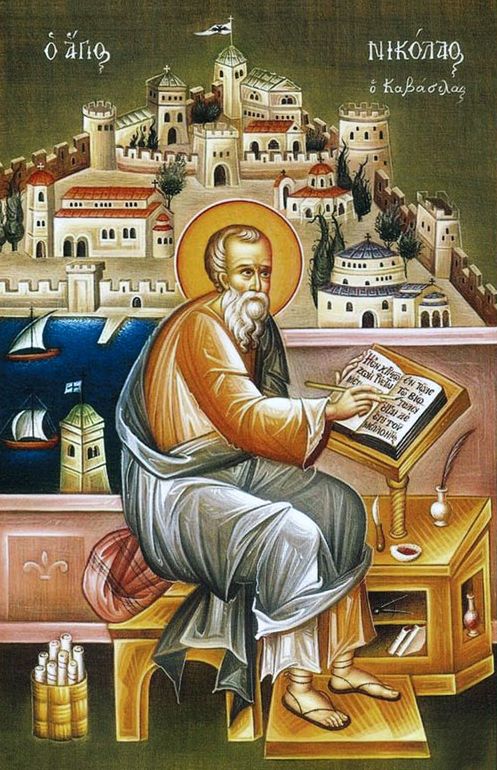
Nicholas Cabasilas, A Model Orthodox Theologian


By Elder Vaseilios Gontikakis, 
former Abbot of the Monastery of Iveron

Nicholas Cabasilas assures us that “the Church is expressed in the Mysteries.” And with Cabasilas himself – as a true and holy believer – the whole Church is expressed and revealed, because within the Church he has become Christ by grace and all his ethos, namely his speech and behavior, have the grace and character of the Divine Liturgy and the God-man Lord.

We can see this in the interpretation he makes of the Divine Liturgy and in the fourth discourse of “The Life in Christ,” which he dedicates to the mystery of the Divine Eucharist.

A

He begins the presentation of the Divine Liturgy simply and humbly. He speaks of what the liturgist does and says in it. He mentions the formalities. He speaks of the Holy Prothesis. He shows it as symbolizing the cave of the Nativity. He speaks of the asterisk that is placed on top of the holy diskarion, covers the Lamb and symbolizes the star, which came and stood above where the Child was.

June: Day 20: Holy Hieromartyr Methodios of Patara


June: Day 20:
Holy Hieromartyr Methodios of Patara

 
(On Dissatisfaction With One's Condition)

By Archpriest Grigory Dyachenko

I. The Holy Hieromartyr Methodios, whose memory is celebrated today, lived at the end of the 3rd century and was a bishop in the city of Patara in Lycia. From his youth he was distinguished by his love for God and the Church, so he entered the Church clergy and became a priest, and then a bishop. He was a very learned man. 

In his time there were disputes about Origen's teaching on the pre-existence of souls and evil spirits, and many were carried away by this teaching. Saint Methodios, through his teachings and writings, exposed the error. He suffered many sorrows for this. Finally, he accepted a martyr's death for the faith of Christ. Saint Methodios left many works written very eloquently.

In his essay on free will, Methodios, in rebuking those who are dissatisfied with their participation, says: “To grumble about the lack of earthly blessings is not wise: a person should be above everything earthly; God created a person for activity, and not for pleasures that relax the soul and body. Perfect equality is impossible – diversity is an attribute of perfection; poverty is allowed either as a punishment for sins, or as a warning against sins.”

June 19, 2025

June: Day 19: Teaching 2: Venerable Paisios the Great


June: Day 19: Teaching 2:
Venerable Paisios the Great


(How Should Parental Love for Children Be Expressed?)

By Archpriest Grigory Dyachenko

I. The Venerable Paisios, whose memory is celebrated today, lived in the 5th century, was a native of Egypt, the son of rich and pious parents, who generously gave charity to all those in need. While still a youth, he lost his father and lived under the care of his mother, who of her seven sons especially loved Paisios, as the youngest. Paisios's mother often thought about what awaited her son in life. One night, an angel appeared to her in a dream and said: "God, the Father of orphans, has sent me to you. Why are you sad, caring for your children? It is not you alone who cares for them, but God too; leave your sadness and dedicate one of your sons to His service." "All my children belong to God," answered the mother, "and if any of my sons pleases Him, let Him take him." Then the angel, taking Paisios by the hand, said: "This one is pleasing to God." - "Better take one of the older sons, who is more intelligent," asked the mother. "Do you not know," replied the angel, "that the power of God is revealed even in weaknesses, and therefore God chose your younger son, as more capable of pleasing him." With these words, the angel became invisible. In the morning, Paisios' mother offered a fervent prayer to God, then she asked that Paisios be accepted into the Church clergy. Her request was fulfilled, and Paisios began to diligently fulfill the duties entrusted to him. Having reached his youth, Paisios became a monk and became famous for the holiness of his life and the gift of clairvoyance and miracles.

June: Day 19: Teaching 1: Holy Apostle Jude


June: Day 19: Teaching 1:
Holy Apostle Jude


(On Eternal Torment)

By Archpriest Grigory Dyachenko

I. About the Holy Apostle Jude, whose memory is celebrated today, the Church historian Nikephoros writes: “The divine Judas, not Iscariot, but another, who was also called Thaddeus and Lebbaeus, the son of Joseph, the brother of James, who was thrown from the roof of the Temple, cast the net of the holy gospel first in Judea, Galilee, Samaria, Idumea, then the cities of Arabia, Syria and Mesopotamia; finally he came to the city of Edessa, which belonged to King Abgar, and where another Thaddeus, one of the 70 Apostles, preached Christ even before him.”

According to tradition, it is also known that the Apostle Jude preached the gospel in Persia, from where he wrote a Catholic Epistle to believers, short but edifying, in which he protects against false teachers and threatens that as it was with Sodom and Gomorrah, “so it will be with these dreamers, speaking evil of what they know not, grumblers, complainers, walking according to their own lusts (ungodly and lawlessly); whose mouth utters pompous words.” “These are stains in your love feasts, while they feast with you without fear, serving only themselves. They are clouds without water, carried about by the winds; late autumn trees without fruit, twice dead, pulled up by the roots; raging waves of the sea, foaming up their own shame; wandering stars for whom is reserved the blackness of darkness forever.” The Holy Apostle Jude further writes in his epistle that the Lord, who did not spare even the angels, will punish every sinner who does not try to correct his life.

The Holy Apostle Jude died a martyr in Mesopotamia (around 80 A.D.); he was crucified on a cross. His burial place remains unknown.