April 30, 2023

First Homily for the Sunday of the Myrrhbearing Women (St. Luke of Simferopol)

 
 By St. Luke, Archbishop of Simferopol and All Crimea

(Delivered on May 20, 1945)

On this third Sunday after Pascha, the Holy Church remembers and glorifies the holy Myrrhbearing women, the first witnesses of the Resurrection of Christ, because the Lord was pleased that they were the first to see Him risen from the dead.

Who were these holy women? Why are they called Myrrhbearers? They loved the Lord Jesus Christ with all their hearts, served Him with their care for all His material needs, learned together with the apostles, listened to His holy discourses; to some extent, they can even be called female apostles: one of them, the first and most ardent, Mary Magdalene, is called Equal-to-the-Apostles.

Paschal Pastoral Encyclical 2002 (Metr. Hierotheos of Nafpaktos)


 "Enduring the cross and abolishing death and rising from the dead, grant peace to our lives, O Lord, for You alone are the almighty."

My beloved brethren,

The events of the Crucifixion and Resurrection of Christ, which are the greatest world events, because they are connected with the rebirth of people and the renewal of the entire creation, took place twenty centuries ago in Jerusalem, which for all Christians is a beloved city. There are kept all the sacred places which are connected with the life of Christ, there is the terrible Golgotha, the happy tomb of Christ and in general Jerusalem and Palestine are the city and the land on which Christ walked during His earthly life, but also there He revealed and continues to reveal His glory.

1962 Paschal Message of St. John Maximovitch


 Christ is Risen!

“Your resurrection, Christ the Savior, angels sing in heaven, and grant us on earth a pure heart to glorify You.”

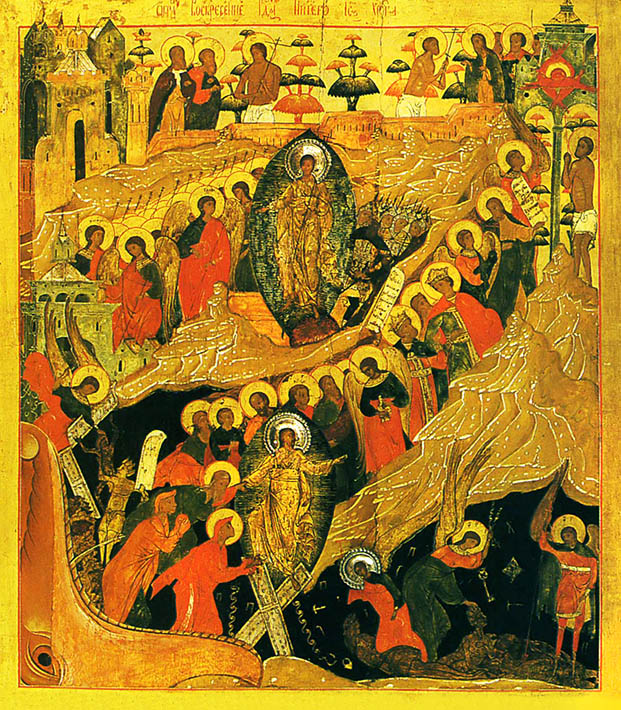
Now everything is filled with light, the sky, the earth and the underworld, the whole creation rejoices and is glad. The earth rejoices, freed from the curse for the sin of Adam. The heavens rejoice, seeing Him who descended from them to earth, now ascending from the underworld and leading out those who were languishing there. Angels sing, glorifying the Conqueror of death, their Creator, now visible. All creatures praise the Lord, all the forces of nature. Each of them sings in their own way and extols the Risen One. Something unusual is happening all over the world. The sacred and saving night is replaced by the luminiferous Great Day.

April 28, 2023

Miracles of the Panagia of the Life-Giving Spring at Longovarda Monastery in Paros: Miracle 3 (Elder Philotheos Zervakos)

 
 ...continued.

3. Another miracle happened during the blockade in 1917,* when there was no wheat on the island** due to the blockade by the Anglo-French. Many of the poor of the island and the refugees took refuge in our Sacred Monastery of the Life-Giving Spring at Longovarda; the majority of rich people, in such circumstances, hide the wheat in order to sell it at inflated prices for profit. The Fathers of the Monastery, feeling sorry for the hungry, provided everyone with bread for food and other supplies that the Monastery had. Then it was time to marvel at the miracles of the Life-Giving Spring, because while the Fathers were giving one by one to those who came and the grain was scarce, but according to the calculations of some who were weak in faith, the grain in the storehouse would soon be exhausted, others on the other hand believed the All-Immaculate Theotokos of the Life-Giving Spring with her blessings would prove it inexhaustible. The wheat did not run out, but was preserved to the astonishment and admiration of those who saw it until the new harvest. But what can I say? The Sacred Monastery has shown to be an unfathomable and inexhaustible river. For who, poor or widowed, or orphaned or sick or suffering, either physically or mentally, coming to the Monastery with faith does not receive their request? All become healthy, both of soul and body enjoying health, they leave giving thanks to the Mother of God and recounting the multitude of her miracles.

Paschal Pastoral Encyclical 2001 (Metr. Hierotheos of Nafpaktos)


My beloved brethren,

After forty days of fasting, prayer and spiritual struggle, we arrived at the day of Pascha, which is the feast of the Resurrection of Christ, "the feast of feasts and celebration of celebrations." The Resurrection of Christ is the supreme event of the mystery of Christ's incarnation, a central event in the festive cycle of our Church that defines the entire ecclesiastical year.

The Orthodox Church is and is called the Church of the Resurrection, because the Resurrection of Christ determines our lives both in the present and in the future. The Apostle Paul clearly says: "If Christ is not raised, our faith is in vain" (1 Cor. 10:17). And in the Catechetical Discourse of Saint John Chrysostom, which we read in the Resurrection Divine Liturgy, among other things it says: "O Death, where is your sting? O Hades where is your victory? Christ is risen, and you are overthrown. Christ is risen, and the demons are fallen. Christ is risen, and the angels rejoice. Christ is risen, and life reigns. Christ is risen, and not one dead remains in the grave. For Christ, being risen from the dead, has become the first fruits of those who have fallen asleep."

1961 Paschal Message of St. John Maximovitch


 Christ is Risen!

"Proclaim, O earth, the glad tidings of great joy, 
and ye heavens, praise the glory of God." 
 
"The Angel cried to the Lady full of grace: Rejoice, O pure Virgin!"

What kind of joy does the Archangel announce? About the one that the whole earth is called to evangelize. The Son of God, the Son of the Virgin, empties Himself, and therefore Gabriel preaches grace.

But now, on the day of the Annunciation, the Virgin weeps bitterly, seeing her Son crucified on the Cross. Where is the joy when the Son Himself cries out: “My God, My God, why have you forsaken Me?”

April 27, 2023

Paschal Pastoral Encyclical 2000 (Metr. Hierotheos of Nafpaktos)


My beloved brethren,

The Orthodox Church is and is called the Church of the Resurrection, because it is closely connected with the Cross and the Resurrection of Christ. The Resurrection is a historical event, which is confirmed by the testimonies of various historians, but mainly by the testimonies of eyewitnesses and people who sacrificed their own lives because of this event. The Apostles and the Myrrhbearing women saw Christ, heard Him and some of them touched Him. And, of course, they then gave their personal testimony about Him.

Christ after His Resurrection did not appear to His crucifiers and enemies to miraculously confirm His value. He could have done this to prove His divinity. But Christ has no need of worldly means to prevail. Christ appeared to His Disciples and the Myrrhbearing women, because they had properly prepared to see Him and thus this vision became life for them. According to the teaching of the holy Fathers of the Church, the vision of God and the presence of the Risen Christ is reached by the person who has previously been purified and illumined by the Grace of God, because he is able to withstand the sight of His great light.

1959 Paschal Message of St. John Maximovitch


 Christ is Risen!

“This is the day the Lord has made; let us rejoice and be glad in it.”

Let us rejoice and be glad now. Let us rejoice, for Christ is risen from the dead.

Just as the bright rays of the sun disperse the darkness after a dark night, so the Risen Christ destroys the darkness of our souls!

Once upon a time, Adam, who had sinned, plunged into spiritual darkness. He ate from the tree, about which God told him: “On the day that you eat of it you shall surely die” (Gen. 2:17). Outwardly, Adam did not die on that day, but spiritually death came for him then.

The seal of death fell on him, the joy of communion with God, the Source of Life, disappeared. Sorrow fell on his heart, sorrows began to overwhelm his soul. His spirit carried the seed of death until finally his body died and his soul descended into hades.

Holy New Martyr Noultsos of Kastoria and Those With Him (+ 1696)

St. Noultsos of Kastoria (Feast Day - April 27)

Noultsos, a faithful Christian about whom we do not have much information, lived in the 17th century and was from Kastoria.

According to a codex at the Metropolis of Kastoria written by the hand of Metropolitan Dionysios Mantoukas of Kastoria (1694-1719), who was from Moschopolis in Northern Epirus: "In 1696, April 21, Noultsos with his brother and his son-in-law were hanged, and it was a great kindness to the Christians to see him on the gallows, and they glorified God on the second day because their end was in great glory, and in this way may God grant many such Christians as Noultsos to receive glory."