January 2, 2021
By Fr. Elias Makos
By Fr. Elias Makos
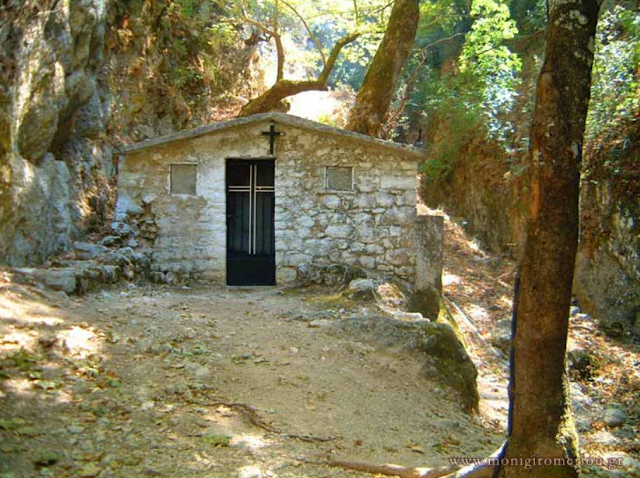
The grave of Saint Neilos Erichiotis (1228-1334), whose memory the Church commemorates on January 2, and was the founder and first benefactor of the Monastery of the Dormition of the Theotokos in Giromeri of Thesprotia, and who closed his eyes peacefully and full of days at the age of 106, after first writing his will and appointing his successor, is located a short distance from the Monastery, in a rugged and steep place.
In fact, he had prepared it himself and chose for it to be in a secluded and inaccessible spot, by a stream, as a confession of his complete self-offering to Christ.
And it reminds us that faith in Christ is a continuous sacrifice, an uninterrupted journey towards Golgotha, with the cross borne on one's shoulder. But the cross is that of Christ and not of course of our own convictions.
Research and excavations are underway, which were delayed due to the coronavirus pandemic, with the aim of finding his remains, 687 years after his repose.
It is expected that after the work is completed, they will come to the surface.*
As the abbot of the Giromeri Monastery, Archimandrite Fr. Methodios Delis, who took the initiative to find the remains of Saint Neilos, told us, “Archaeologists with scanners and special instruments recognized the existence of the relic, as well as a small bronze item, probably a cross.”
According to tradition, the grave of Saint Neilos was covered with a massive rock, which fell when, a few years after his repose, an attempt was made to remove the remains.
Before the start of the work to discover the relic, there was a small chapel at this location.
Saint Neilos was not a static being, but a dynamic personality, who, through asceticism, was directed towards his uninterrupted completion.
From a wealthy and royal family of Constantinople, he found himself in distant Thesprotia, after having previously stayed for a while on Mount Athos, Jerusalem and Vlore in Albania, while having passed through other intermediate areas.
Miraculous powers are attributed to him, as a seal and reward for his ascetic life.
It is said, among other things, that from his hermitage he saw a supernatural bright light on the opposite hill.
There the icon of the Panagia was discovered and the eponymous Monastery of Giromeri was built.
Both from the life and from the testament of Saint Neilos it seems that his presence did not have a philosophical and intellectual dimension, but rather a particularly practical and confessional one.
He did not strive to discover any truth, but proclaimed and confessed with his austerity and asceticism and prayerfulness the one and eternal truth about God, about the world, about man.
Prayer was the exercise of his soul and its elevation to the height of divine greatness. And fasting was the exercise of the body, not simply, of course, as abstinence from food, but with the broader form of self-control.
Saint Neilos, with his self-control, helped the body to follow the soul in its spiritual ascents.
Thus, prayer and fasting become not only weapons against evil and temptation, but also our wings, which raise us to the heights of perfection.
And this austerity, asceticism and prayerfulness required spiritual courage, and Saint Neilos had it. We also need his spiritual courage in our days.
Courage to be close to the Christ of the Gospel and not the Christ of our own inspiration.
Courage to check and abolish the hypocritical piety that exploits and betrays Christ.
Courage to be rebaptized in the redemptive message of the “Kingdom of God” and to be freed from the four walls of the prison of our own selves.
For all this, courage is needed. But not just any courage, but the courage of the faith of Saint Neilos
Source: Translated by John Sanidopoulos.
* Excavations began in 2020, and nothing has been recovered as of 2024.