Showing posts with label Akathist Hymn. Show all posts

March 28, 2026

The Theotokos in the Orthodox Tradition and in the Worship of Great Lent (2 of 2)


By Panagiotis S. Martinis

In our first article, which bore the title “The Theotokos in the Biblical and Patristic Tradition,” we referred to the person and the role of the Theotokos in the mystery of salvation, as these are expressed by the sacred writers of Holy Scripture and the Fathers of the Church, on the occasion of the feast of the Annunciation (March 25).

In the article that follows, we shall refer to the honor rendered to the Theotokos during the period of Great Lent, on the occasion of the Service of the Akathist Hymn.

B. THE THEOTOKOS IN THE WORSHIP OF GREAT LENT


During the period of the Triodion and especially of Great Lent, the Theotokos is particularly honored. Already with the beginning of the Triodion we invoke her help, chanting: “Guide me in the paths of salvation, O Theotokos… by your intercessions deliver me from every impurity.”

Byzantium and the Panagia (Metropolitan Chrysostomos of Mani)


Byzantium and the Panagia

Homily of His Eminence the Metropolitan of Mani, Chrysostomos III

Delivered during the Fourth Salutations (5 April 2019) at Saint Demetrios of Mystras

We find ourselves, by the honorable invitation and blessing of His Eminence the Metropolitan of Monemvasia and Sparta, Eustathios, in Mystras, the capital of the Byzantine Despotate during the 14th and 15th centuries, just a few kilometers east of the historic city of Sparta.

And although Mystras is called a “dead city” because it is no longer inhabited, nevertheless it is a living city of the wonders of God.

It is, of course, connected with the dissolution of the Byzantine Empire by the Fourth Crusade (1204), after which it became a most important spiritual center of the late Byzantine period. Many rulers — the Kantakouzenoi and the Palaiologoi — governed and were active in the Despotate. Many scholars, artists, and spiritual men also left their mark.

The Boundless Motherly Embrace of the Akathist Hymn


The Boundless Motherly Embrace of the Akathist Hymn

April 16, 2021

By Elder Patapios of Kavsokalyva

In the liturgical life of our Church, the Fridays of Great Lent constitute an island of joy within the springtime and the preparation for Pascha, which makes everything good and beautiful appear attainable and within easy reach.

It is a Theometoric-centered path that leads us safely along the cross-and-resurrection journey toward Pascha.

The Akathist Hymn is yet another gift of the Panagia to humanity, but also to each one of us personally, within this heartfelt communion and atmosphere of this service.

With the Theotokos, the world was illumined again; it became new, renewed. It became our home. We are able to live, to be saved through her Son and our God.

March 27, 2026

Saint Cleopa of Sihastria on the Akathist to the Theotokos


1.  The Holy Elder Cleopa Ilie of Sihastria used to say:

“Do you know who the Mother of our Lord is, and how much she loves, and how great her power is, and how great her mercy is? She is our Mother, who has mercy on the poor and the widows and all the other Christians. She always prays to the Savior Christ for all of us.”

2. Considering his healing as a small child, it is not surprising that Constantine [secular name of Elder Cleopa] developed a great devotion to the Mother of God at an early age. By the time he was eleven years old, he could sing the Akathist Hymn by heart. He would later tell the story of how he learned this ancient and poetic prayer: 

“When I shucked corn in the field I would hide the prayer book under the husks until father would come with the horse-cart. During this time I would learn one more oikos and one more kontakion. And, lo and behold, I learned the entire Akathist to the Mother of God.”

The Icon "Life of Jesus – Akathist Hymn – Second Coming" at the Benaki Museum


The icon with the subject "Life of Jesus – Akathist Hymn – Second Coming" is a post-Byzantine icon and is exhibited in the Benaki Museum.

The icon with the theme "Life of Jesus – Akathist Hymn – Second Coming" is complex and includes various iconographic subjects. Specifically, within four concentric circles in the upper part of the icon are depicted: the Creation of the world, the creation of Adam and Eve, the sin of the first-formed and their expulsion from Paradise, scenes from the Old Testament, scenes from the life of the Theotokos and of Jesus, the Passion of Christ, the 24 oikoi (stanzas) of the Akathist Hymn, the last of which is depicted at the center, with the image of the Theotokos seated on a throne holding the Infant. In the lower part of the panel is depicted the Second Coming in a multi-figured composition. In the upper part of the icon, on a band which is held by two Angels, there is the following inscription:

Patriarchal and Synodal Encyclical on the Occasion of the Celebration of the 1400th Anniversary of the Solemn Chanting of the Akathist Hymn While Standing for the Deliverance of the Queen of Cities from the Siege of the Avars and the Persians


Patriarchal and Synodal Encyclical on the Occasion of the Celebration of the 1400th Anniversary of the Solemn Chanting of the Akathist Hymn While Standing for the Deliverance of the Queen of Cities from the Siege of the Avars and the Persians

ECUMENICAL PATRIARCHATE

+ BARTHOLOMEW


By God’s Mercy

Archbishop of Constantinople – New Rome

and Ecumenical Patriarch

To the Plenitude of the Church:

grace and peace from God

✦  ✦  ✦

“To You, our Champion Leader, we, Your City, ascribe hymns of victory and thanksgiving, for having been delivered from calamities, O Theotokos!”

This year marks fourteen hundred years since, in honour of the Theotokos, the Kontakion now universally known as the “Akathist Hymn” was solemnly chanted in church, with all the faithful standing. It is an exalted and triumphant poem which, with singular richness and elegance of expression, refers both historically and theologically to the divine economy of the Incarnation and to the unique role of the All-Pure Mother of God within it.

Through this Kontakion, the faithful at prayer reverently greet the Panaghia with the repeated echo of the first salutation addressed by the Archangel Gabriel, herald of grace and joy, to the one full of grace: the word “Rejoice.” Through this word, the “mystery hidden from all ages” is made manifest, and “the sum of our salvation” is brought to fulfilment. The repetition in this hymn of the word “Rejoice” one hundred and forty-four times in address to the All-Blessed Virgin clearly bears a mystical meaning. It recalls the one hundred and forty-four thousand pure saints of the Revelation, who sing the “new song” with their harps before the throne of God and “follow the Lamb wherever He goes.”[1] As the people of God are purified in both life and doctrine, wholly devoted to the incarnate Word of God and indissolubly united with Him, they hymn the saving divine economy and at the same time salute, in songs of praise and sacred melody, the All-Glorious Mother of the Lord and Mother of the Church, as well as her mighty protection over the Church’s devout flock.

April 4, 2025

The Akathist Hymn: A Masterpiece of Unsurpassed Perfection, With a Byzantine Flavor


By Eleutherios Andronis

The Akathist Hymn is the poetic masterpiece chanted in our churches during the 5th week of Lent, as a seal of all the weekly services of the Salutations.

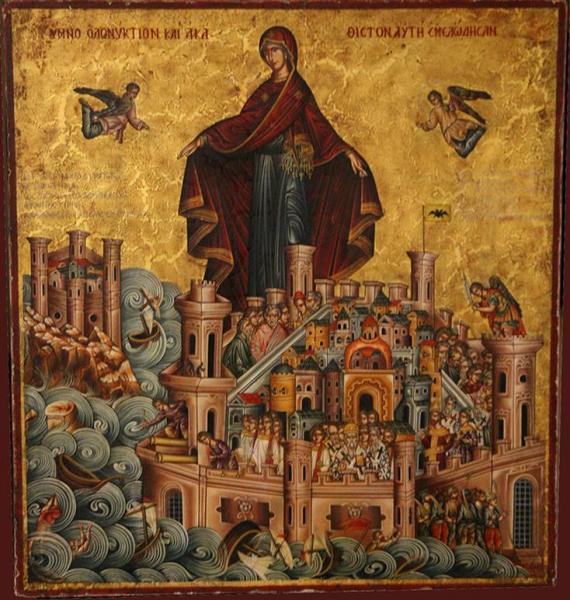
This glorious hymn has the uniqueness of combining the faith and history of the Roman people. It has Byzantium and Orthodoxy as its common roots, as it began to be chanted in the mid-7th century, when, during the reign of Heraclius, Constantinople was saved from the great siege of the Avars. A salvation that tradition attributed to the miraculous interventions of the Panagia and the spirited reaction of the Christians, after Patriarch Sergius blessed the walls of the Queen City with the icon of the Panagia of Blachernae and prayed to the Champion General to save the City.

The Akathist Hymn is a glorious garden, full of theological flowers that exude the fragrance of consolation and salvation. It is not entirely certain who wrote this exquisite hymn, but most scholars attribute its original form to Romanos the Melodist, and it is not excluded that some additions were made later. It consists of 24 Oikoi (stanzas) and each of them begins with the corresponding letter of the Greek alphabet. 12 Oikoi end with “Rejoice, Bride Unwedded” and the other 12 with “Alleluia”. It is an encomiastic and thanksgiving Hymn with absolute symmetry in its composition.

Homily on the Akathist to the Theotokos (Archimandrite Kirill Pavlov)


Homily on the Akathist to the Theotokos

By Archimandrite Kirill Pavlov

(Delivered in 1963 on the Friday of the Week of the Paralytic)

In the name of the Father and the Son and the Holy Spirit!

Christ is Risen!

"Let us run to the gracious and quiet haven, the quick helper, ardent and eager to save all. Let us run to the Virgin’s protection and hasten to repentance." (Kontakion to the Kazan Icon of the Mother of God.)

Dear brothers and sisters, once a woman, delighted by the wondrous teaching of Christ the Savior, raised her voice and exclaimed: "Blessed is the womb that bore you, and the paps that suckled you" (Luke 11:27). These few words express the greatness and glory of the Mother of God with which the whole world, visible and invisible, has given her for her love and mercy to suffering humanity.

March 21, 2025

The Third Salutations To The Theotokos: "Rejoice, Tender Love That Defeats Every Longing"


The Third Salutations To The Theotokos

"Rejoice, Tender Love That Defeats Every Longing"

By Protopresbyter George Dorbarakis

1. The Most Holy Theotokos, for the poet (and therefore for all the faithful, for whom he is the mouthpiece), is not simply a saint above the other saints, who sits on her throne and casts her gaze from on high upon humanity and the faithful. Such a view of her may seem to contain elements of truth, but it is far from reality. For if our Panagia has such an important position, the most important among humans, within the Church, it is because she reveals the life and ethos of her Son and God. Her greatness was that she freely submitted to the will of God and became the most crystal clear and transparent passage, literally the "only gate," through which not something from God, but God Himself as a man could pass into the world. And this means that just as our God “bowed down the heavens and came down,” because He loved us with the greatest love and the greatest eros (“For God so loved the world that He gave His only begotten Son,” and, “While we were yet sinners, Christ died for us”), so too our Panagia, in tune with God’s intense love for man, moves in the same rhythm: she stands sacrificially, full of love and eros, towards every human being, especially the believer who leaves room in his soul and heart for this absolute and unique love to find a “place of rest.” The countless recorded or unrecorded miracles of our Panagia throughout the centuries attest to this reality.

March 14, 2025

The Second Salutations To The Theotokos: "Rejoice Treasury of Purity"

"Akathist to the Theotokos", Andrei Rublev Museum, Moscow.
 
By Protopresbyter George Dorbarakis

"Rejoice, treasury of purity." (Canon, Ode One)

The doxological element towards the Most Holy Theotokos is highlighted par excellence by the Service of the Salutations to our Panagia. And rightly so: she is the one through whom God descended as a man into the world and before her bow the knees not only of the faithful who are inspired by the Spirit of God – only a person in the Spirit can “see” the fullness of grace that the Theotokos has – but also the holy angels. After all, the Mother of the Lord was exalted to a height above the Cherubim and the Seraphim. A prerequisite for this unique choice of our God was of course the purity and innocence of the soul of the little daughter of Nazareth, Mary – this purity attracted our absolutely pure and immaculate God to “rely” on her existence. That is why all the troparia of both the Canon and the Kontakion of the Akathist Hymn project with unsurpassed lyricism the all-holiness of the Theotokos, with images borrowed mostly from holy Scripture, and above all the Old Testament, which constitutes the prophecy of the coming of the Lord Jesus, whose person is revealed in the New Testament.

March 7, 2025

The First Salutations To The Theotokos: Through the Holy Spirit We Are Given Words To Praise Her


Protopresbyter George Dorbarakis

"I shall open my mouth and it shall be filled with the Spirit; and I shall pour out a word to the Mother and Queen; and I shall be seen cheerfully celebrating; and rejoicing I shall sing her miracles." (Eirmos, Ode One, Canon of the Akathist Hymn.)

The holy hymnographer, as the mouth of the Church and ours, tells us that he will speak, he will cry out to the Panagia, who is the Queen Mother, which means first of all that his word does not express only his own feelings and his personal faith, but the faith and feelings of all the members of the Church – after all, there is nothing individual in the Church.

March 22, 2024

Introduction to the Akathist Hymn


By Michael Koutsos, Philologist

The Akathist Hymn was established when the Avars besieged Constantinople in AD 626. However, the poem had been composed and set to music before this event.

The Akathist Hymn consists of the Kontakion (The Salutations) and a Canon. The Salutations are the only Kontakion that has such a wide response. This Kontakion has some peculiarities. It consists of troparia, which are called "oikoi" and form an acrostic, that is, each troparion/oikos begins with a letter of the alphabet, so there are 24 troparia/oikoi. Another peculiarity is that some troparia end with "Salutations" and others with the word "Allelouia". In the oikoi, or stanzas, with odd numbers (Gabriel, the Shepherds, Magi, etc.), they are addressed with Salutations, while in the oikoi, or stanzas, with even numbers, the coming of the Lord is recounted in the various stages of His life on earth. All troparia are not chanted but recited melodically.

April 1, 2023

When Eugenios Voulgaris Was Healed of an Abscess by the Theotokos

Eugenios Voulgaris

Eugenios Voulgaris was the director of the Athoniada School (a Greek Orthodox educational institution founded at 1749 in Mount Athos that is under Vatopaidi Monastery) in the second half of the 18th century. At the Monastery of Dionysiou, this scholar experienced the miraculous power of the Panagia through the original icon that inspired the composition of the Akathist Hymn, who cured him of a painful abscess. He narrates as follows:

I will narrate the miracle that the Panagia performed on me, in order to render her the gratitude I owe her. I'm not writing this to boast that I received such a divine visitation, and I don't even mind if they call me stupid for telling the story.

In 1758, therefore, I was a schoolmaster in Athoniada. When spring came, a dangerous abscess appeared in the depth of my left armpit. I was suffering from a slight fever and felt exhausted. The abscess was constantly growing and hardening. The entire armpit and the left breast had hardened like stone.

All 1508 Greek Words of the Akathist Hymn in Alphabetical Order


The 1508 words of the original composition of the Akathist Hymn in Greek are viewed as mosaics, a piece of art that was fashioned together approximately 1400 years ago to form a masterpiece that is nothing less than divinely inspired.

The word most often used in the original Akathist Hymn is the angelic greeting Χαίρε, which is translated as "Hail" or "Rejoice", appearing 158 times.

As far as some well known hymns and prayers, the hymn Τη ΄περμάχω (To you the Champion General) has 33 words, the prayer Πάτερ Ī·Ī¼ĻŽĪ½ (Our Father) has 58 words, the Ī Ī¹ĻƒĻ„ĪµĻ…ĻŽ (Creed) has 176 words, the prayer Ī’Ī±ĻƒĪ¹Ī»ĪµĻ ουράνιε (Heavenly King) has 38 words, etc.

March 31, 2023

THE AKATHIST HYMN (Its Historical - Doctrinal - Symbolic Elements)


By Panagiotis S. Martinis, ThD

Among the solemn services of Great Lent is also included the Service of the Akathist Hymn, this wonderful Hymn to the Mother of God with its many historical, doctrinal and symbolic elements, which make it unparalleled from a literary point of view.

As is well known, many of the events associated with the Mother of God are related to the Queen City of Constantinople, since the Theotokos was its "Champion General" and its overseer.

In particular, the Service of the Akathist Hymn was connected to the Monastery of Blachernae, where, after the siege of the Avars and the Persians, it was chanted at every vigil of the monastery. The composition of this Hymn is attributed to the famous hymnographer of the 6th century, Romanos the Melodist, the creator of the Kontakion.