Showing posts with label Missions. Show all posts

May 18, 2026

Venerable Macarius of Altai (+ 1847)


Venerable Macarius of Altai
(November 8, 1792 – May 18, 1847) 

Archimandrite, founder of the Altai Spiritual Mission, spiritual writer, author of translations of the Bible and patristic literature into the Russian and Altai languages.

Day of Commemoration: May 18 (31)

Childhood Years and Education

Venerable Macarius, in the world Mikhail Yakovlevich Glukharyov, was born on November 8, 1792, in the family of the priest of the Cathedral of the Entry into the Temple of the Most Holy Theotokos in the city of Vyazma of the Smolensk province. Mikhail received his initial, very good education from his father, who had completed the full course of the theological seminary, which in those times was a rarity. Father Yakov was a preacher well known in the district. He taught his son Latin so well that at the age of seven the boy could translate from the Russian language into Latin. At the age of 8 he was immediately placed into the 3rd class of the ecclesiastical school attached to the Forerunner Monastery of Vyazma.

Once, while returning home, he caught a cold and was ill for half a year. The illness caused serious complications to his vocal cords and lungs. Later, already as a priest, missionary, and teacher, he experienced significant difficulties because of this.

Upon completion of the school, Mikhail was transferred to the Smolensk Theological Seminary. In 1812, because of Napoleon’s invasion and the beginning of the Patriotic War, studies at the seminary were interrupted for a year. In 1813 Mikhail Glukharyov graduated from the seminary with distinction and was retained there as a teacher of Latin grammar.

By synodal decree of 1814, the seminary was required to send two of its best students for the formation of the second course of the renewed Saint Petersburg Theological Academy, and Glukharyov was one of them. Here he attracted the attention of the rector of the academy, Archimandrite Philaret (Drozdov; later Metropolitan of Moscow), who became his first spiritual mentor. “I surrendered my will to His Grace Philaret,” Father Macarius later wrote, “and did nothing and began nothing without his counsel and blessing, almost daily confessing my thoughts to him.” Mikhail was distinguished by deep knowledge in theology, history, geography, and excellent command of the Latin, German, French, Ancient Greek, and Ancient Hebrew languages.

February 16, 2026

The Former Metropolitan of Ganos and Chora, Amphilochios, Has Reposed


On the night of Saturday, February 14th 2026, the former Metropolitan of Ganos and Chora, Amphilochios, reposed in the Lord at the age of 88.

The news was made known in a post by Archimandrite Nektarios Pokkias, who, with emotion, announced the repose of the respected Hierarch, writing:

“Our sweet Elder, Metropolitan formerly of Ganos and Chora, lord Amphilochios, a few minutes ago journeyed into eternity. Eternal be his memory. May we have his blessing… Now he is near his Elder, the Venerable Amphilochios Makris.”

February 14, 2026

Prologue in Sermons: February 14


One of the Best Means of Making Unbelievers Believers

February 14

(Commemoration of our Venerable Father Abraham)

By Archpriest Victor Guryev

Why is it, brethren, that so few pagans are converted to our faith, and why do so few from the schism enter Orthodoxy? It is because we often forget that evil cannot be stopped or overcome by evil, and that evil can be halted — and cut off — only by good.

Venerable Abraham lived among pagans. Some mocked him and forced him to leave them; others constantly troubled him with requests for help. Abraham shared with them what he received from the Orthodox, and by this, it is said, he was delivered from abusive torment. And how did it end? The pagans, struck by the Venerable one’s love for mankind, built a Christian church and themselves all became Christians, and they entreated Abraham to be their priest.

Thus meekness and freedom from malice conquered evil and hatred and increased the flock of Christ!

January 11, 2026

Homily for the Sunday After the Baptism of the Lord (St. Cleopa of Sihastria)


Homily for the Sunday After the Baptism of the Lord

(On the Preaching of the Word of God)

By Saint Cleopa of Sihastria

“From that time Jesus began to preach and to say: Repent, for the Kingdom of Heaven is at hand” (Matthew 4:17).

Beloved faithful,

One of the teachings of today’s Holy Gospel says: “From that time Jesus began to preach and to say: Repent, for the Kingdom of Heaven is at hand” (Matthew 4:17). The same words were spoken by Saint John the Baptist when he began to preach in the wilderness of the Jordan: “Repent, for the Kingdom of Heaven is at hand” (Matthew 3:2). The same message was also given to the Holy Apostles when they were sent to preach the gospel, for He said to them: “As you go, preach, saying: The Kingdom of Heaven is at hand” (Matthew 10:7).

Today’s divine Gospel says: “From that time Jesus began to preach…” (Matthew 4:17). But what does “from that time” mean? It means from the time when the holy and great Prophet John the Baptist was arrested and thrown into prison. This truth is shown by today’s Holy Gospel, which says: “Now when Jesus heard that John had been put in prison, He departed to Galilee” (Matthew 4:12). But did the Savior depart to Galilee out of fear? By no means. Rather, He went to Galilee in order to begin preaching the gospel from there, according to the prophecy of the Prophet Isaiah, who says: “The land of Zebulun and the land of Naphtali, by the way of the sea, beyond the Jordan, Galilee of the Gentiles. The people who sat in darkness have seen a great light, and upon those who sat in the region and shadow of death light has dawned” (Isaiah 9:1; Matthew 4:15–16).

December 30, 2025

Homily on the Occasion of the First Official Celebration of Saint Chrysostomos Papasarantopoulos


Homily by Archimandrite Philippos Chamargias,
Protosyncellus of the Holy Metropolis of Messinia,
on the Occasion of the First Official Celebration of Saint Chrysostomos,
Missionary to Africa, Native of Messinia


(Delivered on December 29, 2025)

Our Holy Church has a feast every day; each day she honors and celebrates a saint. In the three hundred and sixty-five days of the year, we encounter thousands of saints of our faith.

Among them, like a star, there now shines in the firmament of our Church the saint honored today — Saint Chrysostomos, the Missionary to Africa, our compatriot and now a co-patron of this local community of Vasilitsi. But before we refer to the personality of the Saint, let us first see what the word Saint means.

A Saint means one who is pure — pure from every stain of sin.

Saints have come from every social class: men, women, and children. Saints were not only hierarchs, hieromonks, and clergy; every person has the possibility of participation in holiness.

After all, this is the purpose of our life: holiness through the Holy Spirit. When someone acquires the Holy Spirit, he becomes a saint and fulfills his destiny on earth. Christ Himself commanded: “Be holy, for I am holy,” which means: strive in your life to become saints, just as I am holy, I who created you.

October 9, 2025

Saint Chrysostomos Papasarantopoulos - The Messinian and New "Cyril and Methodios" of Africa


By Archimandrite Philip Hamargias,
Chancellor of the Sacred Metropolis of Messinia

The presence of saints in the world, according to the late Professor John Fountoulis, is “proof of the work of the Church, of the energy of the Holy Spirit in the world.”

Thus, the presence of saints in an ecclesial community is the confirmation of the above statement, starting from a local level, which, however, through the Eucharistic communion of the faithful, the Church, transcends the limited limits and extends to the entire Body of the Church.

The Church, therefore, by honoring and exalting saints, challenges and invites each of us, by presenting to us the saints of every era, even the era we are living in, to experience holiness, according to the model of their lives, so that we may become genuine imitators of them, as they are of Christ, and confirming, through our lived experience, that holiness is not a species destined to disappear, nor a fossilized symbol, but a living reality and that each of us can participate in it.

September 26, 2025

Prologue in Sermons: September 26

 
On How We Should Treat Perishing Sinners

September 26

(Homily on the Young Man Whom John the Theologian Saved)

By Archpriest Victor Guryev

When we encounter perishing sinners, it often happens thus: some of us pay them not the slightest attention; others regard them with contempt and derision; a third group, at times, even looks upon their demise with malicious glee; while the fourth, although they finally address them with a salvific word, more often convey a harsh rebuke, which generally leads only to mutual dissatisfaction between the reprovers and the reproved. What do you think, brethren? Should we treat perishing sinners in this way or not? Certainly not! We should act in an entirely opposite manner. "How so?" you may ask. To this question, let the example that follows provide the answer.

July 29, 2025

July: Day 29: Teaching 1: Holy Martyr Kallinikos


July: Day 29:
Holy Martyr Kallinikos

 
(Every Christian Can Contribute to the Spread of the Christian Faith Through Pious Words and Good Life)

By Archpriest Grigory Dyachenko

I. Today the Holy Church celebrates the memory of the Holy Martyr Kallinikos. Saint Kallinikos was born in Cilicia and was raised in the Christian faith. He was deeply grieved, seeing that the people in their error worshiped soulless idols and did not know the true God, and decided to devote his whole life to preaching the holy faith. He went around many cities and villages, converting pagans from idols to Christ God. Among other things, he arrived in the Galatian city of Ancyra, and laboring there in the gospel of Christ, he won many for God. The unbelievers seized him, presenting him to the city governor as a corrupter of the people and a preacher of the forbidden law. The governor, an evil and cruel man and hater of Christians, began to severely reproach him for turning the people away from the gods, and then subjected him to cruel tortures, but the Martyr endured them patiently. Then they sent him to the city of Gangra to be burned there. The journey was difficult and torturous: exhausted and weakened by the tortures he had endured, he had to keep up with the soldiers who were riding on horses; iron boots with sharp nails caused him the most severe pain at every step. But the Martyr trusted in God, prayed to Him the entire journey, and God did not abandon him with His mercy. The weather was sultry; the soldiers accompanying him were exhausted from thirst and heat. Kallinikos, pitying them, turned to the Lord with prayer, and at his prayer there suddenly gushed water out of a stone. The pagans cried out: "Great is the God of Christians!" But then they brought him to the city where the execution was to take place. Seeing the fire prepared for him, he cried out joyfully: "I thank You, Heavenly Father, that You have deemed me worthy to suffer for Your name! Receive my spirit in peace." With these words, he entered the fire and gave up his soul to God. This was in the middle of the 3rd century. His body remained unharmed in the fire and was reverently buried by Christians.

May 23, 2025

May: Day 23: Teaching 2: Saint Leontius the Wonderworker, Bishop of Rostov


May: Day 23: Teaching 2:
Saint Leontius the Wonderworker, Bishop of Rostov

 
(The Greatest Must Be the Servant of All)

By Archpriest Grigory Dyachenko

I. Where Saint Leontius, whose memory is celebrated today, was born is unknown; some consider him a Greek who came from Constantinople; others, with greater certainty, think that he was ordained Bishop of Rostov from among the monks of the Kiev Caves, around the year 1050.

A difficult task lay before him. The inhabitants of Rostov, having expelled two bishops, did not greet the third with joy. Strongly attached to paganism, they began to insult the holy preacher of the word of God in every way and, finally, expelled him; but Leontius decided not to retreat from the good deed. Despite the danger threatening him, he began to live near the city, near a stream. On this site he subsequently built a church in the name of the Archangel Michael. Here he cooked kutia and distributed it to small children, trying in this way to attract them to himself with the power of love and Christian meekness. He told them about the Lord Jesus Christ, and the children began to willingly come to him and listen to him. Then several adults came.

May 21, 2025

May: Day 21: Teaching 2: Saints Constantine and Helen, Equal to the Apostles


May: Day 21: Teaching 2:
Saints Constantine and Helen, Equal to the Apostles

 
(Lessons From Their Lives: Christians Must Turn To the Power of the Honorable and Life-Giving Cross of the Lord and Contribute To the Spread of the Christian Faith)


By Archpriest Grigory Dyachenko

I. Under Saint Constantine the Great, whose memory is celebrated today with his Holy and Equal-to-the-Apostles mother Helen, the Christian faith, persecuted before his time, became dominant in the Roman Empire. The father of Constantine the Great, Constantius Chlorus, respected Christians and gave them honorary positions at his court. His son Constantine, born of Helen, learned the Christian faith in his father's house and from his youth was accustomed to respect it. When his father died in Britain (present-day England) in 306, Constantine was proclaimed Western Emperor. He was then 32 years old. He ruled his subjects with love and meekness. But in other regions of the West, the evil and self-interested Maxentius ruled. In 312, the subjects of Maxentius, unable to endure his oppression, began to ask Constantine to deliver them from the tyrant. Constantine marched against Maxentius, and as he approached Rome, suddenly, in the middle of the day, he and his army saw in the heavens a cross shining with stars, with the inscription: "By this conquer." That same night, Christ Himself appeared to Constantine in a vision and commanded him to make a banner in the likeness of a cross and to depict the cross on the weapons, shields and helmets of the soldiers. Under the banner of the cross, he defeated Maxentius, who, fleeing, drowned in the Tiber River.

May 12, 2025

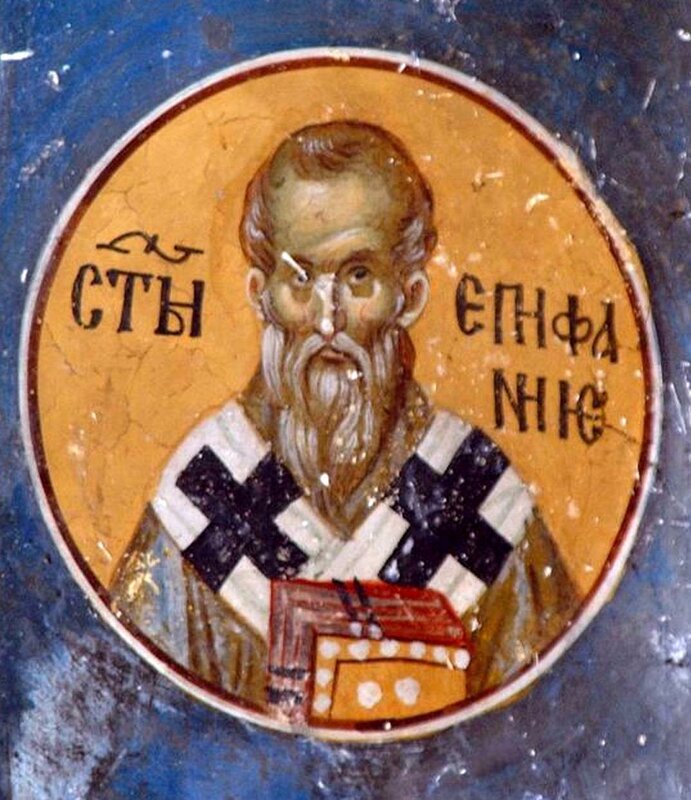
May: Day 12: Teaching 1: Saint Epiphanios, Archbishop of Cyprus


May: Day 12: Teaching 1:
Saint Epiphanios, Archbishop of Cyprus

 
(What is the Easiest Way to Convert Unbelievers to Christ?)

By Archpriest Grigory Dyachenko

I. Saint Epiphanios, Archbishop of Cyprus, who is celebrated today, had Jewish parents and was brought up in the Jewish faith. Once, when he was a youth, he met on the road a monk named Lucian, who was engaged in copying books, selling them and keeping part of the proceeds for himself and distributing the rest to the poor. And so Epiphanios saw a beggar approaching Lucian, throwing himself at his feet and crying out: “Have mercy on me, Man of God! Give me something, for I have not eaten bread for three days and have become completely weak.” Lucian takes off his clothes, gives them to the beggar and says: “Go to the city, sell them and buy yourself some bread.” This act of the pious monk so touched Epiphanios that he fell on his knees before him and declared to Lucian that he wanted to become a Christian. Then he invited Lucian to his home, showed him his property and again began to beg him to make him a Christian. After Lucian left, Epiphanios persuaded his sister to accept Holy Baptism, and both of them, seeing Lucian again, already with tears asked to be quickly illuminated by the Christian faith. Lucian taught them the truths of the Christian faith and then brought them to the Bishop, who granted them Holy Baptism. Then Epiphanios distributed his property to the poor and took upon himself the monastic life.

May 5, 2025

May: Day 5: Holy Great Martyr Irene


May: Day 5:
Holy Great Martyr Irene

 
(Lessons From Her Life:
a. Parents should choose a pious mentor for their children;
b. One should believe in God's providence; and
c. One should participate in the spread of the Christian faith)


By Archpriest Grigory Dyachenko

I. Saint Irene, known as Penelope while a pagan, commemorated today in ecclesiastical hymns and readings, was baptized in her early youth by a disciple of the Holy Apostle Paul, the Holy Apostle Timothy († 93). The following is known about the circumstances of her conversion to the faith of Christ, from the story of her life by Saint Dimitri of Rostov. Brought up in a country palace, far from the distractions of city life, under the guidance of a venerable teacher and the elder Apeliannos, whom Irene’s father, a pagan, did not know that he professed the Christian faith. Penelope grew in all the virtues characteristic of true Christians, and thus the soil of her soul was completely prepared for the reception of the “good seed.” The time came, and the light of Christ shone in the soul brought up under Christian influence.

April 28, 2025

April: Day 29: Holy Apostles Jason and Sosipater With Their Companions


April: Day 29:*
Holy Apostles Jason and Sosipater With Their Companions

 
(On What the Holy Apostles Did To Spread the Christian Faith and What We Must Do To Spread It)

By Archpriest Grigory Dyachenko

I. The Holy Apostles of the Seventy, Jason and Sosipater, whose memory is celebrated today, disciples and relatives of the Holy Apostle Paul, preached the gospel together in various countries. On the island of Corcyra (Kerkyra) they were imprisoned for this and here “they converted seven thieves to Christ,” who accepted a martyr’s death for the faith: they died in a cauldron with melted resin, sulfur and wax. The prison guard, converted to Christ by the Apostles, was also put to death by beheading. The Apostles Jason and Sosipater themselves were subjected to torture in the eyes of all the people and then thrown back into prison. The daughter of the ruler of Corcyra looked on their sufferings from a window and was so amazed by the patience of the martyrs that she confessed herself a Christian. For this she too was imprisoned and then, hanged on a tree, accepted death for Christ, being suffocated by smoke and struck by arrows.

April: Day 28: Teaching 1: Saint Cyril, Bishop of Turov

 
April: Day 28: Teaching 1:
Saint Cyril, Bishop of Turov

 
(Every Christian is Obliged to Contribute to the Spread and Strengthening of the Christian Faith)

By Archpriest Grigory Dyachenko

I. The glorious hierarch of the Russian Church, Saint Cyril, whose memory is today, was born and raised in the city of Turov (now a poor town in the Minsk province, on the river Pripet). Having zealously devoted himself to book learning and having become well versed in the divine writings, Saint Cyril decided to leave the home of his parents and the vain pleasures of the world. In the Borisoglebsky Monastery in Turov he took monastic vows and soon surpassed everyone there in monastic feats. Not content with the usual feats of fasting and prayer, he, following the example of the Eastern ascetics, ascended a pillar. This first pillar dweller of the Russian land spent several years in seclusion, mortifying his flesh more than before with fasting and prayer. But saving his soul, he did not refuse spiritual healing and help to those who were attracted to him in great numbers by the glory of his feats and spiritual wisdom. Giving advice and instructions orally, he also wrote many pious works on the column. And it was not surprising that the prince and the inhabitants of Turov, after the death of the Bishop of Turov, began to ask their great ascetic to be their Bishop. Ready to serve for the benefit of his neighbors, Cyril agreed to their persuasive request and was appointed Bishop of Turov, around 1169. In the rank of Bishop, he zealously taught his flock in the church, and these teachings glorified him so much even in the distant countries of the Russian land that Prince Andrei Bogolyubsky wanted to read them and, receiving them, read them with reverence. But vigorous in spirit, Saint​ Cyril was weakened in body from extraordinary ascetic exploits; moreover, his soul was drawn to monastic solitude, and the Saint left the episcopal see, and spent the last days of his life in deep solitude. For his great Christian virtues, the Church canonized him.

April 26, 2025

April: Day 26: Saint Stephen, Bishop of Perm


April: Day 26:
Saint Stephen, Bishop of Perm

 
(How Christians Can Participate in the Spread of the Christian Faith Among Pagans)

By Archpriest Grigory Dyachenko

I. Saint Stephen, the enlightener of the pagans in Perm, whose memory is celebrated today, lived in the second half of the 14th century. As a young clerk of the Ustyug Cathedral, by the grace of God he conceived the desire to devote his life to the enlightenment of the Zyryans, the wild sons of the northern forests. In the Rostov Theophany Monastery, under the guidance of Arseny, the Rostov bishop and former prince, he studied the dogmas of faith from Slavic books: “Desiring greater understanding,” says his biographer Epiphanius, “he also studied Greek literature.” The Zyryan language was familiar to him even in his homeland in Ustyug; and now he studied it in order to be able to translate ecclesiastical books into it. What needed to be translated for the first acquaintance of the Zyryans with the faith, Stephen translated from Slavic with the help of the Greek language. Having thus prepared himself for the title of preacher of the faith, he asked for a blessing for his work from the then overseer of the Moscow Metropolis, Gerasim, Bishop of Kolomna; and the Grand Duke secured him with his charter. With these aids he arrived at the mouth of the Vychegda River to the rude but simple-minded people, and began to preach the true God.

April 5, 2025

April: Day 4: Holy Martyrs Agathopodas and Theodoulos


April: Day 4:*
Holy Martyrs Agathopodas and Theodoulos

 
(Do Not Give What is Holy to Ridicule)

By Archpriest Grigory Dyachenko

I. During the reign of Diocletian and Maximian, there lived in the Greek city of Thessaloniki, or Thessalonica, two clergymen, the elder Agathopodas and a youth named Theodoulos, whose memory the Holy Church celebrates today.

The first of them was a Deacon, the second fulfilled the office of Reader in the Church; and both led an honest, virtuous life, entirely devoted to the Lord. God, in His mercy, granted Theodoulos miraculous power: he helped those suffering from various illnesses and converted many pagans to Christ.

Suddenly a persecution of Christians began. An order was sent to Thessaloniki, as to all the cities that belonged to the Roman Empire, to force everyone to worship idols. Instruments of execution were placed in the city square to intimidate those who disobeyed. Some Christians then secretly left the city and hid from the persecution of the pagans; others could not withstand the fear of torture and renounced their faith; but many remained in Thessaloniki, calmly awaiting their fate. Among them were Agathopodas and Theodoulos. They prayed incessantly in the temple of God. They were seized, thrown into prison, and then, after a few days, brought to the city governor, Faustinus, for interrogation.

February 16, 2025

February: Day 16: Holy Hieromartyr Pamphilos


February: Day 16:
Holy Hieromartyr Pamphilos
 

(On the Need for a Christian to Care About the Salvation of his Neighbor’s Soul)


By Archpriest Grigory Dyachenko

I. Holy Hieromartyr Pamphilos, whose memory is celebrated today, lived at the beginning of the 4th century, was born in Berytus, in Caesarea of Palestine, where he later served as a priest. Having received an excellent education in Alexandria, he studied the Holy Scriptures: he compared the texts of the New Testament, corrected places corrupted by copyists, copied manuscripts himself and distributed them to all who wanted them. He worked long and hard on this matter and collected a large library of sacred books in Caesarea. At the same time, distinguished by his piety, he distributed his wealth to the poor and devoted himself to the spread of the true faith and Christian education.

February 6, 2025

Saint Boukolos of Smyrna as a Model for our Lives

St. Boukolos of Smyrna (Feast Day - February 6)

By Protopresbyter Fr. George Papavarnavas

Saint Boukolos was ordained Bishop and established in Smyrna by Saint John the Theologian and Evangelist, who had the care and guardianship of the Churches of Asia Minor. Therefore, he is an Apostolic Father of the Church and is honored as the first Bishop of Smyrna. He had godly zeal and a martyr's spirit and served the people of God with great self-denial and sacrificial love. He fought against the heresies that corrupted the faith, but he loved people, because what he wanted was the preservation of the unadulterated faith, but also the salvation of heretics, as well as idolaters, through repentance. And as the sacred Synaxarist notes, this revered Hierarch treated the idolaters with cheerfulness, love, discernment, approachability and kindness. He was careful not to irritate them, because what he wanted was to attract them to the faith, and, indeed, with his behavior and his bright example he attracted many.

December 23, 2024

December: Day 23: Venerable Nephon, Bishop of Constantia

 
December: Day 23:
Venerable Nephon, Bishop of Constantia

 
(Lessons From His Life:
a. The Danger of Bad Company, and
b. The Need to Exhort to Salvation Neighbors Who Are in Danger of Moral Destruction)


By Archpriest Grigory Dyachenko

I. The Venerable Nephon, whose memory is now being celebrated, lived in the fourth century. In his youth he was pious, kind, quiet, meek and loved to go to church. But when he began to reach the age of maturity and lost an experienced mentor, and then became close with bad companions, he began to act according to his own mind and reason, as he pleased, and thus little by little his good character was spoiled. But God showed him His mercy and in an instant awakened in him a feeling of repentance. One day, Nephon's friend, Nikodemos, came to him. Having greeted him, he looked at his friend's face and was greatly horrified. Both friends were silent. "Why do you look at me as if I were a stranger?" Nephon asked. "Believe me, friend," answered Nikodemos, "I have never seen you as you are now; your face is black, terrible and terrifying." Hearing this, Nephon vividly recalled his behavior, covered his face with his hands and began to weep. His repentance was sincere. He began to pray fervently and lead a pious life, crucifying his flesh with passions and lusts with the fear of God's judgment. Finally, for the holiness of his life, he was subsequently, by God's command, chosen as Bishop of the Cypriot church. At the time of his death, his face was illuminated and filled with a special attractiveness and joy.