Showing posts with label New Martyrs Under the Turks. Show all posts

October 24, 2026

The Relics of the Holy New Martyr Chryse: Their Discovery in 2009, Scientific Examination, and Translation in October 2026


Introduction

In October 2026, the relics identified by the Holy Metropolis of Edessa, Pella, and Almopia as those of Saint Chryse, the New Martyr of Almopia, were received at the church dedicated to her in the village of Chryse, in the regional unit of Pella, northern Greece. The event followed a process that had begun seventeen years earlier, when human remains were discovered near the ruins of an old church within the Byzantine castle area of the village.

According to the Metropolis, the remains underwent medical and forensic examinations, including examinations by the Forensic Medicine Service of Thessaloniki and two specialized laboratories in Germany. The findings were reported as consistent with the remains belonging to a young woman approximately seventeen years old who died in 1795, the traditional date of Saint Chryse’s martyrdom. The ecclesiastical account also draws attention to signs of severe injury, particularly around the ribs and skull, which it associates with the tortures described in the Saint’s Life.

The discovery and translation of the relics have drawn considerable interest among the faithful in Greece and abroad. They also renewed attention to the life of the young Orthodox Christian woman whose steadfastness in the faith has been preserved in the Orthodox Church’s hagiographical tradition.

September 23, 2026

Synaxarion of the Holy New Martyr John of Konitsa


Synaxarion

By Venerable Gerasimos Mikragiannanitis,

On the same day [September 23], the commemoration of the Holy and Glorious New Martyr John, who was from Konitsa in Epirus and suffered martyrdom in Vrachori (Agrinio) in Aetolia in the year 1814.

Verses

Sprung from a foul-smelling root, O John,
You brought forth the sweetest fruits of martyrdom.
On the twenty-third, they cruelly severed John’s neck.


He was from Konitsa, a small town in Epirus, and was born to Ottoman parents, by whom he was also raised in their own delusion. His father, who was a Dervish, enrolled him in the order known as the Dervishes. When he reached the age of twenty, he lived a respectable life, inclining toward Christian virtues and ways with great prudence. Not long afterward, he abandoned his former delusion and came to the light of the knowledge of God, believing in Christ God and being born again through divine Baptism on the island of Ithaca, where he received the name John.

May 30, 2026

Synaxarion of the Holy Twenty-Three Hagarane New Martrys of Thyateira

 
Synaxarion

By Haralambos M. Bousias

On the same day [May 30], the commemoration of the Holy and Glorious Twenty-Three New Martyrs from among the Hagarenes, who contested in Thyateira.


Verses

Three together with twenty Martyrs of Thyateira,
You have now magnified Christ by your contests.


The glorious New Martyrs of Thyateira, who came from among the Hagarenes, recently [1649] contended for the faith of Christ, the faith that brings salvation. As obedient students sitting at the feet of the Sheikh of Thyateira, the most wise teacher of the Mohammedan law, they followed him into the knowledge of the truth, which the grace of the All-Holy Spirit had taught him. When the twenty-three young men came to know the truth of the gospel, they abandoned the error of their fathers and enlisted themselves under Christ, remaining faithful to Him even unto martyrdom. Having therefore all struggled lawfully, they endured their sufferings with steadfastness. The Sheikh suffered death by strangulation, while his blessed martyr-disciples endured impalements, the burning of their limbs, and suspension upon the gallows. After their martyric consummation, they became workers of miracles by their own agency through the grace of God.

April 30, 2026

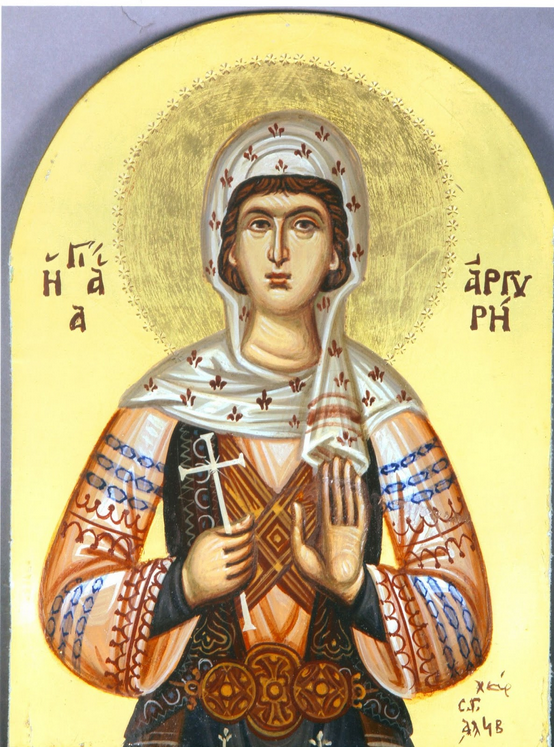
Service of the Holy Glorious Neomartyr Argyri (Prologue to the 1912 Edition)


The 1912 work titled "Service of the Holy Glorious Neomartyr Argyri, who was born in Proussa and martyred in Haskƶy of Constantinople" served as the definitive liturgical text for the Saint's veneration until the late 20th century. The Service was first published in Constantinople at the expense of the prominent lawyer Philippos Philippidis of Constantinople. Modern reprints, such as the 1997 and 2007 editions, often combine Philippidis’s original compilation with newer hymns composed by Saint Gerasimos Mikragiannanitis.

PROLOGUE

Having before our eyes the very great spiritual benefit which we offer to every Christian, and on the other hand having been urged by various venerable men, we proceeded to the publication of the preserved and, with much labor, collected information, as well as of the traditions maintained through living voice, concerning the life of the Venerable Martyr Argyri of Haskƶy, whose sacred relic is found there within a reliquary.

The first words of the present work were written around the year 1907, when we were studying at the Great School of the Nation in Phanar, dedicating the few moments of our student life to writing historical descriptions of my homeland Haskƶy; but their publication was then hindered, on the one hand by their incompleteness, and on the other by other reasons independent of my will. And we rejoice for this, because, although in itself perhaps imperfect, it has now in any case become more complete, having absorbed the studies and research of ours during this short interval.

April 29, 2026

Holy New Martyr Noultzos, Together with his Brother and Brother-in-Law (+ 1696)


By Archimandrite Athanasios Giannousas,
Protosyngellos of the Holy Metropolis of Kastoria

The New Martyrs, as Saint Nikodemos the Hagiorite writes in the prologue of the New Martyrology, are the glory of the Church and the renewal of the entire Orthodox faith.

For, seeing the courageous confession of these people who lived in the years of slavery under the heavy foot of the conqueror, they learned what Saint Demetrios, Saint George, and the other ancient Martyrs had endured in earlier times was real, and they saw it with their own eyes in the persons of these New Martyrs.

It has also been written about the New Martyrs that they were the bulwarks during this difficult period, the resistors — if we wish to use an expression of our time — who by their martyrdom prevented the Islamization of many Christians of their era.

I used to hear about the New Martyrs from my childhood years on Saint Nicholas Street of Acharnon Street.

We celebrated them every year on the Third Sunday of Matthew, something which also takes place in Kastoria every year, and indeed the Service is chanted in all the churches and a related encyclical of our Bishop is read, who especially venerates the New Martyrs.

In honor of the New Martyrs, a splendid church is being built in the borderland and historic Oinoe of Kastoria, in which there will also be small portions of the Holy Relics of the Holy New Martyrs.

Kastoria, together with the Champion General, the Panagia, and the whole company of Saints who guard it protectively, has to boast not only of its Byzantine monuments, its tradition and its heritage, but also of the presence of New Martyrs.

On April 21 of the year 1696, Noultzos was martyred.

November 26, 2025

Holy New Martyr George the Chiopolitis in the Hymnography of the Orthodox Church

The retrieval of the beheaded body of St. George of Chios from the ravine it was thrown into, which his friends transferred to an uninhabited island for burial off the coast of Kydonies.

By Fr. George Dorbarakis

Saint George was born in Chios. His father was named Paraskevas, and his mother Aggerou. At the age of 18 months, orphaned by his mother, he was handed over by his father to be raised by his stepmother. In childhood, his parents handed George over to a woodcarver, named Vissetzis, to teach him his art. When he once came to Psara with his boss, to carve the iconostasis of the Church of Saint Nicholas, George fled with some young men to Kavala. There he was arrested stealing from a garden and handed himself over to the judge. To avoid punishment, he accepted Islam, was circumcised and was named Ahmed. At the age of 10, he returned to Chios crying and confessing Christ. His father, in order to protect him, took him to one of his estates in Kydonies ((also known as Aivali). Later, at the age of 22, he became engaged and the brother of his fiancĆ©e, because he had financial differences with him, betrayed him to the Turkish commander, saying that while he had become a Muslim, he had returned to Christianity. He was tortured cruelly and after he had received the Holy Mysteries in prison, on the morning of November 26, 1807, they cut off his head - in a martyric manner - little by little. Thus he received the crown of martyrdom, from Christ the crowner of athletes. 

September 23, 2025

Holy New Martyr John the Former Hagarene as a Model for our Lives

St. John of Konitsa (Feast Day - September 23)

By Protopresbyter Fr. George Papavarnavas

The Holy New Martyr John lived in the 18th and early 19th centuries AD. He was born in Konitsa, Epirus, to Muslim parents. His father was a Dervish and held the rank of Sheikh. At the age of twenty, he also entered the religious order of the Dervishes. After living for several years in Ioannina, he then went to Vrachori in Aetolia, today's Agrinio, and lived in a house called the Musallim Serai.

We do not know the processes that took place in his inner world and contributed to his life being completely transformed and changed. That is, he suddenly threw off the garments of a Dervish, dressed like a Christian and went to Ithaca, where he was baptized and took the name John. Then he returned to Aetolia, and specifically to the village of Mahalas. There he married and practiced the profession of a field guard. His father, when he learned of these events, sent people to convince him to return to Islam. John chased them away and was then arrested by Muselimi of Vrachori. He confessed his faith in Christ with boldness and courage and, despite the inhuman torture, remained steadfast and unwavering. Then, because they could not bend his brave spirit, they beheaded him on September 23, 1814, and thus he delivered his holy soul into the hands of Christ, whom he loved deeply. The Christians buried his sacred tabernacle on a farm in Vrachori. Later, his sacred relics were brought back, which were deposited in the crypt of the Sacred Monastery of the Dormition of the Theotokos Prousos in Evrytania, and were discovered on January 4, 1974.

September 4, 2025

Holy New Martyr Theodore of Halicarnassus (+ c. 1800)

St. Theodore of Halicarnassus (Feast Day - September 4)

Saint Theodore was martyred for Christ in Halicarnassus, also known as Petroumi of Asia Minor, around the year 1800 at the age of about 30.

The Saint was arrested by the impious Ottomans and imprisoned in the Dungeon of Halicarnassus. During this period of his stay in prison, he was supported by Hierodeacon Joachim Askandalos (+ 1839), a pious and learned man and a monk of the Sacred Stavropegic Monastery of Saint John the Theologian in Patmos.

He was martyred in a horrible way, as can be seen from the beatings on his Honorable Skull and the rest of his Sacred Relics.

August 18, 2025

Former "Christ-Denying" Saints and the Neomartyr Matthew of Gerakari Who Was Martyred in Rethymno of Crete


By Emmanuel K. Doundoulakis,
Permanent Assistant Professor of the
Patriarchal University Ecclesiastical Academy of Crete

Repentance, as a means of restoring, among other things, our relationship with God and our fellow man, is found in Holy Scripture, proclaimed by the Fathers of our Church, presented in the Ascetic literature and attested by our Hagiological tradition. 

The denial of Christ, with a typical example being that of the Apostle Peter after the Lord's arrest and before His sacrifice on the cross, is repeated by a certain category of Saints of our Church, known as "Christ-deniers". We mention, for example, from this category the Venerable Martyrs Euthymios, Ignatios, Akakios, etc.

These specific martyrs are observed mainly during the period of the Turkish occupation and were Christians, who at some stage in their lives denied Christ, the Christian faith, and became Muslims. Mainly the rebuke of conscience, but also a sign from God,1 urged them to repent for their action, for their denial under oath, and to want to bear witness to the "love of Christ".

July 11, 2025

Celebrating the Holy New Venerable Martyr Nikodemos in Berat, Albania


By Fr. Elias Makos

With Vespers on the eve, as well as a vigil in the Church of Saint Michael, as well as a Divine Liturgy on the feast day in the chapel in his honor in the Cathedral of Saint Demetrios, the memory of the local Venerable Martyr Nikodemos was honored in Berat, Albania.

The faithful had the opportunity to venerate the skull of Saint Nikodemos and receive cotton from his sacred lips as a blessing.

When the Saint was beheaded on July 11th 1722, Christians gave money to the Turks and received his relics, which they placed in the Church of the Panagia.

In 1815, the silversmiths of Berat made a silver case for the Saint's head.

July 10, 2025

Holy New Martyr Jonah the Protopsaltis (+ 1821)


The Holy New Martyr Jonah was the Protopsaltis of the Cathedral Temple of the Panagia in Ayia Napa, Limassol of Cyprus.

He was decapitated on July 10, 1821, the day after the sacrifice of the Holy Ethnomartyr Archbishop Kyprianos of Cyprus and the three Metropolitans with him: Chrysanthos of Paphos, Meletios of Kition, Laurentios of Kyrenia.

April 29, 2025

Holy Martyr Vasilije the Baker of Peć (17th cent.)

St. Vasilije of Peć (Feast Day - April 29)

In the 17th century, when Serbia was under Turkish occupation, in the town of Peć, located near the Peć Patriarchate, there lived a pious Christian by the name of Vasilije, who was a baker by profession. He married at a young age and by the time he was 35 years old he already had grown children.

One day, inflamed by carnal passion, a local Turk kidnapped one of his daughters who had just reached the age of marriage. Vasilije, afraid that the Turk would force her into marriage and become a Muslim, went in pursuit of the kidnapper, and when he encountered him, other Turks came to the kidnapper's aid so that Vasilije was outnumbered and severely beaten. When given the option of converting to Islam or losing his life, Vasilije chose to die as an Orthodox Christian. The furious Turks therefore hacked him with a scimitar and left him to die on the street bleeding. This massacre took place on the outskirts of Peć in the direction of the village of Dečani. The Holy Martyr, near death, was able to crawl to the nearby village of ĆuÅ”ka, but there his life came to an end.

August 9, 2024

Holy New Martyr Nicholas of Kokova (+ 1822)

St. Nicholas of Kokova (Feast Day - August 9 & Thomas Sunday)

Born in the village of Polydendri in Imathia, then called Kokova, Nicholas was a disciple in spirit of the Holy Hieromartyr Kosmas the Aitolos, who had passed through and preached in his village. At a young age he went to Naousa to work as a tailor. There he found himself in great ruin in 1822.

The young Nicholas was in Naousa when it was captured by the Turks, who entered the city after the great disaster, and led them to Kioski before Ebu Lubut Pasha. One by one the people of Naousa passed in front of the Turkish Pasha who asked their name and what they believed. As soon as they said they were Christians and wanted to die Christians, the executioner's sword beheaded them.

July 14, 2024

Neomartyrs: The Newly Illuminated Stars of the Church


By  Sophia Bekri
 
"The newly appeared stars" "who gloriously competed in these last years" are annually honored by our Church on the Third Sunday of Matthew (two weeks after All Saints). According to the Synaxarion of the feast, the Service of which was composed by Saint Nikodemos the Hagiorite, on this day "we celebrate all the Holy Newly Appeared Martyrs of Christ who were martyred after the Fall of Constantinople."

The providence of the good and compassionate God acted so that during the long captivity our race did not remain without consolation, but "through this and from this blessed captivity worthy fruit sprung forth in the newly appeared martyrs."

Therefore, the contribution of the New Martyrs is twofold: spiritual and national.

July 10, 2024

Saint Jeremiah Who Was Martyred in Crete

Church of Panagia Zerviotissa

On the 2nd Sunday of Matthew, commemoration is made of Saint Jeremiah, who was the head of the Metochion of Panagia Zerviotissa in Stylos of Crete, which was a dependency of the Monastery of Saint John the Theologian in Patmos. We have little more information about him, except that he was murdered by the Turks in July of 1821. He is commemorated on the 2nd Sunday of Matthew because it is the same day in which is celebrated All the Saints of Patmos, and it usually falls in July.
 

July 9, 2024

The Martyrdom Site of Saint Michael Paknanas in Athens


On July 9, 1771, an 18 year old gardner named Michael Paknanas was brought to the ancient Temple of Olympian Zeus in Athens to be beheaded on the site of its ruins for his refusal to deny his Christian faith and embrace Islam. His last words to the executioner who taunted him were, "Strike for the Faith!"

On the pillar where he was beheaded, faithful Christians left this inscription: "1771 Ιουλίου 9 Ī±Ļ€ĪµĪŗĪµĻ†Ī±Ī»ĪÆĻƒĪøĪ· Īæ Πακνανάς ĪœĪ¹Ļ‡Ī¬Ī»Ī·Ļ‚" (July 9th 1771 Michael Paknanas was beheaded).

In 2010 it was established that a Divine Liturgy would be celebrated next to this spot annually on the Saint's feast day, which is the same as the date he was martyred. Entrance to the historic site is free on this day only for those who participate in the Divine Liturgy.

January 4, 2024

After 160 Years, the Relics of the Turkish Dervish Who Became an Orthodox Saint, Were Found in 1974


By Fr. Elias Makos

On January 4, 1974, the relic of Saint John of Konitsa was discovered by monks, 160 years after his martyrdom in Agrinio in 1814, in a crypt in the Prousos Monastery, right next to the miraculous icon of the Panagia Prousiotissa.

Since then the Church celebrates the finding of his relic.

It was fragrant and is still fragrant to our days, reminding us of the triumph of our faith. A triumph which rested on the bloody struggles of genuine truth.

It had been transferred from Agrinio (Vrachori at the time), where the Saint was martyred, at the initiative of the teacher Iatrides of Karpenisi and the abbot of Prousos Kyrillos Kastanofyllis, to the Monastery, where he remained hidden for more than a century and a half.

September 30, 2023

Testimonies Regarding the Miraculous Discovery of the Sacred Relics of the Holy New Martyr Akylina


Narrative of a Dream of a Pious Woman About the 
Burial Place of the Holy New Martyr Akylina

Ten days after the discovery of the sacred relics of the Holy Great Martyr and Prize-Bearing Kyranna, the following miraculous event happened to me. Saint Kyranna appeared to me in a dream and spoke to me about her friend, Angelina as she called her, and that they are and coexist together.

After a few days I informed His Eminence Metropolitan John of Langada, Liti and Rentini of the dream that Saint Kyranna found me worthy me to see.

During this time, a girl appeared in my dream who told me she was Angelina and urged me to read the Supplicatory Canon of Saint Parthenios, Bishop of Lampsakis, because Nikodemos of Ierissos is being operated on, due to an illness he himself did not know about, stressing at the same time not to look elsewhere to find her, since we know where she is.

Saint Angelina who appeared to me in my dream was young in age, a tall girl with blond hair, of exceptional beauty and she was standing at the outer door that leads to the interior of the Sacred Bema of the Sacred Temple of the All-Great Taxiarches of Ossa. She was telling me how I should measure seven steps from the door near the Sanctuary of the Temple and she pointed out to me a spot where I would stand, exactly opposite, looking at the wall of the Temple and on which there was a sign of the Cross. And the Saint continued saying that there we will find her Bones and continued saying: "Wound to the bones, bitter red water."

September 25, 2023

Patriarchate of Antioch Will Canonize Two New Saints This Fall


Patriarch John X of Antioch and All the East declared during the Divine Liturgy he presided over on the occasion of the Feast of the Nativity of the Theotokos at Saydnaya Monastery in Syria (9/8/23), that the sessions of the Holy Synod will be officially initiated on October 18th of 2023 during which many topics will be raised. One of the most important topics is that the Holy Synod is heading towards canonizing the Hieromartyrs Father Nicholas Khashi, and his son Father Habib Khashi, two Damascene priests who martyred for the faith in the last century.

As a layman, Father Nicholas was an activist for the return of the Patriarchate of Antioch, which had been under Greek rule since the Melkite Catholic schism, to Arab control and was active in the establishment and development of schools for the community. He was then ordained to the priesthood, where he served the Archdiocese of Damascus. Patriarch Meletios (Dumani) then commissioned him as the overseer of the Metropolis of Mersin, whose bishop Alexander (Tahan) had abandoned it due to the poverty and unrest he was experiencing. In Mersin, Father Nicholas succeeded in reuniting his scattered flock and caring for and strengthening the faithful, who were subjected to various forms of persecution and ethnic cleansing. The Turkish authorities became disillusioned with Father Nicholas and arrested him based on the slander against him, then tortured him until he was martyred.