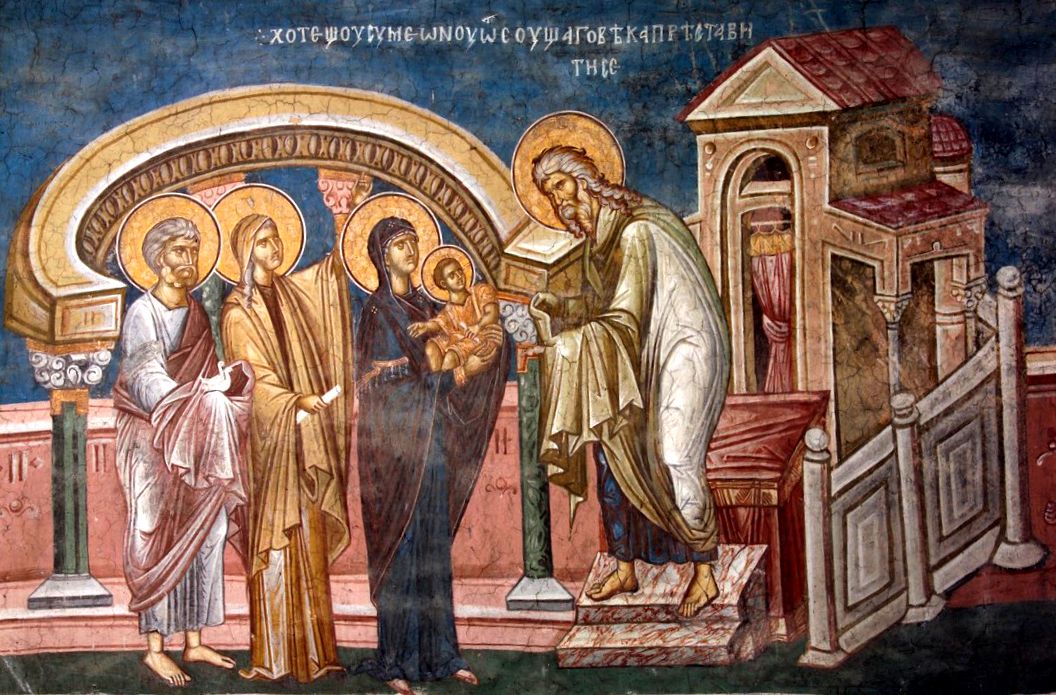
Showing posts with label Reception of the Lord. Show all posts

February 9, 2026

Homily on the Reception of the Lord (Saint Gerasimos Palladas)


In this homily Saint Gerasimos refers to the origin of the feast of the Reception (Hypapante), which goes back to God’s decision to strike all the firstborn male children of the Egyptians, in order that the Hebrews might be freed from the slavery of Pharaoh. From that time on, God required the Jews to bring to the Temple for consecration all firstborn males, of both humans and animals, as an expression of gratitude for that saving intervention of His.

The forty-day period that intervened between the birth of a child and the act of expiation in the Temple was necessary so that the mother and the newborn might be “purified” from the consequences of childbirth. This process would have had no reason to be undergone by the Word of God—nor by His all-pure Mother—yet He did undergo it: “first, so that the Jews might not immediately write that He does not submit to the Law; and second, so that they might not think and say that He is not truly man.”

In the text various symbols are mentioned, such as that of Jesus being offered in place of the lamb—which by tradition was offered on that day—and which in this case was destined to be sacrificed later on behalf of mankind. It is emphasized, of course, that Jesus is the Firstborn of all, the universal Holy One; therefore, in His person every being that comes into life can be “sanctified.” There is also the symbolism of the two turtledoves, which prefigure the Church because of their purity, and that of the two pigeons, which symbolize the Old and the New Testament.

Below is rendered into English the greater part of the homily, in which the author blesses the Spirit-bearing elder Symeon, who was deemed worthy to hold the infant Jesus in his arms.


February 5, 2026

The Reception of the Lord (Archimandrite Joel Yiannakopoulos)


The Reception of the Lord 
(Luke 2:22-38)

By Archimandrite Joel Yiannakopoulos

After the birth of Christ, the Theotokos, as a Jewess, was obliged for two reasons to go to the Temple: first, for her own sake, and second, for the sake of her firstborn Son.

Her obligation toward herself was her lawful purification, her “forty-day purification,” as we would say today. According to the Law, that is, every Jewish woman who had given birth, on the fortieth day after the birth of her male child, had to appear in the Temple in order to be purified. During this purification she was required — if she was poor — “to offer a sacrifice according to what was prescribed: a pair of turtledoves or two young pigeons.” This purification was not a bodily cleansing for reasons of hygiene, but a legal one. By it there was recalled, in general, the sinfulness of humanity, and more specifically the transmission of ancestral sin through birth. This is evident from the fact that if a Jewish woman gave birth to a daughter, she was considered unclean not for forty days but for eighty, in remembrance that Eve was the first cause of the fall of the first-created humans. The sacrifice of the offered turtledoves and pigeons, which did not cleanse but merely reminded one of impurity, indicated the need for the coming of a Redeemer, Christ.

February 3, 2026

Homily for the Reception of the Lord (Fr. Daniel Sysoev)


Homily for the Reception of the Lord 
 
By Fr. Daniel Sysoev

In the name of the Father and the Son and the Holy Spirit!

I congratulate you all on the Feast of the Meeting of the Lord! This is the day when we celebrate the meeting of two Covenants: the Old Covenant, made with the people of Israel, and the New Covenant, made with the Universal Church, now including all nations. We must ponder the words of prophecy proclaimed by the ancient elder Symeon, taking the Creator of the Universe in his arms: "Now let Your servant depart in peace, O Master, according to Your word; for my eyes have seen Your salvation, which You have prepared before the face of all people, a light for revelation to the Gentiles, and the glory of Your people Israel." (By word — according to promise. By revelation — for enlightenment. By Gentiles — the nations.)

This meeting was necessary so that we could understand that the ancient law given to the people of Israel contains something great and important for our day and for the New Testament Church. The entire liturgy of the New Testament Church is woven from the Psalms spoken by the Old Testament patriarch and prophet David. Christianity has a direct relationship to ancient Judaism; indeed, one could put it another way: modern Judaism has absolutely no connection to ancient Judaism, and the direct and sole heir of Old Testament Judaism is the Universal Orthodox Church! Because with it, by the grace of God, the Creator of the Universe, the same covenant was made with ancient Israel. Modern Israel in the flesh has lost this covenant, broken it, rejecting its Messiah, Jesus Christ. The Universal Orthodox Church is the New Israel, having received the blessings that the Lord bestowed upon Old Testament Israel.

Saints Symeon the God-Receiver and Anna the Prophetess in the Hymnography of the Orthodox Church


By Fr. George Dorbarakis

Saint Symeon, whose life was prolonged in this present world because of the oracle he had received from the Holy Spirit — that he would not die before he had seen Christ — received Him in his arms. And after everything that would happen concerning Him was revealed to him by the Holy Spirit and he prophesied these things, according to the oracle that had been given to him he accepted the end of his life. And the prophetess Anna was the daughter of Phanuel, who was from the tribe of Asher. She lived with her husband for seven years, and after she lost him through death, she lived continually in the Temple with fasting and prayer, spending her entire life there. Therefore, because this was her constant way of life, she too was deemed worthy to see the Lord being offered as a man in the Temple, forty days old, by His All-Holy Mother and the righteous Joseph. She glorified God and proclaimed Him with power to all who were in the Temple, saying: "This infant is the Lord who established heaven and earth. This is the Christ, whom all the prophets foretold." Therefore, today we celebrate the memory of these saints, Symeon and Anna, and we proclaim the awesome and ineffable condescension of God toward us.


February 2, 2026

Homily Two for the Reception of the Lord (St. John of Kronstadt)


Homily Two for the Reception of the Lord 

By St. John of Kronstadt

“Now let Your servant depart in peace, O Master, according to Your word; for my eyes have seen Your salvation” (Luke 2:29–30).

With these words the holy elder Symeon cried out at the departure of his life, when he took into his arms the forty-day-old Infant, our Lord Jesus Christ, whom, according to the custom of the Law — still preserved among us — the Most Holy Virgin Mary brought into the Temple. With joy he held in his arms Him who holds all creation; with joy the elder Symeon looked upon his approaching end, because in his own arms he saw Him who assured him of safety and of a blessed life even after death.

But we do not envy you, righteous elder! We ourselves possess your happiness — to receive the divine Jesus not only into our arms, but with our lips and hearts, just as you always bore Him in your heart even before seeing Him, while awaiting Him — and not once in a lifetime, nor ten times, but as often as we wish. Who among you, beloved brethren, does not understand that I am speaking of communion in the life-giving Mysteries of the Body and Blood of Christ? Yes, we possess a greater happiness than Saint Symeon; and the righteous elder, one may say, enclosed the Life-giving Jesus in his embrace as a foreshadowing of how believers in Christ in the times to come, on all days until the end of the age, would take Him up and bear Him — not only in their arms, but in their very hearts. Not only in their arms, I say, because the clergy who celebrate the Divine Liturgy also lift Him up in their hands at every liturgy, and afterward — O immeasurable mercy — enclose Him in the embrace of their hearts! O Jesus, Son of God, abyss of goodness and generosity! How do You not consume us, impure in heart and lips, always unworthy of Your most pure and life-giving Mysteries? And yet — what am I saying? You do indeed consume our unworthiness when we do not bring to You, who sit upon the throne, firm and unshakable faith and contrition of heart; but at the same time You immediately give life, grant rest, and gladden us when we are healed of the sickness of doubt and little faith, for You are the Truth and will not allow even the slightest shadow of doubt to remain in us unpunished.

The Reception of the Lord in the Hymnography of the Orthodox Church

 
By Fr. George Dorbarakis

After forty days had passed since the saving Incarnation of the Lord — His birth without a man from the Holy Ever-Virgin Mary — on this most venerable day, His all-pure Mother and the righteous Joseph brought our Lord Jesus Christ into the Temple, according to the custom of the shadowy and lawful letter of the Mosaic Law. At that time the aged and elderly Symeon also came, he who had received a revelation from the Holy Spirit that he would not die before he had seen Christ the Lord. He received Him into his arms, and after giving thanks and confessing God, he cried out: ‘Now You let Your servant depart, O Master, according to Your word;’ that is, now You may take Your servant, O Lord, in peace. And then, filled with joy, he departed from this life, exchanging earthly things for the heavenly and eternal. 

All the hymnography of this great feast of the Lord and of the Theotokos moves within an atmosphere of awe and mystery: “what appears is earthly, but what is understood is heavenly.” The hymns indeed emphasize the historical reality — the coming of the holy family to the Temple when the forty days from the Lord’s Nativity were completed, and His meeting with the elder Symeon — but they also open the eyes of our soul in the Spirit, so that we may see the “depth” of this reality: the astonished stance of the holy angels, who are unable to comprehend what is taking place on earth, as they behold the Creator of man being carried as an infant, the uncontainable and infinite God being confined within the arms of an old man, the indescribable Son and Word of God, consubstantial with the Father, willingly becoming circumscribed as a human being. And the only explanation they can give for these incomprehensible things is the love of God for mankind.

February: Day 2: Teaching 4: The Reception of the Lord


February: Day 2: Teaching 4:
The Reception of the Lord

 
(On the Motivations for our Precise Fulfillment of God’s Law)

By Archpriest Grigory Dyachenko

I. The Evangelist Luke, describing the Reception of Jesus Christ in the Jerusalem Temple, which is now celebrated (Luke 2:22-39), says that at this event the earthly parents of the Savior did everything as was prescribed in the Old Testament law of God. They went to Jerusalem with the newborn Jesus Christ when, after His birth, the days of their purification according to the law of Moses were completed, that is, forty days (Lev. 12:1-4); they brought this firstborn of theirs to the Jerusalem Temple to present or dedicate Him to the Lord, because in the law of the Lord it was prescribed that every male child who opens the womb, or the firstborn, should be dedicated to the Lord (Ex. 13:2). Then, again according to the law of God, they sacrificed two young pigeons (Lev. 12:8). In short, it was only when they returned from Jerusalem to their city of Nazareth that they had done everything according to the law of the Lord. So respected did they respect the law of God and so strove to fulfill it in everything!

Prologue in Sermons: February 2


The Glory of Our Lord Jesus Christ and His Benefactions to the Human Race

February 2

(Homily of our Holy Father Cyril, Archbishop of Alexandria, on the Reception of our Lord Jesus Christ.)

By Archpriest Victor Guryev

The Holy Apostle and Evangelist John the Theologian says of the Lord Jesus Christ in one place in his Gospel: “We have seen His glory, glory as of the Only-begotten of the Father” (John 1:14); and in another place of the same Gospel the Lord Himself says of Himself that the world was saved through Him (John 3:17). How are we to understand this? What, then, is the glory of Jesus Christ? In what does it consist? And what, finally, do the words mean: the world was saved through Him? Let us speak of this for our edification.

Concerning the glory of the Lord and the salvation of the world by Him, Saint Cyril, Archbishop of Alexandria, says the following:

February 9, 2025

Homily on the Leave-Taking of the Feast of the Reception of Christ (Archimandrite Zacharias Zacharou)


By Archimandrite Zacharias Zacharou

It is a joy for me to be among you again and to concelebrate with you. It is very significant that the celebration of the Divine Liturgy has been appointed today, on the day of the leave-taking of the feast of the Reception of the Lord, which is in reality the feast of the Royal Priesthood of Christ. The “presentation” of the Lord, that is, the sacred work of our salvation, begins in the temple of God.

The last time you invited me to your conference of clergy, we spoke about the double presentation of Christ before God and before men. Christ justified men before God by His true and perfect example. And if we follow it, no, we will never be ashamed, but we will be accepted by the Father and the Spirit as sons of God. Christ also justified God before men, because He loved us to the end, even unto death, and in this way He worked out our salvation. But His appearance also constitutes the beginning of the manifestation of His priesthood, an event of great importance for us who participate in it. There is only one priesthood, the royal priesthood of the Lord, which is the lot of all Christians; however, we, as ordained priests, have a double share.

February 4, 2025

The Miraculous Icon of the Reception of Christ at Koudoumas Monastery in Crete


Next to the katholikon of the Koudoumas Monastery in Crete is a chapel dedicated to the Reception of Christ the Savior, named this due to the miraculous icon of the same name kept there which was shot with bullets, and which in 1940 saved the Monastery from the German invaders. Before this it was known as the Church of the Panagia.

February 3, 2025

On the Reception of the Lord (Timothy the Presbyter of Jerusalem)


On the Prophet Symeon and the Section of the Gospel "Now Let Your Servant Depart In Peace" and on Holy Mary the Theotokos

(Excerpt from Migne P. G. 86, 2004)

By Timothy the Presbyter of Jerusalem*

Since we shall not have enough time to mention the virtues of all the saints, let’s get to know the last of the righteous in this homily of ours. Who was the last of the righteous? The name of Symeon is to be found in the Gospel according to Luke. He’s considered to be the first and the last: the last of the representatives of the Jewish Law and the first of those of the Law of divine grace. He was a Jew as regards religion, but a Christian as regards his gratitude towards God; a lawyer as regards his reading of the Law, but  an angel as regards his understanding of it.

Symeon, who from Pharisaic blasphemy sprouted like a rose from among thorns, is the first person we know about who acquired the favor of God’s grace. Symeon, who had progressed so far in righteousness that he personally received a divine prophecy which stated that he would not leave this transient life before he had embraced with his own human hands eternal life, that is our Lord Jesus Christ. The righteous Symeon, therefore, desired to see the Lord before His incarnation, but he saw Him after and realized who He was.

February: Day 3: Teaching 1: Saint Symeon the God-Receiver and the Prophetess Anna

 
February: Day 3: Teaching 1:
Saint Symeon the God-Receiver and the Prophetess Anna

 
(Why Was Righteous Symeon Not Afraid of Death?)


By Archpriest Grigory Dyachenko

I. Remembering the Reception of our Lord Jesus Christ in the Temple of Jerusalem, the Holy Church also blesses those persons who participated in this Gospel event of the first days of the earthly life of the God-child. When forty days had passed from the birth of the Savior, the Mother of God and Joseph brought the infant Jesus to the Temple of Jerusalem to present Him before the Lord. Here they were met by the Righteous Symeon with the Prophetess Anna who openly announced to everyone about the coming of salvation through the birth of the only-begotten Son of God. According to the testimony of the Gospel, Symeon was a righteous and pious man, awaiting the consolation of Israel, and the Holy Spirit was upon him. This holy elder reverently served God and faithfully fulfilled all duties to his neighbors. For his holy and God-pleasing life he was honored with special favor from God: he was promised by the Holy Spirit that he would not die until he saw the Lord's Christ. How many years Righteous Symeon waited for this joyful promise to be fulfilled, we do not know. But judging by his words, he had to wait a long time for the Consolation of Israel, so that he looked upon death as a joyful end to his difficult and long wandering on earth. Finally, one day, at the inspiration of the Spirit of God, he came to the Temple and received the Infant God together with the most blessed Mary and Righteous Joseph. Then Symeon, taking the Infant Jesus in his arms, glorifying God, exclaimed: "Now let Your servant depart in peace, Master, according to Your word." Present there was also the Prophetess Anna, a widow of about eighty-four years of age, who did not leave the Temple, serving God with fasting and prayer day and night. And she, together with Symeon, praised the Lord and spoke of the appearance of the Savior to all who were awaiting His coming in Jerusalem.

February: Day 2: Teaching 3: The Reception of the Lord

 
February: Day 2: Teaching 3:
The Reception of the Lord

 
(It Is Dangerous To Doubt Matters Of Faith)

By Archpriest Grigory Dyachenko

I. When King Ptolemy, the founder of the famous Alexandrian library, intended to translate the books of the Old Testament from Hebrew into Greek, then 72 wise men were chosen from among the Israelites who thoroughly knew the Hebrew and Greek languages.

Among these 72 wise Israelites was a certain Symeon, a righteous and pious man. Translating the book of the Prophet Isaiah and stopping at his famous prophecy: "Behold, a virgin shall conceive in her womb and bear a son" (Isaiah 7:14), he doubted this and, having thought a little, took a knife and wanted to scrape out this section, as if unworthy of credibility, and replace the word "virgin" with the word "married woman." But suddenly an angel appeared before him and, holding his hand, said: "Believe what is written; you will see with your own eyes the fulfillment of this incomprehensible prophecy." Symeon abandoned his intention, and from that time began to expect the fulfillment of the words of the Prophet Isaiah.

February 2, 2025

Homily on the Reception of the Lord (Archimandrite Kirill Pavlov)

 
Homily on the Reception of the Lord

By Archimandrite Kirill Pavlov

In the name of the Father and the Son and the Holy Spirit!

Dear brothers and sisters, today we celebrate the glorious and joyful feast of the Reception of the Lord. This feast is so called because the Righteous Elder Symeon, who lived in Jerusalem, received the forty-day-old Infant Lord Jesus Christ with His Most Pure Mother in the Jerusalem Temple. This is how this sacred event is described by the Evangelist Luke:

"Now when the days of her purification according to the law of Moses were completed, they brought Him to Jerusalem to present Him to the Lord (as it is written in the law of the Lord, 'Every male who opens the womb shall be called holy to the Lord'), and to offer a sacrifice according to what is said in the law of the Lord, 'A pair of turtledoves or two young pigeons.' And behold, there was a man in Jerusalem whose name was Symeon, and this man was righteous and pious, waiting for the Consolation of Israel, and the Holy Spirit was upon him. And it had been revealed to him by the Holy Spirit that he would not see death before he had seen the Lord’s Christ. So he came by the Spirit into the temple. And when the parents brought in the Child Jesus, to do for Him according to the custom of the law, he took Him up in his arms and blessed God and said: 'Now let Your servant depart in peace, Master, according to Your word, for my eyes have seen Your salvation which You have prepared before the face of all peoples, a light to bring revelation to the Gentiles, and the glory of Your people Israel.' And Joseph and His mother marveled at those things which were spoken of Him. Then Symeon blessed them, and said to Mary His mother, 'Behold, this Child is destined for the fall and rising of many in Israel; and for a sign which shall be gainsaid" (yes, a sword will pierce through your own soul also), that the thoughts of many hearts may be revealed.' Now there was one, Anna, a prophetess, the daughter of Phanuel, of the tribe of Asher. She was of a great age, and had lived with a husband seven years from her virginity; and this woman was a widow of about eighty-four years, who did not depart from the temple, but served God with fastings and prayers night and day. And coming in that instant she gave thanks to the Lord, and spoke of Him to all those who looked for redemption in Jerusalem. So when they had performed all things according to the law of the Lord, they returned to Galilee, to their own city, Nazareth. And the Child grew and became strong in spirit, filled with wisdom; and the grace of God was upon Him" (Luke 2:22–40).

Homily One for the Reception of the Lord (St. John of Kronstadt)


Homily One for the Reception of the Lord

By St. John of Kronstadt

"Now let Your servant depart in peace, Master, according to Your word" (Luke 2:29).

The present feast of the Reception of the Lord is so called because the Righteous Elder Symeon, who lived in Jerusalem, received the forty-day-old Infant, the Lord Jesus Christ, with His most pure Mother in the Jerusalem Temple, took Him in his arms and said: "Now let Your servant depart in peace, Master, according to Your word, for my eyes have seen Your salvation which You have prepared before the face of all peoples, a light to bring revelation to the Gentiles, and the glory of Your people Israel” (Luke 2:29–32). This Elder was wondrous in his holiness, for the Holy Spirit always dwelt in him, in his enlightenment, and in his old age – he was three hundred and sixty years old. It can be said that, beyond the law of nature, the grace of God miraculously preserved him for so long.

February: Day 2: Teaching 2: The Reception of the Lord


February: Day 2: Teaching 2:
The Reception of the Lord

 
(Explanation of the Rite of Churching an Infant)


By Archpriest Grigory Dyachenko

I. What has now happened to our Lord and Savior in the Temple in Jerusalem, something similar, my brethren, was once done to each of us. And we, like Him, were brought into the temple, placed before the Lord, churched, and dedicated to Him for eternal service. All this was done to us at such an age when we, like infants, had no idea of ourselves, and therefore we did not know what was happening to us. But the Holy Church could neither occupy itself, nor occupy us with idle rites; what was done to us had an important meaning. Together with our being brought to the temple and churched, we received many rights and promises; just as at the same time important and sacred duties were imposed on us.

February 1, 2025

February: Day 2: Teaching 1: The Reception of the Lord


February: Day 2: Teaching 1:
The Reception of the Lord

 
(On Decent Behavior in the Temple)

By Archpriest Grigory Dyachenko

I. In the Old Testament Temple of Jerusalem, prayers and sacrifices were performed according to the precise instructions of the ritual law. Therefore, the elder Joseph and Mary the Mother of God, having come there and brought the infant Jesus, on the fortieth day after His birth, did everything there as was prescribed in the law of the Lord.

Instead of the Jewish temple, we have Christian temples; instead of the ritual law of the Old Testament, we have our own ecclesiastical law, liturgical law.

We, children of the Orthodox Church, are obliged to coordinate all our actions in the Church with this ecclesiastical law.

February 2, 2024

The Justinianic Bubonic Plague of 542 and the Establishment of the Feast of the Reception of Christ


By St. Dimitri of Rostov

The celebration of the Reception of the Lord was established in the reign of Justinian,1 but earlier, although the Reception of the Lord was commemorated in the Church,2 it was not solemnly celebrated. The pious Emperor Justinian established that this feast should be celebrated as a feast of the Lord and the Theotokos, along with other great feasts. Special circumstances motivated the establishment of this festival. During the reign of Justinian in Byzantium and its environs, for three months, starting from the last days of October, there was a strong plague, so that at first five thousand people died a day, and then ten thousand; the bodies of even rich and high-ranking people were left without burial, for the servants and slaves all died and there was no one to bury the masters themselves.

February 3, 2023

Fifth Homily for the Day of the Reception of the Lord (Archpriest Rodion Putyatin)

 
 By Archpriest Rodion Putyatin

"So he came by the Spirit into the temple" (Luke 2:27).

The Reception of our Lord Jesus Christ is such a feast in our Church, of which we have only twelve in a year, and therefore it is called a Great Feast. Who receive our Lord Jesus Christ - where, when and how? Righteous Symeon received our Lord Jesus Christ in the temple of Jerusalem, on the fortieth day after His birth, when His parents, according to the law, brought Him there.

Christian Listeners! And each of us will certainly receive the Lord Jesus Christ in this life. If we don’t receive Him, then we won’t find peace in life, we won’t be calm at death, we won’t rest with the saints even after death – for all the ages, for all eternity we will worry, suffer from sins, if we don’t receive Jesus Christ.

February 2, 2023

Homily Two on the Feast of the Reception of the Lord (St. Luke of Simferopol)


 By St. Luke, Archbishop of Simferopol and All Crimea

(Delivered in 1953)

1953 years ago, for the first time, the world heard that prayer of St. Symeon the God-Receiver, which you now hear every day at Vespers: “Now let Your servant depart in peace, Master, according to Your word; for my eyes have seen Your salvation which You have prepared before the face of all peoples, a light to bring revelation to the Gentiles, and the glory of Your people Israel.”

The soul of St. Symeon the God-Receiver departed in peace, after 300 years of life in the world in anticipation of the fulfillment of the prophecy of Isaiah: “Behold, the virgin shall conceive and bear a Son, and shall call His name Emmanuel, which means, 'God is with us.'"