Showing posts with label Saints and Feasts of June. Show all posts

October 3, 2026

The Sacred Relics of Venerable Onouphrios of Koronisia Have Been Found and Translated


A significant event took place at Koronisia in Arta on Thursday, October 1, 2026, with the finding and translation of the sacred relics of Venerable Onouphrios, who practiced asceticism at Koronisia. The event was announced by the Holy Metropolis of Nikopolis and Preveza as a moment of spiritual joy for the local Church and faithful. The relics, recovered from the tomb of the Venerable Onouphrios in his namesake chapel, were prepared by the Metropolitans of Nikopolis and Preveza, Chrysostomos, and of Arta, Kallinikos, placed in a special reliquary, and transferred in procession to the Church of the Nativity of the Theotokos, where they are now kept and offered for veneration.

The tomb of Venerable Onouphrios is located in the small chapel dedicated to him, immediately beside the katholikon of the former Monastery of the Nativity of the Theotokos at Koronisia, which today serves as the parish church of the island. Before the opening of the tomb, a Divine Liturgy was celebrated there. Following the Liturgy, the tomb was opened and the sacred relics were collected. After their preparation by the two Metropolitans, they were placed in a special larnax and carried in procession to the main church.

The life of Venerable Onouphrios is only sparsely documented. The Metropolis of Nikopolis and Preveza states that the time of his birth, his place of origin, and the precise date of his repose are unknown. He was a monk of the once-renowned Monastery of the Nativity of the Theotokos at Koronisia, and his ascetic life eventually established him in the local consciousness as the protector of Koronisia. The Metropolis further notes that popular piety has preserved numerous signs and miracles associated with him, which it intends to publish in due course.

June 8, 2026

Translation of the Relics of the Holy Great Martyr Theodore the Stratelates in the Hymnography of the Orthodox Church


By Fr. George Dorbarakis

1. Saint Theodore lived during the time of Licinius. He was born in Euchaita and was from there by origin, though he lived in Heraclea of Pontus. He was handsome in body, but even more beautiful in soul, adorned with eloquence, knowledge, and every other kind of wisdom; for this reason some called him Vryorhetor (‘the Powerful Orator’). After passing through every kind of torture, the Saint left his blessed body upon the earth, a body which pours forth streams of healings upon all who approach it with faith. His holy spirit, however, dwells in the heavens. It is the translation of this precious and holy body that we celebrate today.

2. As is often the case, the feast of the translation of the relics of the Great Martyr Theodore contains virtually nothing concerning the actual event of the translation itself. The entire Service is devoted instead to the exaltation of the Saint’s holiness and virtues. Here the hymnographer, Saint Theophanes, repeatedly makes use of the Saint’s very name in order to emphasize that he is “one who bears the name of the gifts of God” (Ode I and elsewhere). He also focuses on the martyrdom that Theodore endured.

Prologue in Sermons: June 8

 
The Pious Should Not Despair When They Suffer Without Fault

June 8

(The Martyrdom of the Holy and Glorious Great Martyr Theodore Stratelates)
 
By Archpriest Victor Guryev

During times of severe affliction, many even among the pious lose heart, become faint in spirit, and say: “God has abandoned me; otherwise He would see what I am suffering and would come to help me!”

Is this so? No. The Lord sees everything, knows everything, and will never allow His servants to be tempted beyond what they are able to bear. And if He does permit afflictions to come upon them, sometimes very grievous ones, it is solely in order to grant them a higher reward in heaven as those who have endured to the end.

As proof of this, let us take something from the account of the sufferings of the Holy Great Martyr Theodore Stratelates. When he had been crucified and, besides the terrible agony of being nailed to the cross, endured other dreadful tortures as well, he finally, exhausted in both body and spirit, cried out:

June 3, 2026

Holy Martyr Loukilianos and Those With Him in the Hymnography of the Orthodox Church


By Fr. George Dorbarakis

Saint Loukilianos became known to the broader Church through the renowned and holy Elder of our times, Father Paisios the Athonite. Shortly before 1980, when he moved to the Koutloumousiou Cell of Panagouda, and before he had even unpacked his few belongings and ecclesiastical books from their boxes, he decided to perform the service of the day, June 3, using his prayer rope. When the time came to commemorate the saint whose feast was being celebrated, he became perplexed because he could not remember which saint it was. Then, to his amazement, he saw two men appear in his cell, one younger and the other older. He immediately recognized the younger one: it was Saint Panteleimon. The other, however, he did not recognize. When he asked who he was, the second Saint replied, “I am Saint Loukilianos.” The Elder did not hear clearly and asked again, “What? Saint Loukianos?” “No,” repeated the Saint, who was unknown to him, “Saint Loukilianos.” Then the Saints disappeared.

The Elder was deeply moved that God had responded even to an unspoken thought of his. Yet he wished to verify the vision. He searched through the boxes, found the June Menaion, and saw with great emotion that indeed, on June 3, our Church celebrates Saint Loukilianos. From that time on, the Elder honored this Saint in a special manner and kept an icon of him in the humble chapel of Panagouda.

Prologue in Sermons: June 3


To Those Who Cannot Get Along in One Place and Are Looking for Something New

June 3

(The Teaching of Saint Ephraim on the Impropriety of a Monk Moving from Place to Place)
 
By Archpriest Victor Guryev

There are many, very many people in the world who live by the proverb, “It is better where we are not,” and who continually move from one place to another. In most cases, this is not praiseworthy. What most often compels us to change our place of residence? General dissatisfaction with life, laziness, the pursuit of gain, an inability to get along with others, or, finally, envy of our neighbors. All these are blameworthy motives. Only pressing necessity can justify the desire to change one's place. Therefore, if you wish to leave where you now live, first examine whether your motives are pure and whether necessity truly compels you to do so. Reflect carefully, reflect as a Christian; and if your motives are indeed pure and necessity genuinely requires it, then go. But if not, it is better to remain where you are, for otherwise you will not avoid sin, and you certainly will not receive God's blessing or happiness in a new place.

June 2, 2026

Saint Nikephoros the Confessor of Constantinople in the Hymnography of the Orthodox Church


By Fr. George Dorbarakis

Saint Theophanes, the hymnographer of Saint Nikephoros, with a verse that is at once bold and realistic, reveals to us the spiritual stature of the Saint whose feast is being celebrated:

“As Patriarch you stand next to the Patriarch, the divine elder Abraham O Nikephoros. On the second, Nikephoros found his allotted portion in Eden.” (Verses from the Synaxarion)

And he does not stop there. Not only Abraham, but all the great Patriarchs of the Old Testament, such as Isaac, Jacob, and Moses, honor Saint Nikephoros with odes and hymns, considering that he has been added to their own heavenly choir. 

“The choirs of the Patriarchs honor your holy memory, O Nikephoros, with hymns and songs; for they have received your glorious soul as an addition to their ranks.” (Kathisma at Matins)

Why is this so? We might have expected the Holy Hymnographer to tell us first of all that he was the child of a martyr — his father Theodore was a martyr. And yet, not a single reference is made to the saintly father. The Hymnographer, one might say, is dazzled by the holy life of Saint Nikephoros, and it is upon this that he focuses both his own attention and ours.

Prologue in Sermons: June 2


On the Fear of God and on the Fact that the Lord Receives Our Prayers in Every Place

June 2

(A Homily of Saint John Chrysostom)
 
By Archpriest Victor Guryev

In order that the virtuous life may not seem difficult to us, we must hold fast to the following: we must have the fear of God in our hearts, and we must pray more fervently, not being constrained by any particular place for prayer. This is evident from the following.

Saint Chrysostom says:

“If you have learned to sin, then impose upon yourself the fear of God, and you will overcome the habit of sin. Then it will not be difficult for you to conquer anger within yourself and forgive the one who has grieved you. Then it will not be difficult for you to pray to God and ask His mercy. Then you will speak no evil words against anyone. Then you will not envy your neighbor. Then you will learn to love everyone. Then it will be easy for you to avoid foul speech and slander, and you will not trouble others. Then you will not swear oaths. Then you will be merciful toward people.

June 1, 2026

Prologue in Sermons: June 1


On Not Judging Priests

June 1

(A Homily of Saint John Chrysostom on How One Ought to Honor a Priest)
 
By Archpriest Victor Guryev

In parishes where there are many schismatics among the Orthodox, the schismatics usually do everything possible to separate the Orthodox from the Orthodox Church. To accomplish this, they stir them up against the priests. As soon as they notice the slightest fault in an Orthodox shepherd, they immediately begin proclaiming it everywhere: "Look at the kind of shepherd you have! See what he does and how he lives! How can anyone listen to such a man? How can anyone go to him for confession?" and so on. And simple-minded Orthodox Christians often yield to these evil suggestions against their spiritual fathers, abandon them, flee from the Church, and, becoming schismatics themselves, become slanderers of Christ's priests. Therefore, in order to stop the mouths of these malicious accusers, and to remove you, brethren, from their slanderous suggestions and calumnies against the shepherd, we present to you the following teaching of Saint John Chrysostom concerning how one ought to honor a priest.

July 2, 2025

Dias, the Ionian Island Dedicated to the Panagia Where Orthodox Priests Were Exiled


Steep on all sides and imposing, it has been described by Professor Spyros Marinatos as “the Meteora of the sea”. It was named Dias because in ancient times, on the rocky islet there was an altar of the god Zeus. 

There is a reference in Hesiod about this islet that, at the top of Aenos in Kefallonia, there was a Temple of the God Zeus, where traces and many relics of sacrifices had been found, which were saved until 1813. When the priests on Aenos sacrificed the sacred carcasses on the altar of Zeus, the smoke that rose to the sky gave the "sign" and the ceremony of a second, almost simultaneous sacrifice began on the rocky islet of Dias, which is in line of sight with Megalo Soros (the highest peak of Aenos). When the priests saw the second column of smoke, they understood that the sacrifice to Zeus had been completed. 

The rocky islet of Dias during the British rule was a place of exile for clergy, for spiritual and political reasons. Many priests, on the occasion of the measures imposed by the English, opposed and were accused of seeking popular uprisings against the English authority. In fact, in a specific issue of civil law, which had to do with the chronological system of registry acts, and was the subject of the Church, many priests resisted. The priests of Lixouri resisted very vigorously and were exiled to Dias and Vardiani as punishment.

June 30, 2025

June: Day 30: Synaxis of the Holy Apostles


June: Day 30:
Synaxis of the Holy Apostles

 
(Brief Information About the Holy Apostles and Lessons From Their Lives - 
Imitation of the Holy Apostles in Following Christ)


By Archpriest Grigory Dyachenko

I. On the day of the Synaxis of the Holy, Glorious and All-Praised Apostles, let us talk about the Holy Apostles. Since not everyone knows well enough in whose honor we celebrate, we think we will now offer you a short conversation about the Holy Apostles in general, and we will say: 1) who the Holy Apostles were, 2) how many of them there were, 3) what they did for our holy faith and for believers, 4) how they ended their holy life, and 5) in what we should imitate them.

II. a) Who were the Holy Apostles? The name apostle means "messenger," "servant," and the Holy Apostles were messengers of Jesus Christ, His servants. They were also called Disciples of Christ, because they were closest to Jesus Christ and listened to His holy teaching more than anyone else. Our Savior chose them to serve people when He Himself came out to serve the human race publicly, three years before His death on the cross. In order to reveal His omnipotence to the world, the Savior chose them almost all from poor and humble families; by origin, they were mostly simple fishermen, or publicans (tax collectors) - and some, although they were of more noble birth, later preferred poverty and dishonor to worldly wealth and vain glory. Having been called to the apostleship, they left their relatives, their homes and all their property and followed Jesus Christ inseparably. By order of their Divine Teacher, they preached throughout the cities and villages, willingly sharing with Him all the hardships and sufferings. For being the closest disciples of the Savior, they were repeatedly honored with special conversations with Him about the mysteries of the Kingdom of God, hidden from the people for a time; for being zealous servants of Christ, they were honored by Him with a special grace-filled power, which rested upon them in abundance - they were honored with miracles. And after the ascension of the Lord to heaven, on Pentecost, they received the Holy Spirit Himself in the form of fiery tongues, by the power of which they then performed the work of their service until death. Now they are honored with high honor in heaven, surrounding the throne of God. And at the Dread Judgment of Christ, sitting on twelve thrones, they will judge us and all people together with the saints. These are who the holy apostles were!

June 29, 2025

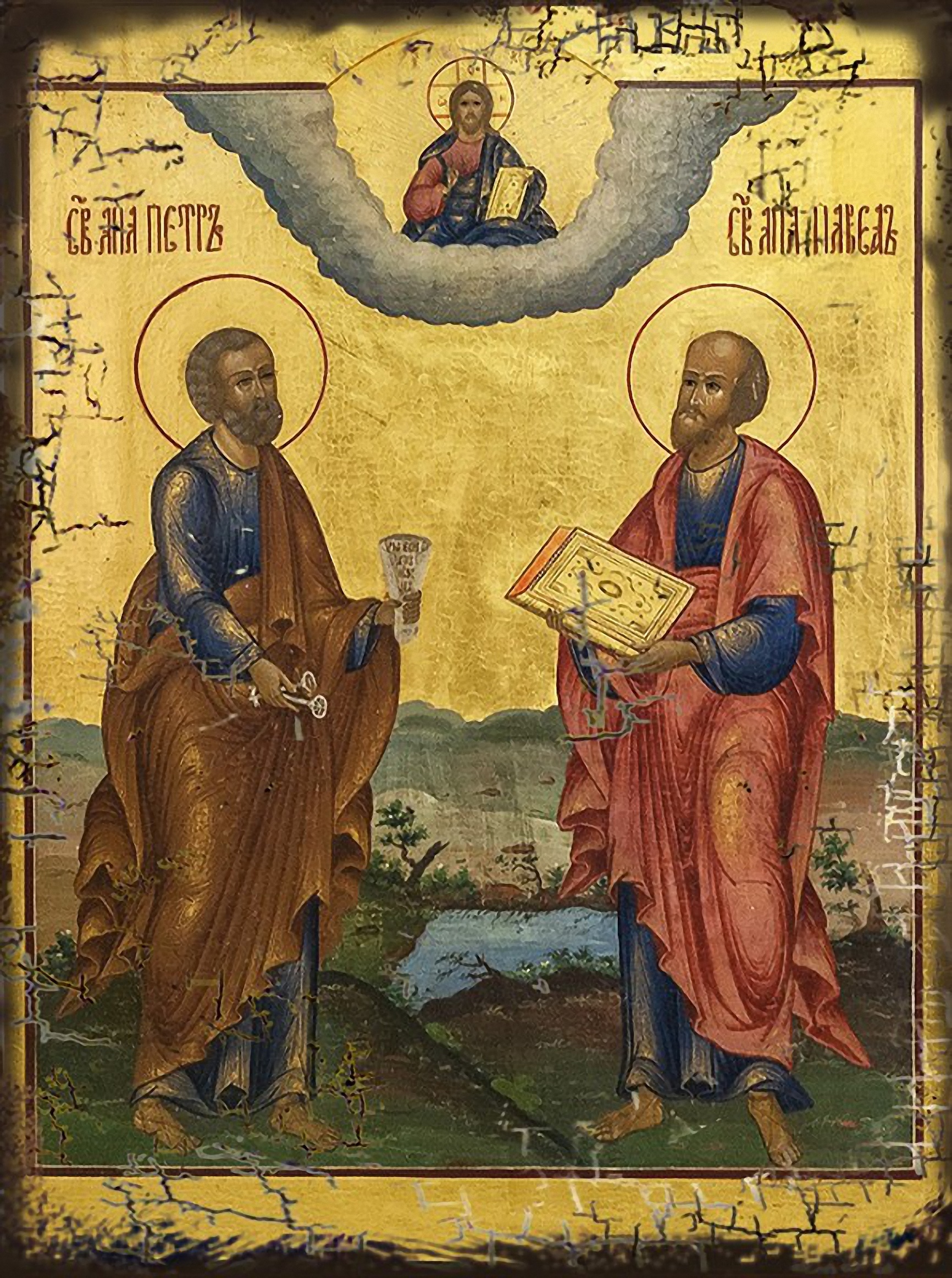
June: Day 29: Teaching 2: Holy Foremost Apostles Peter and Paul


June: Day 29: Teaching 2:
Holy Foremost Apostles Peter and Paul


(The Apostles Teach Us By Their Lives the Truth That Without the Grace of God Man Is Very Weak)

By Archpriest Grigory Dyachenko

I. The Holy Church gives great praise to the Apostles Peter and Paul, who are celebrated today. Their labors for the dissemination and strengthening of our holy faith and the Church are above all our praises. In this regard, it is enough for us to participate with mind and heart in the hymns of the Holy Church, composed in honor of the Holy Apostles. We cannot think of anything better. And why would we think of anything better, when the labors of the evangelism of the Apostles Peter and Paul are in full view of everyone and make everyone who reflects only revere them? However, it's only for those who reflect, as you can’t truly grasp their importance without considering the deeds of the apostles.

June 28, 2025

June: Day 29: Teaching 1: Holy Foremost Apostles Peter and Paul


June: Day 29: Teaching 1:
Holy Foremost Apostles Peter and Paul


(How Should We Endure the Troubles, Misfortunes and Sorrows That Befall Us?)

By Archpriest Grigory Dyachenko

I. Today is a feast in honor of the Holy Foremost Apostles Peter and Paul.

The Apostle Peter (Cephas, Simon) was a fisherman from Bethsaida, brother of the Apostle Andrew, called to the apostleship by Jesus Christ Himself. After the ascension of the Lord, he was the first of the apostles to begin preaching the risen Lord in Jerusalem, suffered much for this from the Jews and even suffered imprisonment, from where he was miraculously saved by an angel. Then he preached the gospel in Samaria, Syria, Pontus, Galatia, Bithynia, Asia and Egypt. He was an apostle primarily to the Jews. He completed his evangelistic feat in Rome, where during Nero's persecution, around the year 67, he was crucified on a cross, upside down, since he did not want to resemble his Divine Teacher in the manner of his suffering.

June: Day 28: Teaching 2: Venerables Sergius and Herman of Valaam


June: Day 28: Teaching 2:
Venerables Sergius and Herman of Valaam


(The Beneficial Influence of Monasticism on the Course of our History)

By Archpriest Grigory Dyachenko

I. Today we celebrate the memory of Venerables Sergius and Herman, the Wonderworkers of Valaam. Venerables Sergius and Herman were the founders of monastic life on the Valaam Island of Lake Ladoga and lived in the first half of the 14th century. Orthodox Christianity began to spread in the vicinity of Lake Ladoga from the beginning of the 13th century, but in 1249 the Swedes, having conquered this region, began to introduce Catholicism by force. The Swedish king Magnus forcibly converted the people in the vicinity of the city of Oreshek (Shlisselburg), and many of those forcibly converted to Catholicism at the first opportunity again deviated to paganism. At this time, Venerables Sergius and Herman, having settled on Valaam, founded a monastery there and supported Orthodoxy both by teaching and by the example of their lives. The brotherhood of monks gathered by the Venerables was quite populous; the monastic rule was distinguished by its strictness. The death of Sergius and Herman occurred around 1353. Their relics rest under a crypt in the monastery katholikon Church of the Transfiguration on Valaam.

June: Day 28: Teaching 1: Translation of the Relics of the Holy Unmercenaries Cyrus and John


June: Day 28: Teaching 1:
Translation of the Relics of the Holy Unmercenaries Cyrus and John


(The Perniciousness of Pride and the Means of Combating It)

By Archpriest Grigory Dyachenko

I. The sick turned to the holy unmercenary physicians Cyrus and John, whose translation of relics is commemorated today, not only during their lifetime, but also after their death. Thus, a certain city governor's son fell ill; local physicians treated him unsuccessfully. The father and son finally turned to the unmercenary physicians Cyrus and John, who appeared to the sick man and ordered him to "abandon his pride" and, as proof of his humility, demanded that he sweep their temple himself. The sick man fulfilled the demand - and was healed. When, after some time, he again forgot the lesson given to him, the illness returned. Now he had to carry water to the sick in order to be healed.

June 27, 2025

Why the Orthodox Church Considers Cyril Loukaris an Orthodox Saint and Not a Calvinist


In 1629, in Geneva, there appeared in Latin, under the name of Cyril Loukaris, who was then the Patriarch of Constantinople, the so-called "Eastern Confession of the Christian Faith," which was then translated and published into English, French and German in 1631, and finally translated into Greek in 1633. This text allegedly by the Patriarch of Constantinople was meant to be a response to Roman Catholics and contained Calvinist doctrines. The Synod of Constantinople in 1638 anathematized both this confession and Patriarch Cyril, but the Synod of Jerusalem in 1672, which dealt specifically with Cyril's case, completely justified him, testifying that the Synod of Constantinople cursed Cyril not because it considered him the author of the Confession, but because Cyril did not write a refutation of this work attributed to him.

June: Day 27: Saint Sampson the Hospitable


June: Day 27:
Saint Sampson the Hospitable

 
(On the Virtue of Hospitality)

By Archpriest Grigory Dyachenko

I. The Venerable Sampson, whose memory is celebrated today, was a Roman by birth, the son of very noble and rich parents, who gave him a good education and from his early years instilled in him love for God and the desire to follow the law of the Lord. Loving his neighbors, as the Lord commands, Sampson learned the art of medicine in order to help the suffering. The Lord blessed his good intentions and gave him the miraculous power to heal any ailment.

After the death of his parents, Sampson inherited a rich estate, which he used for the benefit of his neighbors. He set all his slaves free, gave generous alms, received and fed the poor and the strangers. He loved solitude very much, but, caring above all for the benefit of his neighbors, he settled in Constantinople and built a house where he received the poor, the sick, and the strangers. He himself treated the sick and by the power of God worked many miracles. Out of humility, he tried to hide these manifestations of God's special mercy to him, but his holy life became known, and the Patriarch ordained him a priest.

June 26, 2025

Synaxis of the Lydda Icon of the Mother of God, also known as the Roman


The preaching activity of the Holy Apostles Peter and John the Theologian, before their departure to preach the gospel outside of Palestine, was concentrated mainly in the cities close to Jerusalem. Among other places, they also visited the city of Lydda, later called Diospolis. There they converted many to Christ and erected a temple in the name of the Most Pure Mother of God. 

At that time, the persecution of Christians, after the murder of the Holy Archdeacon Stephen, ceased for a time. Tiberius Caesar, who had heard much about Christ, even forbade the persecution of Christians, which is mentioned in the Book of Acts: “Now the churches throughout all Judea and Galilee and Samaria had peace" (Acts 9:31).

Having established a community of new Christians in Lydda, the apostles returned to Jerusalem and begged the Virgin Mary to come to Lydda, see the temple and bless it. The Virgin Mary answered them:

"Go with joy: I will be there with you."

June 25, 2025

June: Day 25: Teaching 1: Holy Martyr Febronia of Nisibis

 
June: Day 25: Teaching 1:
Holy Martyr Febronia of Nisibis


(Do Parents Have the Right to Force Minor Children to the Service of God?)

By Archpriest Grigory Dyachenko

I. Saint Febronia, who is remembered by the Church today, was given to a community of ascetics in the third year of her life, which was in Mesopotamia and founded by the deaconess Platonida. Mesopotamia at that time was one of the regions of the vast Roman Empire. When Febronia reached the age that allowed abstinence, she began to eat every other day on the advice of her aunt, the pious Bryene, who was then the abbess of the monastery. Since Febronia's health did not suffer at all from fasting, she soon increased her abstinence and ate the smallest amount of bread and water. To this she added the strictest life, slept on a narrow and short board, often got up at night and read the Holy Scriptures or prayed. 

Meanwhile, a persecution of Christians arose in the Roman Empire, and to persecute them, the Emperor Diocletian sent his dignitaries Lysimachos and Selenos to Mesopotamia. Selenos was a cruel man and in his hatred of Christians he was not inferior to the Emperor himself. Lysimachos, who was only twenty years old at the time, was kind and gentle and had heard many good things about Christians from his mother in his childhood, who, being a Christian herself, had bequeathed to her son before her death to protect Christians. Having sent Lysimachos to Mesopotamia, Diocletian did not particularly trust him, suspecting his inclination towards Christianity, and therefore gave him Selenos as his leader. The inhabitants soon heard with horror about the cruel actions of Selenos in Mesopotamia and Syria, how he exterminated Christians with the sword and gave them over to be torn apart by wild beasts. Many of the Christians, among them presbyters, hermits and the bishop himself, fled when Selenos approached. 

June 24, 2025

June: Day 24: Teaching 1: The Nativity of Saint John the Baptist


June: Day 24: Teaching 1:
The Nativity of Saint John the Baptist


(Good and Pious Children Are the Fruit of the Fervent Prayers of Their Parents)

By Archpriest Grigory Dyachenko

I. The nativity of the great Forerunner of the Lord is very remarkable for the fact that his birth itself was unusual and miraculous, that it was the fruit of the fervent, lifelong prayers of his parents, the reward of their faith and hope, their righteousness and piety, their patience and devotion to the will of God.

The holy parents of the Forerunner of the Lord were righteous and pious. Yet, these great righteous figures faced a temptation that was more unfortunate than any affliction recorded in the Old Testament Church. "They had no children" from the beginning of their married life until old age, which at that time was considered a clear indication of God's disfavor and seemingly an act of rejection by God. One can imagine, dear brethren, how fervent were the prayers of these pious spouses, who, despite their diligence in following God's law and their earnest efforts to "walk in all the commandments and ordinances of the Lord blamelessly," found themselves deprived of God's blessing; so, all these prayers seemingly went unheard. But in heaven, all their prayers were heard, all their sighs and tears were counted; there was prepared for them such a reward that abundantly fulfilled their long-standing deprivation. To them, in their old age, when they themselves had ceased to hope, they were granted such a son, "one greater than He has not risen among those born of women," whose birth was a cause of universal joy, whose life was a wonder to the holy angels, an object of reverence to the entire people of Israel, who was sent by God to prepare the way for the coming Redeemer of the world. A righteous reward for long-standing, lifelong patience and hope!

June 22, 2025

June: Day 22: Holy Hieromartyr Eusebius of Samosata

 
June: Day 22:
Holy Hieromartyr Eusebius of Samosata

 
(On Obedience To Civil Authority)

By Archpriest Grigory Dyachenko

I. Saint Eusebius, whose memory is celebrated today, lived in the 4th century and was bishop in the city of Samosata (on the Euphrates River) in the Antiochian metropolis. He waged a long and tireless struggle against heretics and suffered much under Constantius, who patronized the Arians. Under Emperor Julian, Eusebius, hiding his bishopric, went around various regions to confirm Christians in the faith and support them. At this time, he also restored several churches and ordained many priests and deacons.

Upon the ascension of Jovian, Eusebius and other holy figures were restored to their thrones. The pious emperor respected them, while the heretics feared them. However, the Church did not enjoy peace for long, as Jovian soon passed away; after him, Valens ascended to the throne and once again instigated persecution against the Orthodox faith, exiling shepherds into banishment. Eusebius was imprisoned in Thrace, and in his stead an Arian was appointed. Eusebius learned of his exile while in Samosata; preparing to leave the city, he asked the messenger to keep this matter confidential, so that the people would not harm the messenger bringing news of their separation from the bishop. Under the cover of night, he left the episcopal residence, but upon crossing the Euphrates, he was halted by the townsfolk who had learned of his departure, and they wept, beseeching him to return. Eusebius persuaded them not to resist royal authority and to return to their homes, and, having blessed everyone, continued his journey to Thrace, from where he returned during the time of Gratian, who summoned the exiled bishops back to their flocks. However, he soon died from a wound inflicted upon him by an Arian woman who had thrown a vessel from the roof, which struck the bishop on the head... As he was dying, he bequeathed that the woman should not be punished.