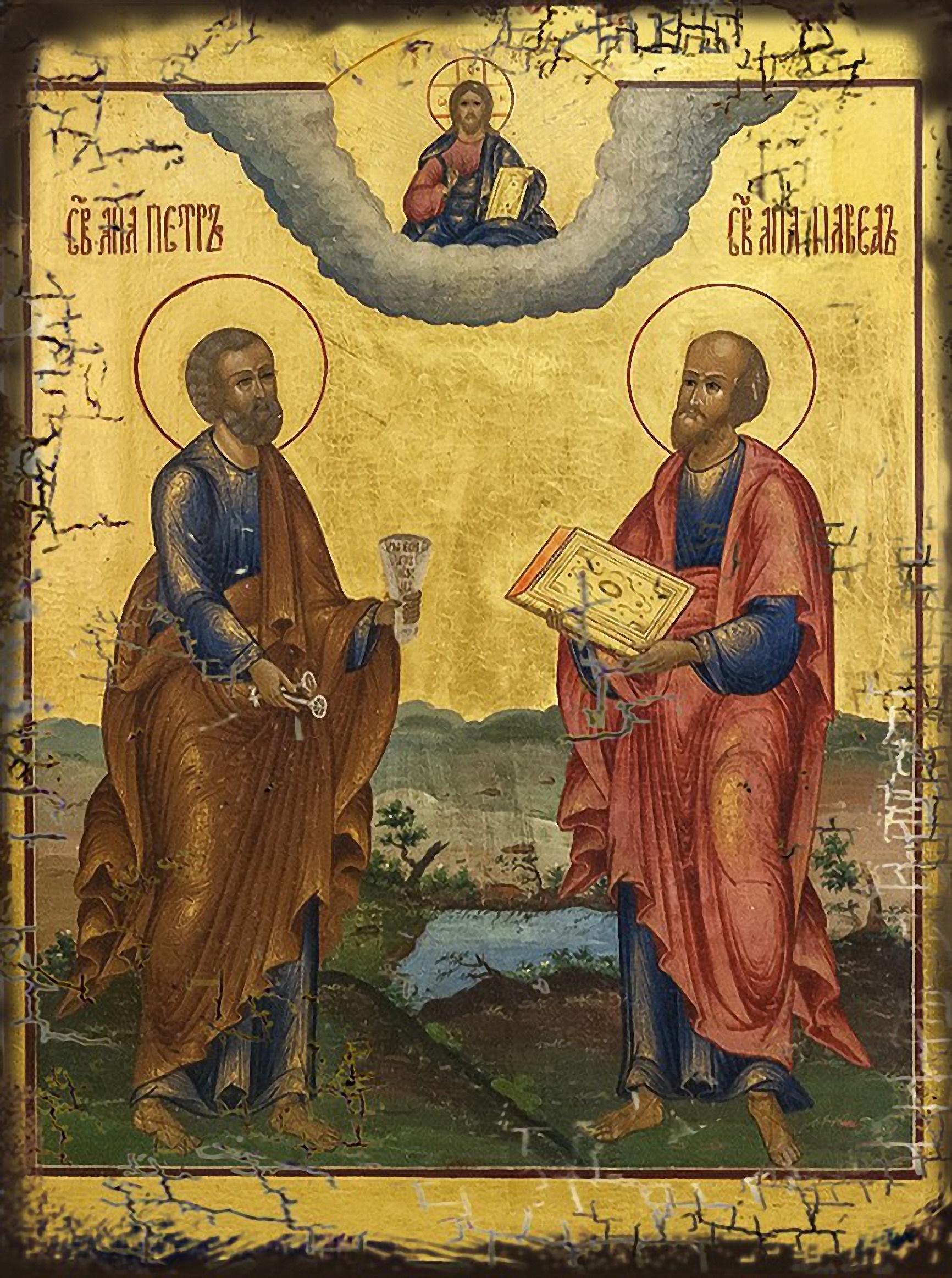
Showing posts with label Apostle Peter. Show all posts

April 25, 2026

The Authorship of the Gospel of Mark According to Early Christian Sources

 
The earliest references to the authorship of the Gospel of Mark come from late 1st–2nd century Christian writers. They consistently associate the Gospel with Mark, understood as a companion and interpreter of the apostle Peter. Here are the key sources in roughly chronological order:

1. Papias of Hierapolis (c. 100–130 AD)

Papias is the earliest known source to explicitly discuss Mark’s authorship. His work is preserved later by Eusebius of Caesarea.

“Mark, having become the interpreter of Peter, wrote down accurately whatever he remembered… though not in order, the things said or done by the Lord.”

Key points:

- Mark is Peter’s interpreter (ἑρμηνευτής).
- He wrote from Peter’s preaching.
- The Gospel is accurate but not arranged in strict order.

January 16, 2026

The Veneration of the Honorable Chain of the Holy Apostle Peter in the Hymnography of the Orthodox Church


By Fr. George Dorbarakis

On this day we celebrate the Veneration of the Honorable Chain of Saint Peter, which the tetrarch Herod put upon him when he imprisoned him, as the Apostle Luke relates in the Acts of the Apostles. This Chain, which was loosed by the appearance of an Angel, was found by some of the faithful and preserved in succession. It was later transferred by the pious to Constantinople and placed in the temple of Saint Peter within the Great Church.

On the occasion of the Honorable Chain of the Apostle Peter, the hymnography of the Church today sets forth two things: first, the very existence of the chain itself and the interpretation of its veneration; and second, the honor shown by the Church to the sacred person of the Apostle Peter. And this is natural: this Chain of the Apostle is understood in the same way as icons in the Church — as means of reference to the saints. “The honor passes to the prototype.” The same is true of the Chain: through it we are led to him who was the first among the Apostles, “he who, being wholly united to the most pure light, Christ, through divine participation in Him, appeared as a second light, illuminating also our souls.”

January: Day 16: Teaching 2: Veneration of the Honorable Chains of the Holy and All-Praiseworthy Apostle Peter


January: Day 16: Teaching 2:
Veneration of the Honorable Chains of the Holy and All-Praiseworthy Apostle Peter

 
(On the Suffering of the Righteous)

By Archpriest Grigory Dyachenko

I. Today’s feast reminds us of how the Holy Foremost Apostle suffered in chains — that is, in bonds, in prison confinement — suffering for the holy faith.

II. Why, one may ask, must those suffer who so greatly loved their Lord, and to whom, beyond doubt, the Lord was close with His mercies? “Why is the path of those who please the Lord strewn with various afflictions?”

Can light and darkness live in friendship? No! The morning light drives away the darkness of night; the gloom of approaching night drives away the light of day. In the same way, the world hates the righteous, because their deeds, their character, their aspirations are opposed to it, like light and darkness. For the world, the very life of a righteous person is a reproach. Even if the righteous person, by a vow of humility, says not a word to the world about its dark deeds; even if, by a vow of love, he does everything to preserve peace with all — still it cannot be that the world will remain forever pleased with the righteous. “The world has hated them, because they are not of the world” (John 17:14), says heavenly Truth about His beloved disciples. The world hates God’s disciples precisely because they in no way belong — or do not wish to belong — to the world. Thus, sufferings are inevitable for the righteous in the world, as long as this sinful world exists. “All who desire to live godly in Christ Jesus will be persecuted” (2 Tim. 3:12).

June 30, 2025

Encomium to the Holy Apostles Peter and Paul (St. Ephraim the Syrian)


Encomium to the Holy Apostles Peter and Paul 

By St. Ephraim the Syrian

Rejoice, Holy Apostles, kings of Christ; for to you He has entrusted the heavenly and earthly kingdom. He has given you the power to rule and to care for both thrones, wanting on the one hand that the inheritance of the earthly kingdom may be restored, on the other hand that glory may shine, beauty may abound, light may be revealed, mysteries may be known, the power of the heavenly kingdom may be proclaimed.

Rejoice, you who are the salt of the earth, which can never lose its power. Rejoice, you who are the light of the world (Matt. 5:13-14), who dwell in the east and shine everywhere, who enlighten those who are in darkness, who burn without wood. The lamp is Christ, and the lampstand is Peter, and the oil is the gift of the Holy Spirit.

Rejoice, you who are the light of the world, to which all night gives way; whom the cloud does not overshadow, the storm does not fight against, nor does the thunder approach, but rather the darkness within us is illuminated by it, the hidden things are revealed, the obscure are clarified, the thoughts are purified.

June 29, 2025

Homily Three on the Day of the Foremost Apostles Peter and Paul (St. John of Kronstadt)


Homily Three on the Day of the Foremost Apostles Peter and Paul 

By St. John of Kronstadt

"I will give you (Peter and in his person all the apostles) the keys of the Kingdom of Heaven, and whatever you bind on earth will be bound in heaven, and whatever you loose on earth will be loosed in heaven" (Matt. 16:19).


The Heavenly Kingdom, for which we are destined from the beginning of the world, was closed from the time of Adam's transgression due to his sins and the sins of his descendants. It was reopened anew through the cross and death of the Son of God, Who, by virtue of His divine-human merits, received from God the Father the authority to open and close it: to open for the penitent, and to close for the unrepentant. The Lord bestowed His authority upon the Apostles, and after them upon the Archbishops and Priests. For the first time, He promised to grant it to all the Apostles in the person of the Apostle Peter, when he confessed Him as the Son of God on behalf of them all. He said to him: "You are Peter, and on this rock I will build My Church, and the gates of hades shall not prevail against it. And I will give you the keys of the Kingdom of Heaven," etc. (Matthew 16:18). He did not say: I give, but – "I will give;" because at that time the sacrificial offering for the sins of the world had not yet been made, and the time to grant this authority had not yet arrived: it was given after the resurrection of the Lord from the dead, when He appeared to the Apostles, breathed on them, and said: "Receive the Holy Spirit: whosoever sins you forgive, they are forgiven them, and whosoever sins you retain, they are retained" (John 20:23). Hence, brethren, you see how holy, important, venerable, and necessary the office of the Apostles, and their successors, the Archbishops and Priests, is within the Church of Christ: they are the servants of Christ and the builders of God's Mysteries; they continue the work of Christ; they open and close heaven for people; without them there is no authority to bind and loose human sins – there is no salvation. God the Father has given all authority to Jesus Christ, and Jesus Christ has given it to the Apostles and Priests. From this perspective, dear brethren, it is evident that the keys to the Kingdom of Heaven are perpetually available to those who earnestly seek to gain entry: these keys are entrusted to every priest, and one need only to sincerely repent of their sins before him, subsequently engaging in actions that demonstrate true repentance. How can those who choose not to seize this opportunity escape accountability – to enter the Kingdom of Heaven while disregarding the necessity of repentance and amendment, or feeling ashamed to confess to a priest, or dismissing confession as a mere human construct – and ultimately suffer the consequences solely due to their own negligence and inaction.

June: Day 29: Teaching 2: Holy Foremost Apostles Peter and Paul


June: Day 29: Teaching 2:
Holy Foremost Apostles Peter and Paul


(The Apostles Teach Us By Their Lives the Truth That Without the Grace of God Man Is Very Weak)

By Archpriest Grigory Dyachenko

I. The Holy Church gives great praise to the Apostles Peter and Paul, who are celebrated today. Their labors for the dissemination and strengthening of our holy faith and the Church are above all our praises. In this regard, it is enough for us to participate with mind and heart in the hymns of the Holy Church, composed in honor of the Holy Apostles. We cannot think of anything better. And why would we think of anything better, when the labors of the evangelism of the Apostles Peter and Paul are in full view of everyone and make everyone who reflects only revere them? However, it's only for those who reflect, as you can’t truly grasp their importance without considering the deeds of the apostles.

June 28, 2025

June: Day 29: Teaching 1: Holy Foremost Apostles Peter and Paul


June: Day 29: Teaching 1:
Holy Foremost Apostles Peter and Paul


(How Should We Endure the Troubles, Misfortunes and Sorrows That Befall Us?)

By Archpriest Grigory Dyachenko

I. Today is a feast in honor of the Holy Foremost Apostles Peter and Paul.

The Apostle Peter (Cephas, Simon) was a fisherman from Bethsaida, brother of the Apostle Andrew, called to the apostleship by Jesus Christ Himself. After the ascension of the Lord, he was the first of the apostles to begin preaching the risen Lord in Jerusalem, suffered much for this from the Jews and even suffered imprisonment, from where he was miraculously saved by an angel. Then he preached the gospel in Samaria, Syria, Pontus, Galatia, Bithynia, Asia and Egypt. He was an apostle primarily to the Jews. He completed his evangelistic feat in Rome, where during Nero's persecution, around the year 67, he was crucified on a cross, upside down, since he did not want to resemble his Divine Teacher in the manner of his suffering.

April 17, 2025

Why Did Peter Deny Christ? (Saint Joseph the Hesychast)


Question: Elder, you spoke to us earlier about the imperfection of the Apostle Peter, before Pentecost. Did he deny our Lord because of his imperfection?

Answer: The issue of Peter’s denial, according to the judgments of the Fathers, is an economy. For it was not possible for Peter, who throughout the entire period that he was with Christ and showed so much zeal and so much humility, to fall into such a great error, to deny the Lord Christ three times. This is not logical. Remember Peter’s confession! When our Jesus asked: “Who do you say that I am?” Peter confessed and said: “You are the Christ, the Son of the living God.” And Jesus turned and said to him: “Blessed are you, Simon Bar-Jonah, for flesh and blood has not revealed this to you, but My Father who is in heaven. And I say to you that you are Peter, and on this rock I will build My Church” (Matthew 16:16-18).

January 16, 2025

January: Day 16: Teaching 1: Veneration of the Honorable Chains of the Holy and All-Praiseworthy Apostle Peter


January: Day 16: Teaching 1:
Veneration of the Honorable Chains of the Holy and All-Praiseworthy Apostle Peter

 
(It Is Worthy and Righteous to Venerate the Chains of the Holy Apostle Peter)

By Archpriest Grigory Dyachenko

I. On the 16th day of January, the Holy Church celebrates a spiritual celebration in memory of one event from the life of the great Apostle Peter.

The event commemorated by the Holy Church took place in the first century of the Christian Church, when the Holy Apostles and all Christians were imprisoned and executed. It was not easy for the confessors of the Christian faith to live then. This is how the Apostle Luke narrates this in the Book of the Acts of the Holy Apostles:

"Peter [who was imprisoned by order of King Herod, to be executed after the feast of the Passover] was therefore kept in prison, but constant prayer was offered to God for him by the Church. And when Herod was about to bring him out [to execute him], that night Peter was sleeping, bound with two chains between two soldiers; and the guards before the door were keeping the prison. Now behold, an angel of the Lord stood by him, and a light shone in the prison; and he struck Peter on the side and raised him up, saying, 'Arise quickly!' And his chains fell off his hands. Then the angel said to him, 'Gird yourself and tie on your sandals;' and so he did. And he said to him, 'Put on your garment and follow me.' So he went out and followed him, and did not know that what was done by the angel was real, but thought he was seeing a vision. When they were past the first and the second guard posts, they came to the iron gate that leads to the city, which opened to them of its own accord; and they went out and went down one street, and immediately the angel departed from him. And when Peter had come to himself, he said, 'Now I know for certain that the Lord has sent His angel, and has delivered me from the hand of Herod and from all the expectation of the Jewish people'” (Acts 12:5-11).

October 25, 2024

"Saint Peter Raises Tabitha in Joppa" (one of the last works of Photios Kontoglou)

 
"Saint Peter Raises Tabitha in Joppa", ink on paper 1965 
(one of the last works of Photios Kontoglou)

June 29, 2024

Homily Two on the Day of the Foremost Apostles Peter and Paul (St. John of Kronstadt)


By St. John of Kronstadt

We, brethren, have waited for the feast of Holy and Glorious and All-Praised and Foremost Apostles Peter and Paul. They are worthily blessed by the whole universe. Worthy, because for Jesus Christ our Lord and for the salvation of human souls they denied themselves and laid down their lives, rejected all the beauties and sweets of the world; with their teaching they enlightened the whole world, darkened by idolatry and various passions, and brought many souls to Christ, that is, they delivered them from eternal destruction and brought them into the Kingdom of Heaven. And all of us Christians of the whole world, present and past, owe to them the gospel and the salvific rules of Christian life. That is why we worthily bless them. The death of both Apostles was martyrdom. The Apostle Peter was crucified on the cross upside down, and Apostle Paul was beheaded by the sword.

What was the reason for such glorious exploits of the Apostles, for which they are worthily blessed by the whole world? Their living faith and love for Christ, a faith in which they considered everything earthly to be rubbish and dung and infinitely valued everything heavenly, infinitely highly valued every word of the Lord Jesus Christ, held every word of Him tightly in their hearts, tried to fulfill every commandment of His with all their strength; they infinitely valued every human soul and tried with all their might to save every human soul from sin and eternal destruction; for in their memory and in their heart they constantly held the words of the Savior: "For the Son of man came to seek and save the lost" (Matthew 18:11). Their love for Christ – in which they loved all people as Christ loved and loves them – for whom they were ready to go both to prison and to death, inspired them to sacrifice everything in the world for the salvation of human souls; to renounce the enjoyment of all the blessings of the world, to be subjected to all kinds of sorrows, dangers, and death. This was the reason for the glorious exploits of the Holy Apostles, and especially of Peter and Paul! Let us learn from them such faith and love for Christ.

Homily on the Commemoration of the Holy Foremost Apostles Peter and Paul (Archimandrite Kirill Pavlov)


 By Archimandrite Kirill Pavlov

(Delivered in 1962)

In the name of the Father and the Son and the Holy Spirit!

"Their messages has gone out through all the earth, and their words to the ends of the world" (Ps. 18:5) - this is how the king and prophet David sings, prophetically praising the holy Apostles, who were destined to work on spreading the gospel ny preaching throughout the universe.

Beloved brothers and sisters, today the Church of Christ has put on festive clothes, spiritually glorifying the two great apostles - Peter and Paul. All the Apostles worked on the structure of the Church of Christ, but the now honored holy apostles Peter and Paul worked more than anyone else and for their fiery zeal and ardent love for the Lord Jesus Christ and their neighbors were called the foremost, as worthy of all praise. The entire Church of Christ is grateful to them for the labors, illnesses, sorrows, persecutions, disasters that they endured, spreading the faith of Christ and turning people from the darkness of paganism to the light of Christ’s teaching.

Homily Three for the Holy Apostles Peter and Paul (Archimandrite George Kapsanis)


 The Tradition of the Holy Apostles Peter and Paul

By Archimandrite George Kapsanis

The great Apostle of the Gentiles, the apostle Paul, when he came here to our blessed homeland - three times he passed through here, and here in Macedonia, he walked and sanctified it - what did he preach? He preached Christ. What did he preach to the Thessalonians? Christ. What did he preach in Beroea? The God-man Christ. What did he preach to the Corinthians? Christ. What did he preach in our country, bit by bit? Christ, the God-man.
 
From the apostle Paul and from the apostle Peter we also received the faith of the God-man Christ. And this is the faith of the Church, this is the foundation of the Church, this is the tradition of the Church which the Church received, lives and delivers: the God-man Christ.

May 27, 2024

Homily Two for the Sunday of the Paralytic (St. John of Kronstadt)


By St. John of Kronstadt

Listen, my brethren, to the sermon for today’s reading from the Acts of the Apostles. This reading speaks of the healing by the Apostle Peter in the name of Jesus Christ of the paralytic Aeneas, a certain man in the city of Lydda, and of the resurrection from the dead by the same Apostle Peter in the city of Joppa (Jaffa) of one virtuous Christian woman named Tabitha, through prayer and the command to stand up (Acts 9:32–42). What is noteworthy about this reading? – The strong faith of the Apostle Peter in Christ the Savior and the divine, life-giving power of Christ are worthy of note.

Peter sees before him a paralytic man who has not moved for eight years, and immediately heals him in the name of Jesus Christ. "Aeneas!" he says to the sick man, "Jesus Christ heals you; get up from your bed." And he immediately stood up. The word was followed by deed. What a power of faith in Christ God! What power is in the name of Christ! It instantly revived dead limbs and gave them the strength of youth! But what a close union of Peter with Christ! What Peter wants, the Lord also wants! What Peter commands, the Lord also deigns, and the Lord immediately fulfills it. This is how closely Peter, who denied Christ, was united with Christ through repentance and faith! This is what unshakable faith he had in Him! What fiery love! Glory to the mercy of Christ, which accepts repentant sinners! Glory to the divine power of Christ, working miraculously in those who believe in Him!

July 4, 2023

Homily Five on the Holy Foremost Apostles Peter and Paul (St. Luke of Simferopol)


By St. Luke, Archbishop of Simferopol and All Crimea

(Delivered in 1958)

Who gave the Apostles Peter and Paul the name of  "foremost", who exalted them with this name above all other apostles? Is it not the Church of Christ, which has the power to rank the righteous as saints, to give them the names of great venerables and hierarchs, great martyrs, and even great ecumenical teachers and hierarchs?

No, I say, not from the Holy Church, but from Jesus Christ Himself, they received the name of the foremost and exalted above all other apostles. They received their great name from the Son of God, the Omniscient one Who knows all the hearts of men. Listen to the amazing Gospel story about the conversation of Jesus Christ with His apostles: “[Jesus] asked His disciples, saying, 'Who do men say that I, the Son of Man, am?' So they said, 'Some say John the Baptist, some Elijah, and others Jeremiah or one of the prophets.' He said to them, 'But who do you say that I am?' Simon Peter answered and said, 'You are the Christ, the Son of the living God.' Jesus answered and said to him, 'Blessed are you, Simon Bar-Jonah, for flesh and blood has not revealed this to you, but My Father who is in heaven. And I also say to you that you are Peter, and on this rock I will build My church, and the gates of Hades shall not prevail against it. And I will give you the keys of the kingdom of heaven, and whatever you bind on earth will be bound in heaven, and whatever you loose on earth will be loosed in heaven'" (Matthew 16:13-19).

Homily Four on the Holy Foremost Apostles Peter and Paul (St. Luke of Simferopol)


 By St. Luke, Archbishop of Simferopol and All Crimea

(Delivered in 1957)

Great and extremely difficult is the task of preaching the gospel of Christ, for one must preach not only by word, but by one's whole life, by all one's being, by all one's deeds, by fulfilling all the commandments of God, even the smallest part, for thus said our Lord Jesus Christ: "Whoever breaks one of the least of these commandments and teaches people to do so, he will be called the least in the Kingdom of Heaven; but whoever does and teaches, he will be called great in the Kingdom of Heaven” (Matthew 5:19).

Not only with their great epistles, both universal and to individual churches, but with their whole lives, the holy foremost Apostles Peter and Paul preached to the world the great truth of Christ, and they showed us the most vivid example of faith in the Lord Jesus Christ and love for Him.

July 1, 2023

Homily Three on the Holy Foremost Apostles Peter and Paul (St. Luke of Simferopol)


By St. Luke, Archbishop of Simferopol and All crimea

(Delivered on June 29/July 12, 1953)

The greatness and holiness of the foremost apostles Peter and Paul is enormous.

It would seem that on the day of their holy memory it is necessary to talk about all their greatest and most holy deeds.

I have done this many times in past years, but today, to your surprise, I intend to speak about the sins of the holy apostles.

Why about sins? How dare I speak of their sins? Therefore, I dare say that their greatness was also expressed in relation to their sins; because their sins are most instructive for us, and we should imitate them in the way they treated their sins.

The Holy Apostle Paul, as he speaks of himself, was a cruel persecutor of the Church of Christ, he was deeply convinced that the truth was only in the teaching taught by Moses; he was convinced that the Lord Jesus Christ was destroying this teaching, and therefore it was necessary to pursue, persecute all those who believed in Him.

Homily One on the Holy Foremost Apostles Peter and Paul (St. Luke of Simferopol)


 By St. Luke, Archbishop of Simferopol and All Crimea

(Delivered on June 29/July 12, 1949)

The Holy Foremost Apostle Paul was called to his great ministry in a miraculous way. When he approached Damascus with the evil intention of seizing, imprisoning, and torturing all those who believed in Christ, a light from heaven suddenly shone on him. He fell to the ground and heard a voice saying to him, "Saul, Saul, why are you persecuting me?" He said, "Who are you, Lord?" The Lord said, “I am Jesus, whom you are persecuting. It is hard for you to kick against the goads." He said in trembling and horror: “Lord! What will you tell me to do?" And the Lord said to him, “Get up and go into the city; and you will be told what you must do” (Acts 9:3–6).

How amazingly by the power of God, by the appearance of the Lord Jesus Christ Himself, this cruel persecutor of Christians was converted to faith in Him and became the most ardent of all the apostles! Why did he receive such a miracle? After all, the Lord called other apostles simply, passing along the shore of Lake Gennesaret, where fishermen, poor Galileans, illiterate, who did not have any learning, dried their nets. Christ stopped when he saw Peter and Andrew and said to them: "Follow me, and I will make you fishers of men" (Matt. 4:19; Mark 1:17).