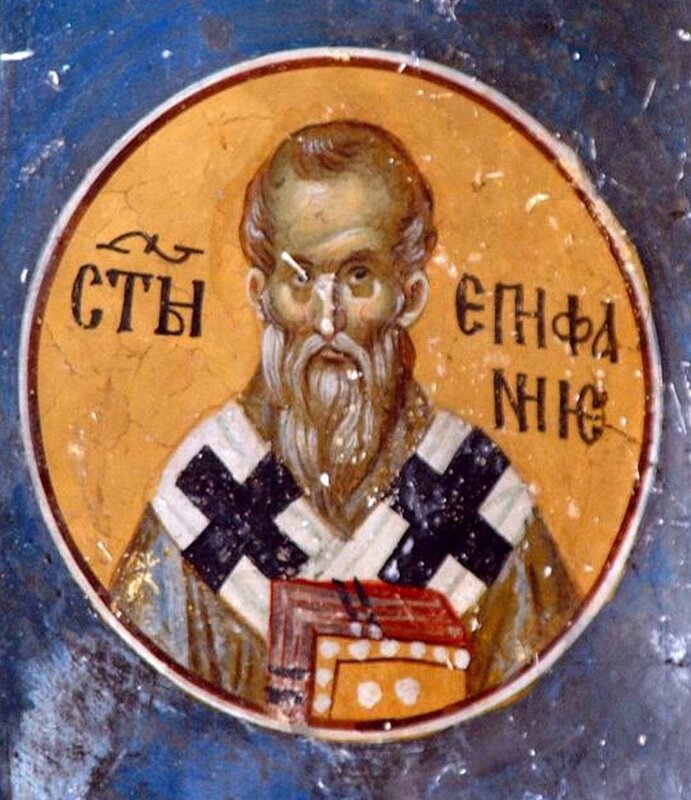
Showing posts with label St. Epiphanios. Show all posts

May 12, 2026

Saint Epiphanios as a Bishop in Cyprus


By Dr. Georgios Kakkouras, 
Doctor of Theology, Secondary Education Teacher of Religious Studies

“Epiphanios the Great, the renowned Archbishop of Salamis or Constantia, is rightly considered one of the most illustrious adornments of the Church of Cyprus” (History of the Orthodox Church of Cyprus, Hackett–Papaioannou).

Nevertheless, he was not Cypriot by origin. He was born in Eleutheroupolis of Palestine to parents who were Christians(?) of Hebrew or Greek descent. He devoted himself with unusual zeal to learning and acquired a rich theological and literary education. He knew five languages — Greek, Hebrew, Latin, Syriac, and Coptic — something astonishing for that period, when no special methods for teaching languages existed.

His life was written by three biographers, two of whom are identified as his disciples, and for this reason there are many sources concerning his life and work. At a young age he entered the monastic life and became a disciple of the great ascetic Saint Hilarion. Thus the ascetic monastic element characterized his entire later life.

Saint Epiphanios of Cyprus in the Hymnography of the Orthodox Church


By Fr. George Dorbarakis

The great Father and Hymnographer of Saint Epiphanios, Saint John of Damascus, repeatedly focuses our attention on what he considers the first thing we must notice: the Saint’s conversion from the Jewish faith to the grace of faith in Christ. For Saint Epiphanios, the Hymnographer notes, the Mosaic Law functioned in the way the Apostle Paul says: as a “schoolmaster unto Christ.” That is, Epiphanios did not have a veil over his mind when he studied the Old Testament. Rather, because his soul was open, he perceived the meaning of the Law, which is none other than Christ Himself. For we must not forget that the Old Testament also, as we learned from the Lord Himself, “points” to Christ. Without Christ it remains closed and uninterpreted. “What Moses and the prophets wrote, they wrote concerning Me,” revealed the infallible mouth of our incarnate God.

“The Law written in letters became for you a schoolmaster leading to Christ, Epiphanios, showing you the grace of the knowledge of God in the Savior, which shone forth and had been mystically prefigured and symbolized in the clearest way” (Sticheron of Vespers).

Prologue in Sermons: May 12


Woe To the One Who Becomes Rich in Himself and Not in God

May 12

(From the Life of Saint Epiphanios.) 
 
By Archpriest Victor Guryev

The Psalmist says: “The rich have become poor and hungry, but those who seek the Lord shall not be deprived of any good thing” (Ps. 33). What do these words mean? The Prophet means that the Lord never abandons those who place their hope in Him. And we may add that they also mean this: woe to the one who grows rich in himself and not in God.

In the city where Saint Epiphanios was bishop, a famine once occurred, and there was great distress in that place. At that time there lived there a wealthy nobleman named Faustian, who possessed enormous stores of grain. He was a pagan. Epiphanios said to him: “Friend, sell me some wheat on credit, so that I may feed the starving. In time I will repay you.”

Faustian replied: “Go to your God, and He will give it to you.”

Epiphanios went to the church of the holy martyrs and all night long prayed to God with tears that He would feed the hungry. There was also there a pagan temple into which no outsider was permitted to enter, for whoever entered immediately died.

March 1, 2026

Prologue in Sermons: March 1


Admonition of the Lover of Money

March 1

(Account concerning John, Bishop of Jerusalem, how Epiphanios by wisdom took silver from him and distributed it as alms to the poor and needy.)

By Archpriest Victor Guryev

A lover of money is the same as an idolater, for in both his mind and his heart there is nothing but money, and money becomes his idol. Therefore the Apostle also calls love of money idolatry, saying that covetousness is idolatry (Col. 3:5). This sin is one of the grave sins, and for it the Lord strictly punishes and brings lovers of money to their senses.

Once a certain deacon from Jerusalem came to Saint Epiphanios, Archbishop of Cyprus, and told him about John, Bishop of Jerusalem — that, out of love of money, he stored up wealth and gave no alms to the poor. Hearing this, Epiphanios sent John a letter exhorting him to show mercy to the poor; but John paid no attention to the message.

December 11, 2025

Prologue in Sermons: December 11

 
When Judging Others, the Court Must Be Impartial

December 11
 
(A Sermon From the Life of Epiphanios, that one should rightly judge in court and not be partial in court to either the rich or the poor.)

By Archpriest Victor Guryev

Some people who are appointed judges over others make mistakes in the following case. For example, a rich and a poor person come to court. The former is right, and the latter is wrong, which clearly means that the former should be considered right, and not the second. Meanwhile, another simple-minded judge thinks: “How then shall I judge the poor? For it is written: ‘You shall justify the widow, judge for the fatherless, give to the poor’” (3 Esdras 2:20). And, based on this reasoning, he justifies the poor man who is wrong, but condemns the rich man who is right, and thinks that he has done a good deed. No, brethren, this is not so. If you are a judge, do not judge as man judges, but as the Lord judges; and with the Lord there is no injustice, nor respect of person (2 Chronicles 19:7). Judge impartially, otherwise no good will come from your judgment.

May 12, 2025

Chapel of Saint Epiphanios in Limnatis of Cyprus


Just 20 minutes from the Cypriot city of Limassol, northeast of Limnatis, the ancient chapel of Saint Epiphanios is preserved, hidden in a ravine.

The chapel, although almost ruined, preserved remarkable frescoes from the 15th and 16th centuries. Due to its historical importance, it was placed under the auspices of the Department of Antiquities and in 1969 the damaged parts of the north and west walls were completed and its arch was also reconstructed.

In the surviving frescoes, one can distinguish the Platytera among Archangels, Hierarchs, Saint Stephen, the Apostle Paul, Saint Paraskevi and Saint George. On the hill above the chapel, a beautiful picnic area has been created, offering panoramic views of the area, giving additional reasons for a visit. 

May: Day 12: Teaching 1: Saint Epiphanios, Archbishop of Cyprus


May: Day 12: Teaching 1:
Saint Epiphanios, Archbishop of Cyprus

 
(What is the Easiest Way to Convert Unbelievers to Christ?)

By Archpriest Grigory Dyachenko

I. Saint Epiphanios, Archbishop of Cyprus, who is celebrated today, had Jewish parents and was brought up in the Jewish faith. Once, when he was a youth, he met on the road a monk named Lucian, who was engaged in copying books, selling them and keeping part of the proceeds for himself and distributing the rest to the poor. And so Epiphanios saw a beggar approaching Lucian, throwing himself at his feet and crying out: “Have mercy on me, Man of God! Give me something, for I have not eaten bread for three days and have become completely weak.” Lucian takes off his clothes, gives them to the beggar and says: “Go to the city, sell them and buy yourself some bread.” This act of the pious monk so touched Epiphanios that he fell on his knees before him and declared to Lucian that he wanted to become a Christian. Then he invited Lucian to his home, showed him his property and again began to beg him to make him a Christian. After Lucian left, Epiphanios persuaded his sister to accept Holy Baptism, and both of them, seeing Lucian again, already with tears asked to be quickly illuminated by the Christian faith. Lucian taught them the truths of the Christian faith and then brought them to the Bishop, who granted them Holy Baptism. Then Epiphanios distributed his property to the poor and took upon himself the monastic life.