Showing posts with label Nativity of the Theotokos. Show all posts

September 12, 2026

Homily for the Nativity of the Most Holy Theotokos (St. Sergius Mechev)

  
Homily for the Nativity of the Most Holy Theotokos

By Holy Hieromartyr Sergius Mechev

In the name of the Father and of the Son and of the Holy Spirit!

A few days ago, by the mercy of God, we entered with you into the New Ecclesiastical Year, and today we celebrate the first great feast of the annual liturgical cycle—the Nativity of the Most Holy Theotokos.

In order to understand the meaning of this feast, and together with it the meaning of the other feasts of the Church, we must first of all remember that the life of the Church is a mystery, incomprehensible to those who are outside the Church.

It is not by chance that the most important thing in the life of the Holy Church—Her center, through which we become partakers of the grace of God—we call MYSTERIES.

By our own created mind, we could not comprehend this mystery. But the Lord, in His mercy, gradually reveals it to those who live in the Mysteries, who draw near to this source of grace and drink its living water.

Homily One on the Nativity of the Most Holy Theotokos (St. Justin Popovich)


Homily One on the Nativity of the Most Holy Theotokos 

By St. Justin Popovich

(Delivered in 1964, at the Monastery of Ćelije)

This Holy Great Feast of today bears the joy of the whole universe, as it is said in the beautiful hymn: “Today the Most Holy Mother of God brings the Lord Christ into the universe!” It is as though God were driven out from the earth—and indeed He was driven out from the earth. God was driven out from the earth by us human beings, beginning with our first foremother Eve. The Most Holy Virgin brings God back into the world. That is a great joy. Her troparion today speaks to us of that great joy and of that great truth.

The Nativity of the Most Holy Mother of God, it is said in the troparion, “proclaimed joy to the whole universe,” to the whole world. Why? Because with her, in truth, the Lord Christ came into this world! He, because of her and through her, became man and gave us everything that He, as the God-man, could give us: He gave us all the joys of Paradise on earth and upon the earth, which became hell because of our sins, because of human sins; not because of some others, not because of the sins of the devil and his black angels, but because of man, because man fell through an indescribable fall. And the Most Holy Mother of God, giving birth to the Lord Christ, gave birth to salvation for the world. Hence, in the Orthodox Church, there are so many prayers, so many hymns to the Most Holy Mother of God.

September 11, 2026

Homily Three on the Nativity of the Theotokos (St. John of Kronstadt)


Homily Three on the Nativity of the Theotokos 

By St. John of Kronstadt

(Delivered in 1907 or 1908)

“The universal joy has shone forth for us from the righteous Joachim and Anna, O all-lauded Virgin, through whom, because of her exceeding purity, the temple of God is made a living one, and she alone is truly recognized as the Mother of God.” (Sticheron at the Aposticha, Forefeast Service)

Before beginning my poor word on the Nativity of the Mother of God the Word, I beseech this Pre-eternal Word to grant me understanding to glorify according to my strength, or rather according to the grace of God, this truly great Christian feast, the Nativity of the Most Holy Virgin Mary, who was destined by the Creator of the ages to become the Mother of the Son of God according to the flesh.

In my mind I compare two virgins: the first-created virgin Eve, when she had not yet known conjugal union, and the truly Immaculate and Ever-Virgin Theotokos Mary.

The first virgin became willingly the cause of ancestral sin, the curse, and death, and of all the evils to which we remain subject and from which we suffer terribly to this day; the second, by God, became the cause of righteousness, blessing, and life, with which God the Word, born from her according to the flesh, has benefited us.

September 9, 2026

“At the Little Panagia at Pyrgi” (A Poem by Alexandros Papadiamantis)

Δεῦτε į¼€Ī½Ļ…Ī¼Ī½Ī®ĻƒĻ‰Ī¼ĪµĪ½ λαοί» — Ī— Παναγία γιορτάζει ĻƒĻ„Īæ Πυργί-ΚαρΓάση -  SkiathosVoice.gr
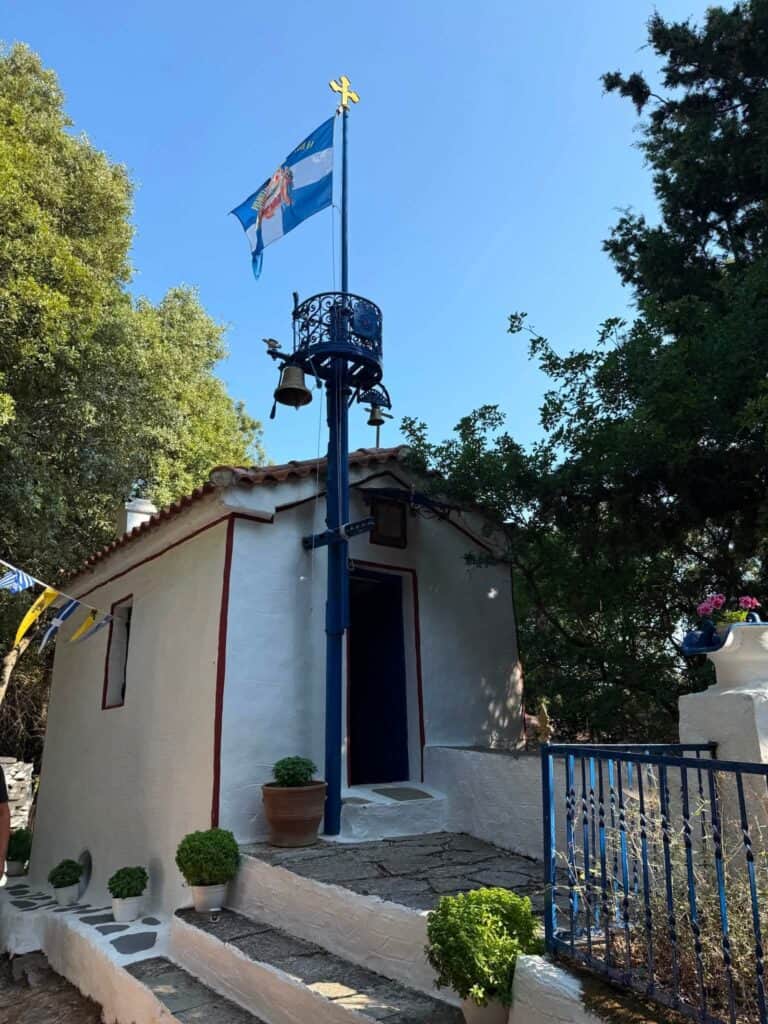
The Church of the Dormition of the Theotokos, also known as Panagia Kardasi, inspired the poem by Papadiamantis "At the Little Panagia at Pyrgi".

Introduction

Alexandros Papadiamantis’s “At the Little Panagia at Pyrgi” (Στὓν Ī Ī±Ī½Ī±Ī³ĪÆĻ„ĻƒĪ± ĻƒĻ„į½ø Πυργί) is one of the poet’s late Theometoric poems, composed in 1910, during the final months of his life on his native island of Skiathos. The poem was published posthumously in 1923. Papadiamantis, who was born on Skiathos in 1851 and died there on January 3, 1911, devoted a number of his later poems to particular churches and shrines of the Panagia on the island, joining the familiar landscape of his homeland to the devotional world that permeates his writing.

The title refers to a small church of the Panagia at Pyrgi, and the poem is deeply rooted in the physical landscape surrounding it. Papadiamantis evokes the deserted seashore, the rock and precipice facing the sea, the little fragrant church on the ridge, the wild tree bending over the rocks, and the shepherd with his pipe and animals. Yet this is not merely landscape poetry. At the Nativity of the Theotokos, the entire landscape participates in the feast: the shore, the rock, the tree, the shepherd, the goat, and the kid all rejoice, and finally all creation itself exults. The concrete world of Skiathos thus becomes the setting in which the cosmic significance of the birth of the Mother of God is revealed.

Open for Us the Doors of Mercy: Homily on the Nativity of the Mother of God (St. Cleopa of Sihastria)


Open for Us the Doors of Mercy: 
Homily on the Nativity of the Mother of God 


St. Cleopa of Sihastria

“Your Nativity, O Virgin Theotokos, has proclaimed joy to all the universe, for from you has shone forth the Sun of righteousness, Christ our God.” (Troparion of the Feast)


Beloved faithful!

When I think of the great honor and glory with which the Most Good and Most Generous God has adorned the Mother of God in heaven; when I think of the eternal glorification with which the heavenly powers praise her; when I then think of the divine services and prayers that all the children of the Church of Christ offer to her here on earth, as well as of the words of praise composed in her honor by the saints and chosen ones of God, my mind urges me, unworthy though I am, to add today, on this radiant feast of the Nativity of the Most Holy Theotokos, this small drop to the great sea of praises in her honor. And this is what I would like to say.

Homily on the Nativity of the Most Holy Theotokos (Fr. Daniel Sysoev)


By Fr. Daniel Sysoev

In the Name of the Father and of the Son and of the Holy Spirit!

I congratulate you all on the great feast of the Nativity of our Most Holy Lady Theotokos and Ever-Virgin Mary! On the very day of the Nativity of the Theotokos, we both rejoice and exult, because she is born who, according to the flesh, gave birth to the Son of God for us. The best of all the daughters of mankind has been born. We can say that the birth of the Theotokos is the greatest of all human births. This, of course, is not the birth according to the flesh of the Son of God, whose vessel the Most Pure Mother of God became, but it is the culmination of all the births that took place in ancient times. We know that the Holy Scripture of the Old Testament and the very practice of the people of ancient times taught that the greatest blessing that can be bestowed upon a person is the birth of a son or daughter, and not simply the birth of a human being, but the birth of a righteous person. This was considered the greatest blessing in ancient times.

The Lord said: “And if you will listen to these ordinances and keep and observe them, then the Lord your God will keep the covenant and mercy with you, as He swore to your fathers, and He will love you and bless you and multiply you, and He will bless the fruit of your womb and the fruit of your land” (Deut. 7:13–14).

To many emancipated young women of today, and to worldly men, this may seem abnormal. But God is the source of life, and it is His will that there be more living beings. And the perception of childbearing as a great blessing from God is precisely connected with the perception of God as the Living God.

September 8, 2026

Homily on the Nativity of our Most Holy Lady Theotokos (St. Theodore the Studite)


Homily on the Nativity of our Most Holy Lady Theotokos 

By St. Theodore the Studite

1. Today creation celebrates with splendor, receiving the Virgin as a new heaven. A maiden has been born upon the earth, the living chamber of the King of heaven. A young woman has come into the light, shining more brightly than a ray of the sun. An infant has shone forth from a barren womb, the most holy sanctuary of virginity.

Who will not hasten to the festival? Who will not bring festal gifts, dear and beloved to the Virgin?

The most beautiful gift for those living in virginity is incorruption; for those who are married, temperance; for the rich, generosity; for the poor, thanksgiving; for rulers, meekness; for kings, justice; for priests, holiness; for all, good order in all things.

Since, then, such are the gifts, and with such gifts comes this splendid celebration, come, let us leap for joy in gladness. Let us sing songs of thanksgiving with David: “Let us rejoice in the Lord; let us shout aloud to God our Savior.”

For the Creator of all things, a temple has been prepared for His reception; for the creative Word, a dwelling place for His sojourn has been prepared; for the Sun of righteousness, a cloud of light has been spread forth; for Him who encompasses the heavens in clouds, the fabric of a God-woven garment is being raised up; for Him who mingles the seasons and gathers together times and years, a bridal gathering-place has been revealed.

September: Day 8: Teaching 3: Nativity of the Most Holy Theotokos


September: Day 8: Teaching 3: 
Nativity of the Most Holy Theotokos
 

(The Cause of Christian Joy at the Birth of the Mother of God)

By Archpriest Grigory Dyachenko

I. The parents of the Most Holy Theotokos were the holy and righteous Joachim and Anna. Saint Joachim was descended from King David, while Anna was from the high-priestly lineage of Aaron, and both led a godly life: on every feast they gave alms and offered abundant sacrifices in the Temple. They had been married for fifty years, but, having no children, they grieved deeply over this and prayed to God for the removal of their barrenness. Once, on a great feast, Joachim wished to offer a sacrifice to God in the Temple. But the high priest, before the multitude of people, began to reproach him for his sins, saying that God had not blessed him with children and that he was unworthy to offer a gift to God.

Returning home in sorrow, Joachim went out into the field where his flocks were grazing, and there, pouring out his grief before God in prayer, he vowed to fast for forty days and to live in the wilderness. Anna, learning what had happened in the Temple and seeing that her husband did not return, likewise began to grieve and weep. One day, as she was sitting in the garden beneath a spreading tree, she saw on the tree a nest with young birds. This increased her sorrow even more. She thought that she must be more sinful than everyone in the world, since the Lord did not grant her even the joys that the birds and beasts have. She began to pray with tears, and suddenly an angel appeared to her and said: “Anna, your prayer has been heard. You shall give birth to a daughter, most blessed; through her all the tribes of the earth shall be blessed, and salvation shall be given to the whole world. You shall call her Mary.”

The Nativity of the Most Holy Theotokos in the Hymnography of the Orthodox Church


By Fr. George Dorbarakis

We did not even have time to bring to an end the praises of the Most Holy Theotokos for the month of August — a month that is made radiant, as we all know, by her Dormition, but also by the deposition of her honorable zoni — and already we are beginning new celebrations on the occasion of the feast of her Nativity. But our Church never ceases to celebrate the Mother of the Lord, indeed on a daily basis, since all her hymns are crowned by the troparia dedicated to her, the well-known Theotokia, just as all the great feasts of our saints have as their standard-bearers the canons dedicated to her. And rightly so: the Panagia is a type of the Church, because just as she gave birth to the Son of God as man, so the Church gives birth to Christ in the hearts of human beings. Therefore, not only on the feasts of the Mother of God, but at all feasts and always, the Panagia has the first place. What, however, does today’s feast specifically set before us, so that it is distinguished from the other feasts of the Panagia?

Homilies from the Menaion for Every Day of the Year: September 8


The Month of September

8th Day


9. What Parents Should Do if They Desire Their Children to Grow Up as Good and Godly People

(From a homily on the Nativity of the Most Holy Theotokos. Menaion, September 8)

All parents, perhaps we may say, even without exception, naturally desire that their children should grow up to be good and godly people. Even the most wicked person, we see, punishes his child when the child has done something wrong, thereby showing that he too, although he himself is wicked, nevertheless wants his son to grow up good and not evil. Thus, the desire to see one’s children good is, one may say, the desire of all parents. But we would add only this, which we do not think is superfluous: although the desire is the same among all, its fulfillment is not the same for everyone. With some, the children turn out good, while with others they are wicked. And what follows from this? In our opinion, it is that it is not enough for parents merely to desire that their children should turn out good; they must also know what they, as parents, need to do so that their desire may become a reality. What, then, must they do?

September 7, 2026

The Panagia is the Dawn From Which the Sun of Justice Emerged to Illumine the World


By Metropolitan Hierotheos of Nafpaktos and Agiou Vlasiou

The Panagia, as we say in the Apolytikion of the feast of her Nativity, was deemed worthy by God to give birth to justice, which is Christ Himself. It says: “For from her has arisen the Sun of justice, Christ our God.” Christ is the Sun of justice, and the Panagia is the dawn from which Christ emerged and illumined the whole world. Christ is characterized as the “Sun of justice” because He shone upon the world and restored it to its former glory, its original beauty, delivering it from the dark gloom of ignorance.

Usually, we understand justice as the giving back of what is due, as the correction of the injustice that occurs in the world for various reasons, and as the administration of justice. But the question that arises is how one determines what is just and what justice is, because each person sees the matter from a different subjective perspective and understands justice in a different way.

September 12, 2025

Homily One on the Nativity of the Theotokos (St. John of Kronstadt)


Homily One on the Nativity of the Theotokos 

By St. John of Kronstadt

(Delivered in 1902)

“We magnify you, Most Holy Virgin, we honor your holy parents, and we glorify your most glorious nativity” (Magnification).

 
 Nineteen hundred years ago, humanity was elated and exalted by the birth from the righteous yet barren parents, Joachim and Anna, of a wondrous infant – the Virgin, who was destined before the creation of the world to be a marvelous Mother in the flesh of God the Word Himself, the Creator and Savior of the world – the God of spirits and of all flesh. The sorrow of the barren parents, descendants of King David the prophet, who longed for a blessed progeny and suffered reproach from neighbors who had the blessing of offspring, was exceedingly great; yet, within them was a strong faith in the God of Israel – a steadfast hope in His mercy, fervent prayer, unwavering devotion to the God of their forefathers, and an unshakeable expectation of the promise made long ago by God to Israel – the Messiah, the Deliverer of mankind. And their sorrow was soon turned into joy; faith and hope were not put to shame; the complete devotion of Joachim and Anna to God was rewarded with an extraordinary and glorious fruit – the pure Maiden Mary. Even before her birth, the righteous parents made a vow to God to dedicate and consecrate to Him the Child that He would give them; and upon her birth, they immediately fulfilled their vow and brought her to the Temple of God – to be raised for the Lord. 
 

Homily One on the Afterfeast of the Nativity of the Theotokos (Archimandrite Kirill Pavlov)


Homily One on the Afterfeast of the Nativity of the Theotokos 

By Archimandrite Kirill Pavlov

(Delivered in 1960, on the 16th Week After Pentecost)

In the name of the Father and the Son and the Holy Spirit!

Dear brothers and sisters, these days the Holy Church of Christ, and we with it, brightly celebrate the all-joyful holy days of the afterfeast of the Nativity of the Most Holy Theotokos. The Church proclaims to us: "Your Nativity, O Virgin Theotokos, brings joy to the whole universe, for from you did the Sun of Righteousness, Christ our God, shine forth" (Troparion of the Nativity of the Most Holy Theotokos). "A woman," according to the word of Christ the Savior, "when she is in labor, has sorrow because her hour has come; but as soon as she has given birth to the child, she no longer remembers the anguish, for joy that a human being has been born into the world" (John 16:21), that is, the birth of every person into the world brings joy and comfort to the parents of the newborn and to all relatives and friends. And not only the birth itself, but also the very memory of the birth of a notable family member, their day is almost always a day of special joy and deliberate celebration for the family. As for great individuals who have distinguished themselves through charitable deeds in glory of their homeland, their birthdays are invariably celebrated with joy at the appointed time even after their death.

September 8, 2025

The Island of Kyra Dikia


The island of Kyra Dikia is located off the west coast of Kerkyra (Corfu), approximately in the middle of the island, north of the beach of Agios Gordis and very close to the coast.

Kyra Dikia has an area of approximately 500 sq.m. and is a steep rock, on the almost flat top of which, however, green trees, wild olive trees, cypresses and sycamores grow, making it extremely beautiful.

A small pier has been built there, so that the boats and caiques of the people of Kerkyra who visit Kyra Dikia can tie up on June 29 (Holy Apostles Peter and Paul) and September 8 (Nativity of the Theotokos), when the church at its top celebrates its feasts. On these days, many visitors from Sinarades and several from nearby villages arrive on the island by boats from Gialiskari or Kontogyalo, to attend the Divine Liturgy. After the service they will buy baked goods and lay out food under the shade of an olive tree, drinking the famous red wine of Sinarades. After they sleep under the olive trees and take a refreshing dip in the clear blue waters they return home.

Homily on the Nativity of the Theotokos and the Sunday Before the Exaltation of the Cross (St. John of Kronstadt)


Homily on the Nativity of the Theotokos and the Sunday Before the Exaltation of the Cross

By St. John of Kronstadt

"God so loved the world that He gave His only begotten Son, that whoever believes in Him should not perish but have eternal life" (John 3:16).

We have two feasts today, beloved brethren – the Sunday, or the week before the Exaltation of the Cross, and the Nativity of the Most Holy Theotokos. One is a feast of the Lord, the other of the Theotokos. For both feasts, it is customary to read two Apostolic and two Gospel readings for the instruction and edification of Christians. On the Sunday feast, today we read the Gospel of John, which speaks of how the Son of God was destined to die for our redemption from sin, the curse, and death – not by any other means, but through the cross, the most disgraceful and tormenting death, so that everyone who believes in Him may not perish forever, but have eternal life. And for the feast of the Nativity of the Most Holy Theotokos, we read the Gospel of Luke about a certain woman named Martha who received the Lord into her home, and about how another woman, listening to the word of the Lord, blessed the Mother of God by loudly proclaiming among the people: "Blessed is the womb that bore You, and the breasts which nursed You" (Luke 11:27). – A simple yet worthy blessing!

September: Day 8: Teaching 2: Nativity of the Most Holy Theotokos


September: Day 8: Teaching 2: 
Nativity of the Most Holy Theotokos

 
(That God Can Act Independently of the Laws of Nature and Perform Miracles)

By Archpriest Grigory Dyachenko

I. The pious parents of the Mother of God, Joachim and Anna, were barren during their fifty years of marriage, and having reached a ripe old age, they no longer hoped to have children according to the law of nature. But their barrenness greatly grieved them, especially because many reproached them for it and said that the Lord did not favor them because of some of their secret sins. Therefore, they earnestly prayed to the Lord that He would deliver them from reproach and grant them fruit according to His goodness, as He once granted it to Abraham and Sarah. The prayer of the righteous was heard, and their patience was rewarded with the special mercy of God: for when the time appointed by Providence came for the birth of Her Who Herself was to bear the Savior of the world, then God sent His angel to announce to Joachim and Anna that this God-chosen maiden would be born of them. And truly, righteous Anna, who was then already about seventy years old, supernaturally conceived and at the appointed time gave birth to the Most Holy Virgin Mary. Thus, the birth of the Mother of God, which took place not according to the ordinary law of nature, but by the special action of God, clearly shows that "where God wills, the order of nature is overcome."

September 8, 2024

September: Day 8: Teaching 1: Nativity of the Most Holy Theotokos


September: Day 8: Teaching 1: 
Nativity of the Most Holy Theotokos
 
(On How We Should Act During Trials Sent To Us By God)

By Archpriest Grigory Dyachenko

I. The parents of the Most Holy Theotokos, Joachim and Anna, were pious, virtuous, and righteous before God. Having sufficient wealth, they devoted part of it to the needs of the temple service, and gave part to the poor. Their life, apparently, from the outside, was happy, if all happiness is considered in material abundance and family peace, love, and harmony. And yet they were very unhappy. They bore the yoke of childlessness. Having been married for fifty years, they had no children. This misfortune is little understood by people of the present age; now they are more burdened by having many children than by childlessness, and those who have no children are often considered happy. But it was different then. Then the childlessness of spouses was considered a sign of God's punishment for some grave sins. Why is this so? Because at that time the appearance of the Redeemer was expected on earth; and it is clear that everyone, in addition to the natural desire inherent in uncorrupted parents, wanted to have children and in order, if God so desired, to become the progenitor of the Redeemer. And whoever did not have children, therefore, had no hope of this. Therefore, the childlessness of spouses was recognized as a punishment from God even in the eyes of strangers. It is understandable from this what grief accompanied the righteous Joachim and Anna's childlessness. But this grief was aggravated by outside reproaches. Once the high priest in the temple did not accept the sacrifice from Joachim, saying to him with reproach: "You are not worthy for us to receive a gift from you to God; being childless, of course, you do not have the blessing of God for any secret sins." And the Jew, who brought the sacrifice together with Joachim, reproachfully remarked to him: "Why do you precede me in approaching God? Do you not know about your barrenness?" Thus, both the internal, heartfelt grief and the outside reproaches for some secret crimes, which the righteous spouses had not committed, caused such moral suffering to the righteous spouses as can be understood only by people who suffer like them. They grieved in the depths of their righteous souls; but at the same time they did not despair of God's mercy. They cast all their sorrow upon God, and with constancy and zeal, little understood by people who do not trust in God, they prayed to God that the Lord would grant them, even in their old age, a child, promising to dedicate it to the service of God. The Lord heard their prayers, but delayed in fulfilling them, in order to surprise the righteous elders with His mercy, in order to raise their faith in the living Providence of God, in hope in Him and love for Him.

The righteous spouses bore God's severe trial! But what consolation the Lord sent them after the trial! The Lord God sends His angel to gladden the righteous elders with the news that they will give birth to a most blessed daughter, through whom salvation will be given to the whole world. And indeed, they gave birth to a daughter, whom they named Mary, and Mary was deemed worthy to become the Mother of the Lord; and Her parents were deemed worthy of the name of holy and righteous grandparents of God. Wondrous are the works of the Lord, revealed in human life!

II. Brethren! Even at the present time the Lord sends people trials, to whom He pleases.

Let us be patient in enduring trials. May God protect every person from becoming faint-hearted in trials of God's Providence.

Let us bear trials with constancy and hope in the mercy of God, which never leaves a person completely, and with faith in a better future, which the Lord will undoubtedly arrange, if only we prove worthy of it.

Let us be inspired in enduring trials by the thought that whom the Lord loves, He disciplines, for the spiritual and moral benefit of the one being tested and disciplined.

Seeing those tested and disciplined by the Lord, let us not vainly philosophize that the Lord punishes them necessarily for some grave sins, and even more so reproach them. The ways of the Lord in relation to the lives of people are inscrutable; and we cannot know why the Lord God acts one way with one, and differently with another. "Judge not, lest ye be judged."

Brethren! Let us commit ourselves and our whole life to the all-wise and all-good will of the Lord, Who grants us incomparably more than we ask or even dare to think about. Let us meekly, following the example of the holy righteous ancestors of God Joachim and Anna, endure the misfortunes sent upon us: through them, as gold through fire, the Lord cleanses us from every filth of sin and makes us incomparably more blessed both in this and in the future life than we would be blessed without these cleansing sorrows.

And when disasters and various sorrows seem ready to crush us, let us cry out for help to Him, without whose will not a hair falls from our head, Who will never send a temptation that exceeds our strength.

Source: A Complete Annual Cycle of Short Teachings, Composed for Each Day of the Year. Translated by John Sanidopoulos.
 

September 16, 2023

Encomium on the Nativity of our Most Holy Lady the Theotokos (St. Nicholas Cabasilas) - 5 of 5


 ...continued from part four.

13. Once again, that she dwelt in that untrodden place is not something that honors the Virgin, but rather that place. Just as the old Passover is honored by the addition of the slaughter that it symbolized, and the baptism of John by the spiritual baptism, and the rest of the symbols by the true realities. Because, if other symbols symbolized and led to other realities, the Holy of Holies certainly led to the all-holy Virgin. The fact that entry into the Holy of Holies was allowed only to the High Priest and that once a year while he had previously been cleansed of sins, indicated the mysterious pregnancy of the Virgin, who bore within her the only sinless One, the One who with a single sacred rite and once throughout the ages wiped out all sin. And the fact that the Holy of Holies was again untrodden to all men, except the holiest of all, was a sign that showed that the blessed Virgin never brought into her soul anything that was not entirely holy. And the temple was so highly respected, precisely because it was going to receive her in it, since nothing else of what was in it was possible to give it this majestic modesty. Nothing, indeed, was so valuable that its value would put it beyond the reach of many. It was even possible for all people to hold the manna in their hands and take it in their dwellings and eat it. And the staff had nothing more sacred than the priests who held it and for whose sake it blossomed shoots and leaves. Finally, of the tablets, the most precious of all, the ones that contained the law, everyone could hold them in their hands. So what should we consider that honored that place so much, if not the prefigurations of the All-Immaculate, that is, that all the things that were there had their reference and led to her? For this very reason, while it was inaccessible to all men, it was accessible to her. And as soon as the Virgin appeared, she immediately abolished the law that had been in force from the beginning, which shows on the one hand that the temple did not allow any other people to enter, because it honored her and reserved itself only for her, and on the other hand, that it was so far superior to men and never accepted even the slightest element of human inferiority. And this was done in order to show that, if the space that represented the Virgin was so far away from everyone and had, so to speak, nothing in common with people and the universe, what should we think about the realities themselves, since of course it is possible to know the height and value of the largest from the measure of the smallest things?

Homily on the Nativity of the Most Holy Theotokos (St. John Maximovitch)


By St. John Maximovitch

(Delivered in Qingdao in 1948)

“O Lord, how manifold are Your works! In wisdom You have made them all” (Ps. 103:24), the Psalmist proclaimed even in ancient times.

What is that wisdom (or "sophia" in Greek) by which all things were created?

Another Psalm says, “By the word of the Lord the heavens were made, and all the host of them by the breath of His mouth” (Ps. 32:6).

And the holy Evangelist John the Theologian proclaims: “In the beginning was the Word, and the Word was with God, and the Word was God... All things were made through Him, and without Him nothing was made that was made” (John 1:1-3).

September 9, 2023

Encomium on the Nativity of our Most Holy Lady the Theotokos (St. Nicholas Cabasilas) - 4 of 5


 ...continued from part three.    

9. Thus the All-Immaculate with her rightful gifts and their utilization herself wove for herself this crown. For, while the help she received from God was the same as that received by all, she so far exceeded the others by what she added of herself, that she not only conquered wherever they were conquered, but also conquered so brilliantly, so that her victory may be sufficient for her own glory as well as for other people and be like a victory achieved by all. For she did not prove the human race worse by surpassing it as an adversary, but embellished it. Nor did she make it ashamed as if defeated, but showed it more brilliantly. Not even by becoming extremely beautiful herself did she reveal the ugliness of her race, but she gave them more beauty. Nor again, by successfully defending human nature in herself, did she thereby clearly transfer the cause of sin to each man separately, making the responsibilities heavier for men. On the contrary, having herself prospered in an unprecedented way, she dishonored and defeated sin, in order to free from all evil the oppressed and vanquished. And thus the beauty which was given to human nature, she preserved not only in herself, but, as far as possible, in all other men, unadulterated by every foreign element.