The sacred relics of the Venerable and God-bearing Luke, known more popularly as Hosios Loukas, which were treasured in the magnificent katholikon of his eponymous Monastery until 1460, due to the occupation of the Boeotian land by the Turks, were transferred by the Hosioloukaite monks of the Monastery to Lefkada. From there, due to the arrival of the Turks in Lefkada, they were transported to Bosnia by the rulers of Bosnia, who bought them from the Turks thinking they were the relics of Luke the Evangelist, since there had been confusion between the two saints bearing the same name.
February 7, 2023
February 6, 2023
Saint Photios the Great's Encyclical to the Eastern Patriarchs (867)
In 867, Ecumenical Patriarch Photios the Great sent a famous Encyclical to the Eastern Patriarchs and held a great synod with many hundreds participating. The encyclical and synod addressed errors in doctrine and practice being used by Frankish missionaries in Bulgaria and it reprimanded Pope Nicholas for ruling with an iron fist (Constantinople received many complaints from bishops and monastics in the West regarding Nicholas’ tyrannical reign as pope). This synod is often called a "Robber Synod" that led to the "Photian Schism" in Western resources. However, at this point, Nicholas had excommunicated Photios and had broken communion with the Christian East four years prior. So blaming Photios for the schism is historically ignorant.
Encyclical to the Eastern Patriarchs (867)
By St. Photios the Great
Countless have been the evils devised by the cunning devil against the race of men, from the beginning up to the coming of the Lord. But even afterwards, he has not ceased through errors and heresies to beguile and deceive those who listen to him. Before our times, the Church, witnessed variously the godless errors of Arius, Macedonius, Nestorius, Eutyches, Discorus, and a foul host of others, against which the holy Ecumenical Synods were convened, and against which our holy and God-bearing Fathers battled with the sword of the Holy Spirit. Yet, even after these heresies had been overcome and peace reigned, and from the Imperial Capital the streams of Orthodoxy flowed throughout the world; after some people who had been afflicted by the Monophysite heresy returned to the True Faith because of your holy prayers; and after other barbarian peoples, such as the Bulgarians, had turned from idolatry to the knowledge of God and the Christian Faith: then was the cunning devil stirred up because of his envy.
Homily Four on the Sunday of the Publican and the Pharisee (St. Luke of Simferopol)
By St. Luke, Archbishop of Simferopol and All Crimea
(Delivered on February 2, 1958)
Every year, shortly before Great Lent, you hear the blessed parable of our Lord Jesus Christ, which teaches us how to pray to God and how not to pray to Him. This parable is so deeply important that we need to renew it in our memory every year and delve deeper and deeper into it. Many times I have already tried, according to my understanding, to put into your hearts and minds the interpretation of this great parable of Christ.
But this year, too, a thought came to me from God that I have not yet told you all that is necessary. Therefore, let us delve once more into the grace-filled teaching of the Lord Jesus Christ to us what kind of prayers please Him and what burden Him. Hence, again I will remind you of the blessed parable of the publican and the Pharisee.
February 5, 2023
Homily Three on the Sunday of the Publican and the Pharisee (St. Luke of Simferopol)
By St. Luke, Archbishop of Simferopol and All Crimea
(Delivered in 1952)
(Delivered in 1952)
The Holy Fathers commanded for us a very important and saving rule, which is unlikely to be fulfilled by all of you.
The rule is that every evening before going to bed, sit down for a short time and think over everything that happened that day: all your deeds, actions, thoughts, all your behavior, all your words, and delve into whether there was anything evil and bad done on that day.
And if you find evil and bad, then repent. This rule is very important for the reason that if we get used to remembering every evening what we did during the day, what we said and thought, if we find everything bad, then we will be displeased, ashamed; and we will gradually correct ourselves, get used to not doing what we did and what we noticed.
February 4, 2023
Saint Isidore of Pelusium, the Philosophical Ascetic of the Church
By Lambros Skontzos
Egypt was the cradle of monasticism in early Christian times. Great ascetic figures brightened Egyptian monasticism. One of them was Saint Isidore of Pelusium. A truly great personality of Orthodox monasticism, who perfectly combined in his person asceticism and theology.
He came from lower Egypt. He was born in 350 near Mount Pelusium and therefore received the nickname Pelusiumite, which was located at the northeastern end of the Nile Delta. His parents were virtuous, faithful and noble, and raised him in piety. Having the financial ability, they gave him a great education. He learned his first letters in his hometown. Then, around 370, he went to Alexandria, where he studied at the famous philosophical schools there. He studied Theology at the famous Catechetical School of Alexandria, where his teacher was the great ecclesiastical theologian and teacher Didymus the Blind. He studied ancient Greek literature and studied the Holy Bible and the Fathers of the Church in depth. He was a particular admirer of Saint John Chrysostom (354-407) and a scholar of his works. He even supported him during his dispute with Patriarch Theophilus (+ 412) and worked for his restoration in Alexandria.
February 3, 2023
Fifth Homily for the Day of the Reception of the Lord (Archpriest Rodion Putyatin)
By Archpriest Rodion Putyatin
"So he came by the Spirit into the temple" (Luke 2:27).
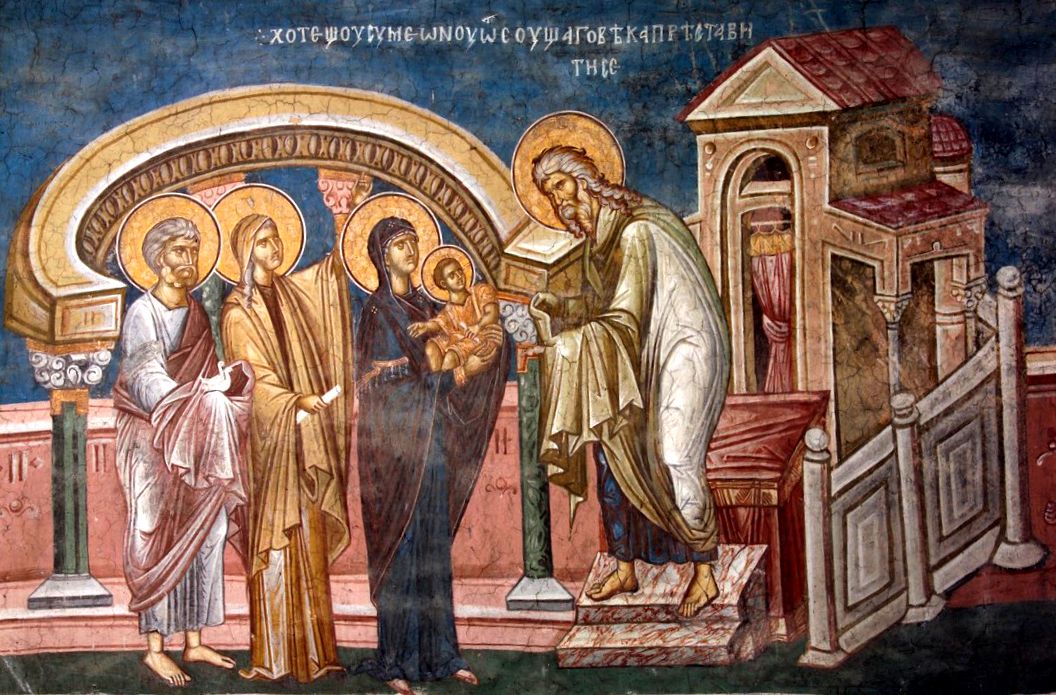
The Reception of our Lord Jesus Christ is such a feast in our Church, of which we have only twelve in a year, and therefore it is called a Great Feast. Who receive our Lord Jesus Christ - where, when and how? Righteous Symeon received our Lord Jesus Christ in the temple of Jerusalem, on the fortieth day after His birth, when His parents, according to the law, brought Him there.
Christian Listeners! And each of us will certainly receive the Lord Jesus Christ in this life. If we don’t receive Him, then we won’t find peace in life, we won’t be calm at death, we won’t rest with the saints even after death – for all the ages, for all eternity we will worry, suffer from sins, if we don’t receive Jesus Christ.
February 2, 2023
Homily Two on the Feast of the Reception of the Lord (St. Luke of Simferopol)
By St. Luke, Archbishop of Simferopol and All Crimea
(Delivered in 1953)
(Delivered in 1953)
1953 years ago, for the first time, the world heard that prayer of St. Symeon the God-Receiver, which you now hear every day at Vespers: “Now let Your servant depart in peace, Master, according to Your word; for my eyes have seen Your salvation which You have prepared before the face of all peoples, a light to bring revelation to the Gentiles, and the glory of Your people Israel.”
The soul of St. Symeon the God-Receiver departed in peace, after 300 years of life in the world in anticipation of the fulfillment of the prophecy of Isaiah: “Behold, the virgin shall conceive and bear a Son, and shall call His name Emmanuel, which means, 'God is with us.'"
Fourth Homily for the Day of the Reception of the Lord (Archpriest Rodion Putyatin)
By Archpriest Rodion Putyatin
Holy Father, Bless!
So the deacon speaks on behalf of all Christians, addressing the priest. The deacon does not bless, but asks the priest to bless. Why? Because among us Orthodox, especially at church services, God blesses the priest, he sends up the glory to God, and equally, God's blessing and sanctification is taught mainly by the priest. So it is with us, so it was with the Old Testament. When the righteous Joseph and the Blessed Virgin Mary with the Infant Jesus on the fortieth day after His birth came to the temple of God to bless God and receive a blessing from God, who blessed? The Priest, the holy righteous Symeon. Anna the prophetess also blessed God then, but she blessed later, when she heard Symeon blessing,
February 1, 2023
Third Homily for the Day of the Reception of the Lord (Archpriest Rodion Putyatin)
By Archpriest Rodion Putyatin
"We magnify Thee, Life-Giver Christ, and honor Your Most Pure Mother, Who, according to the law, has now brought Thee to the temple of the Lord."
According to the law of Moses, on the fortieth day after the birth of Jesus Christ, the Mother of God came and brought Him with her to the temple of God, where the holy righteous Symeon received Him and, taking Him in his arms, blessed God and sang the well-known song: "Now let Your servant depart in peace..."
Remembering this event, the Holy Church established a feast and, rejoicing, magnifies the Christ Child then offered and glorifies the Most Holy Virgin Theotokos who brought Him.
Subscribe to:
Posts (Atom)