April 5, 2023

Homily on the Anthropomorphic Representation of God (St. Luke of Simferopol)

 
On the Anthropomorphic Representation of God

(Delivered on April 21, 1948 - 
Wednesday of the 6th week of Great Lent)

Recently I spoke about anger, about this passion that we all have, but I know that there are many Christians who think and say to themselves: “Is it a great sin when I am angry? For God Himself is angry.” Are there any texts of Holy Scripture that speak of the anger of God, the wrath of God? In the 6th Psalm we read: “Lord, do not rebuke me with your wrath, nor punish me with your anger” (v. 2). You see, both the wrath and the anger of God are spoken of in this Psalm of David. Well, are those really right who justify their anger by the fact that God Himself is angry?

No, they are completely wrong, they do not understand what you all need to understand; they do not understand that not only in these places, but also in many places of the Holy Scriptures, God is presented as humanoid. You will find words in Scripture that God has a head, ears, eyes, arms, legs, muscles; that God walks, approaches and withdraws, sleeps and wakes, sits and walks. Shall we understand these words of Scripture in their literal sense, shall we not see indulgence here towards our human understanding?

April 4, 2023

Sixth Homily for the Fifth Sunday of Great Lent (St. Luke of Simferopol)


The Quiet Light of the Knowledge of God in the Hearts of the Venerables

By St. Luke, Archbishop of Simferopol and All Crimea

So the end of the Holy Forty Day Fast is approaching. Let us gather our thoughts and consider whether the goal of holy fasting has been achieved in us?

Why is Great Lent established, obligatory for all Christians? So that we can prepare for a worthy meeting of the greatest day in the history of mankind, the day of the salvation of the human race, the glorious Resurrection of our Lord and God and Savior Jesus Christ after His death on the cross.

Three weeks before the start of Great Lent, the Holy Church carefully begins to prepare us for this meeting, reminding us of the Gospel parables and urging us to delve into their meaning, and then, on the Sundays of Lent, recalling the events of Church history, in particular, those associated with the names of great saints.

April 3, 2023

Fifth Sunday of Great Lent: Homily on Repentance (Bishop Elias Meniates) - Part 1 of 5


The following discourse is a product of the rhetorical skill of Bishop Elias Meniates of Kernika (or Kernitsa) and Kalavryta, who is considered a "New Chrysostom", due to the content of his words, but also due to his natural effervescence. He was born in Lixouri of Kefallonia in 1669 and reposed in 1714, at the age of only 45 years. He preached in Venice, where he studied, in Kerkyra, in his native Kefallonia, in Zakynthos and for seven years in the All-Revered Patriarchal Church of Saint George in Constantinople. There he was officially appointed under Patriarch Gabriel III the Preacher of the Great Church of Christ. From the few discourses of his that have been saved, one understands their power, the appeal they had and how much the enslaved Greeks under the Turks and Venetians were deprived of such a comforting and consoling sermon. His sermons became the spiritual sustenance of the Orthodox for a long time until today, being in publication many times.  

Homily on Repentance

Delivered on the Fifth Sunday of Great Lent

A virtuous soul with divinely-inspired zeal, what will it not do and what can it not find!

The pious and wise monk Methodios was sent by God and by the Church to instruct the king of the Bulgarians in the Orthodox faith. This was when he had renounced idolatry and entered into the true knowledge of God. He had been baptized and had submitted his authority to the empire of the Romans and to the Ecumenical Patriarchate of Constantinople.

Fifth Homily for the Fifth Sunday of Great Lent (St. Luke of Simferopol)


 About the Deep Hearts of the Saints

By St. Luke, Archbishop of Simferopol and All Crimea

(Delivered on April 11, 1954)

Recently, I spoke to you about the extraordinary depth of the heart of a thief who suddenly believed in the Lord Jesus Christ crucified next to him, and now I will offer you a conversation about the hearts of all the saints.

The reason for this is the fact that the Holy Church dedicates the fifth Sunday of Lent to the memory of the greatest saint, Mary of Egypt. First of all, I will talk about her heart.

Mary was a brilliant young beauty who lived in the vast Alexandria, the capital of Egypt. With her beauty she captivated many, many young people, with her debauchery she acquired great wealth and lived in luxury. Once she went for a walk on the seashore, and saw a ship there ready to sail, and learned that this ship with many worshipers was heading to Jerusalem for the feast of the Exaltation of the Cross of Christ.

April 2, 2023

Saint Savvas of Kalymnos and the Oil Lamp That Remained Burning for 18 Years


The folowing was narrated by Eldress Philothei, Abbess of the Sacred Monastery of All Saints in Kalymnos:

The foundations of the church of the Monastery of the Holy Archangels were laid. Saint Savvas had established it in the name of the Archangels. The Bishop came to lay the foundation and told us that he would establish the church in the name of Saint John Chrysostom.

I resisted, because Saint Savvas had laid its foundations in the name of the Holy Archangels.

We sisters took to prayer, that the Saint would show us what to do.

Second Homily for the Fifth Sunday of Great Lent (St. Luke of Simferopol)


Turn To Me With All Your Heart

By St. Luke, Archbishop of Simferopol and All Crimea

(Delivered on April 22, 1945)

Today the Holy Church cites the example of Saint Mary of Egypt, one of the greatest saints, whose life is so amazing and so deeply instructive that everyone should know about it.

In her youth, Mary of Egypt was a brilliant beauty. She lived in Alexandria, leading a wild and depraved life. Once, walking along the seashore, she saw a ship leaving for Palestine for the feast of the Exaltation of the Cross of the Lord. There were many young people on the ship, and the idea came to her to board this ship in order to seduce them. Upon arrival in Palestine, all the pilgrims rushed to Jerusalem, to the Church of the Resurrection of Christ; Mary went there too. But when she wanted to enter the temple together with everyone, she felt that some invisible force repelled her and did not allow her to enter.

April 1, 2023

Prayer of Saint Bessarion of Agathonos to Saint Mary of Egypt


 By Saint Bessarion of Agathonos
 
Mary of Christ, Egyptian
Protector of sinners
of repentance and salvation
you are a true example.

Accept the prayer made to You
by one more sinner
full of passions and vices
obscenities and selfishness.

When Eugenios Voulgaris Was Healed of an Abscess by the Theotokos

Eugenios Voulgaris

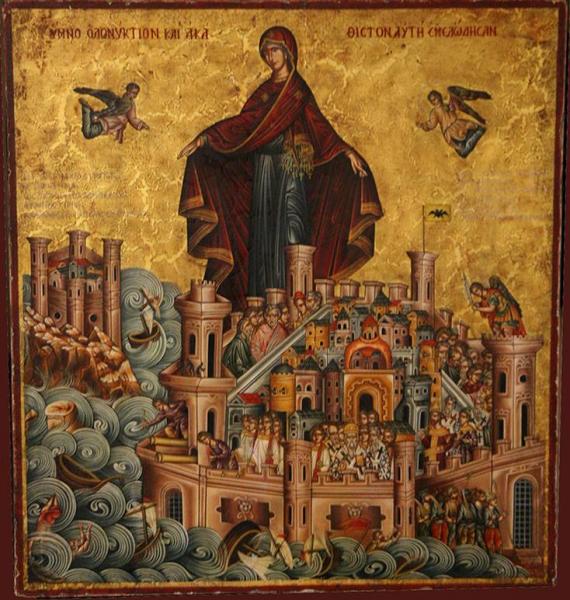
Eugenios Voulgaris was the director of the Athoniada School (a Greek Orthodox educational institution founded at 1749 in Mount Athos that is under Vatopaidi Monastery) in the second half of the 18th century. At the Monastery of Dionysiou, this scholar experienced the miraculous power of the Panagia through the original icon that inspired the composition of the Akathist Hymn, who cured him of a painful abscess. He narrates as follows:

I will narrate the miracle that the Panagia performed on me, in order to render her the gratitude I owe her. I'm not writing this to boast that I received such a divine visitation, and I don't even mind if they call me stupid for telling the story.

In 1758, therefore, I was a schoolmaster in Athoniada. When spring came, a dangerous abscess appeared in the depth of my left armpit. I was suffering from a slight fever and felt exhausted. The abscess was constantly growing and hardening. The entire armpit and the left breast had hardened like stone.

All 1508 Greek Words of the Akathist Hymn in Alphabetical Order


The 1508 words of the original composition of the Akathist Hymn in Greek are viewed as mosaics, a piece of art that was fashioned together approximately 1400 years ago to form a masterpiece that is nothing less than divinely inspired.

The word most often used in the original Akathist Hymn is the angelic greeting Χαίρε, which is translated as "Hail" or "Rejoice", appearing 158 times.

As far as some well known hymns and prayers, the hymn Τη Υπερμάχω (To you the Champion General) has 33 words, the prayer Πάτερ ημών (Our Father) has 58 words, the Πιστευώ (Creed) has 176 words, the prayer Βασιλεύ ουράνιε (Heavenly King) has 38 words, etc.