
The Confirmation of the Resurrection
By Metropolitan Hierotheos of Nafpaktos and Agiou Vlasiou
By Metropolitan Hierotheos of Nafpaktos and Agiou Vlasiou
Every year on the day of Pascha we celebrate the Resurrection of Christ, this great event in the history of humanity and ecclesiastical life. We celebrate it brilliantly, we celebrate it solemnly, we rejoice heartily. The Resurrection of Christ, together with His Cross, is the center of ecclesiastical life.
The Resurrection of Christ is not simply an fact of the faith of the Apostles, it is not a fact of a simple tradition that we received and preserve, it is not only a central point of our culture and our customs, which we accept without being able to prove it.
It is mainly a fact which is confirmed in every era.
Every philosophy is replaced by another, newer philosophy; all scientific knowledge is supplemented by later knowledge; every tradition is deconstructed by other traditions. This does not happen with the Resurrection of Christ, since He remains throughout the ages as a beacon of light, as a true life that fills people with hope, love and light.
This is demonstrated by the people who are reborn daily, who are perfected in their spiritual life, who are sanctified. All this is done by the power of the Risen Christ. He grants light and life, rebirth and fulfillment, transcendence of death, hope of eternal life. The saints are filled with this light of the Resurrection of Christ, with the difference that they do not cause theosis, but undergo theosis, which means that they are sanctified by Christ and are not the source of sanctification.
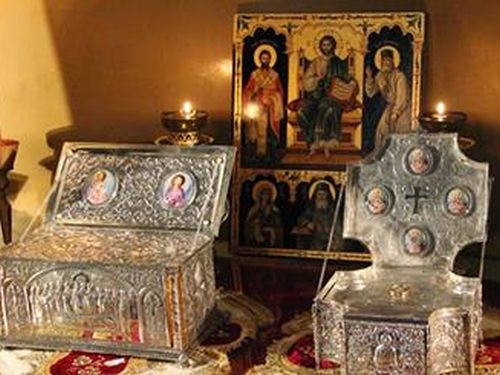
Those who visit the Holy Mountain during Renewal Week, i.e. between Pascha Sunday and Thomas Sunday, realize with how much spiritual joy the holy monks celebrate the Resurrection of Christ. They celebrate brilliantly, heartily and with all their senses. Mainly, they do litanies, and according to the rule of each Monastery they depart from the Monastery holding lamps, hexapteryga, relics of saints and icons, while the priests and deacons are dressed in their bright robes and chanting resurrection troparia as they go around the gardens and forests of the Sacred Monastery, to announce to the whole creation the fact of Christ's Resurrection.
During these brilliant litanies, the monks hold icons of the Most Holy Theotokos and relics of saints, which they present to those present. The presence of the icons of the Panagia shows us the joy of the Mother of God for the resurrection of her Son and God. And the relics of the saints show that they were sanctified by the power of the Risen Christ and are real members of His glorious Body.
After all, the relics of the saints, some of which are incorruptible and some of which are fragrant and smell good, are a manifestation of the truth that death has been abolished, that what is called death is sleep, that the saints are spiritually resurrected, and await the resurrection of their bodies as well during the Second Coming of Christ.
During their lives, the saints experienced the resurrection of the inner man, the resurrection of their heart, that is why they touched eternal life, which their relics reveal, and with this certainty they await the second resurrection, that is, the coming of Christ, the resurrection of their bodies and their entry into the Kingdom of God.
Thus, the relics of the saints are the confirmation of the Resurrection of Christ, they are the testimony that the Resurrection of Christ is not a philosophical and religious idea, it is not a deception and an illusion, but it is a confirmed reality. We have miraculous evidence of this great event, it is the experience of a wonderful life.
We know very well that Christ was resurrected because the Apostles who were witnesses of the Resurrection told us, because the saints proclaimed it throughout the centuries, and because their holy relics confirm it. These are the proofs of the Resurrection of Christ. This means that the whole ecclesiastical life is that which offers us the testimony of Christ's Resurrection.
This is the meaning of the resurrection litanies. And we who are overcome by death, when we are seized by the fear of death and despair, participate emotionally and mentally in these litanies with the relics of the saints in order to gain the certainty of the victory of life over death and try to live the life of Christ and His friends, who are the saints.
I wish all the Christians of our Local Church many years of blessing and resurrection.
Christ is Risen, brethren!
With warm paternal blessings,
The Metropolitan
+ HIEROTHEOS of Nafpaktos and Agiou Vlasiou
The Metropolitan
+ HIEROTHEOS of Nafpaktos and Agiou Vlasiou
Source: Translated by John Sanidopoulos.
